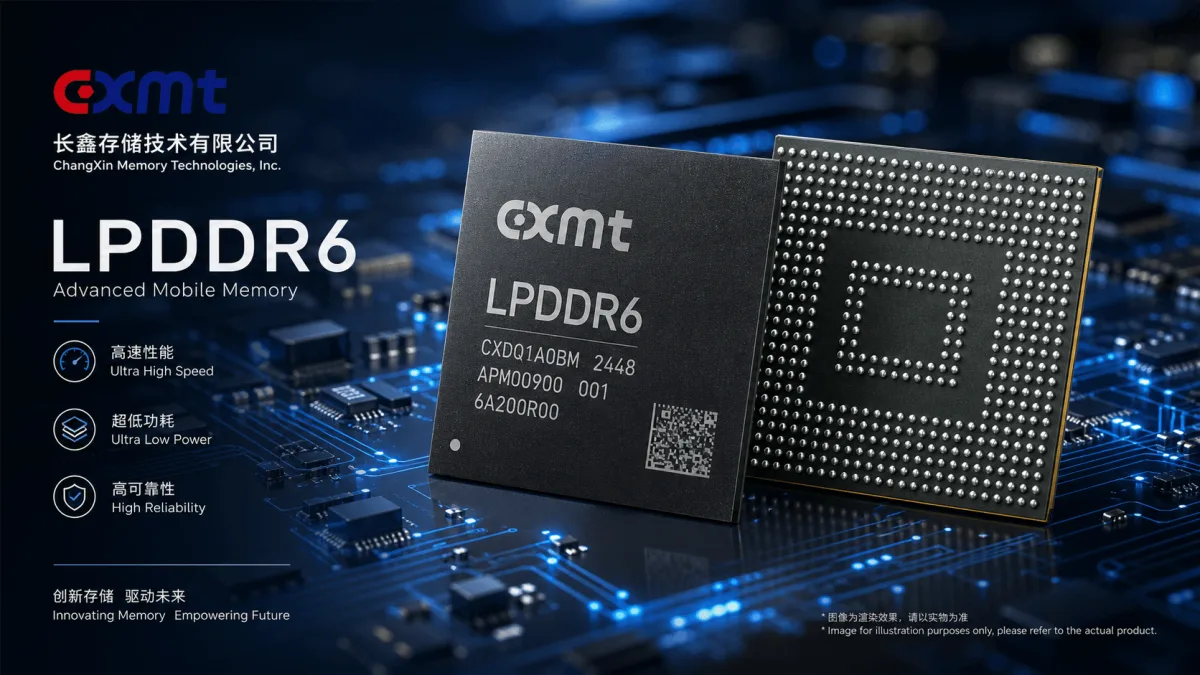
Chinese memory manufacturer ChangXin Memory Technologies (CXMT) is nearing the final stages of development validation for its next-generation CXMT LPDDR6 mobile DRAM. Designed to hit a blistering 12,800 Mbps data rate, the new memory chip positions the company to challenge industry leaders like SK Hynix and potentially secure a highly coveted spot in Apple's supply chain.
For smartphone manufacturers and tech consumers, this breakthrough signals a major shift in the global semiconductor market. It promises faster, more power-efficient devices while actively breaking the monopoly of traditional overseas memory giants over frontier technology iteration.
The 12,800 Mbps LPDDR6 Architecture
The introduction of standard LPDDR memory follows four strict stages: single-die verification, development validation, small-batch qualification, and formal mass production. With development validation - which covers compatibility, system stability, performance, power, and mechanical reliability - now in its final phase, CXMT has pushed LPDDR6 commercialization past the halfway point.
The first CXMT LPDDR6 product features a 12,800 Mbps data rate and a 10,667 Mbps baseline rate. It is built with a 16Gb die density and a 16GB chip capacity, utilizing 1295-ball POP packaging. This milestone means CXMT has spanned two DRAM generations in under three years, having previously launched its 6,400 Mbps LPDDR5 (12Gb dies, 12GB POP) in late 2023, and its 10,667 Mbps LPDDR5X in 2025, which delivered a 66% performance improvement and 30% lower power consumption over its predecessor.
This rapid iteration is fueled by massive capital injection. The company invested 9.593 billion yuan in R&D in 2025 alone, marking a 51.28% year-over-year increase. Cumulative R&D investment exceeded 20.6 billion yuan between 2023 and 2025, resulting in 6,972 patents by the end of 2025.
Market Share and Financial Surge
The technological leaps have triggered explosive financial growth for CXMT, whose market value surpassed 3.6 trillion yuan within a week of its listing. The company's financial and market metrics highlight a dramatic upward trajectory:
- Global Market Share: Currently at 7.67% according to Omdia, while Nomura estimates it at approximately 10%, forecasting a rise to 18% by the end of 2028.
- Stock Target: Nomura describes CXMT DRAM as the "jewel in China's crown," setting a target price of 116 yuan.
- H1 2026 Revenue: Expected to reach between 110 billion and 120 billion yuan, representing a massive 612.53% to 677.31% year-over-year increase.
- Net Profit: Projected to hit between 50 billion and 57 billion yuan, an astronomical jump of 2244% to 2544%.
Apple's Supply Chain and the Global DRAM Race
Internationally, the LPDDR6 race is currently led by SK Hynix, which completed development validation for the world's first 16Gb LPDDR6 DRAM on a sixth-generation 10-nanometer-class process in March, targeting mass production in the second half of 2026. Meanwhile, Samsung and Micron have restrained their LPDDR6 investments, shifting wafer capacity toward higher-margin HBM and server DRAM, inadvertently creating a growth window for CXMT.
CXMT's LPDDR products are already integrated into the supply chains of Xiaomi, Transsion, Honor, OPPO, and vivo. Now, Apple is pushing to include CXMT in its supply chain diversification strategy. Apple reportedly sought approval to purchase CXMT DRAM, contacted the US Commerce Department, and began internal testing of the chips for products sold in China. During Apple's fiscal Q3 earnings call on July 30, CEO Tim Cook noted that evaluating all options and having more DRAM suppliers would benefit both supply stability and pricing.
The Geopolitics of Mobile Memory
Apple's potential adoption of CXMT LPDDR6 is about much more than just securing cheaper components; it is a strategic geopolitical hedge. By sourcing advanced memory locally for devices sold within the Chinese market, Apple can insulate a significant portion of its manufacturing pipeline from ongoing US-China trade frictions.
Furthermore, CXMT reaching mass production parity with SK Hynix forces a critical industry reckoning. Samsung and Micron's strategic pivot toward AI-driven HBM and server DRAM assumed that their legacy dominance in mobile memory would remain unchallenged. CXMT's rapid ascent not only proves that domestic Chinese memory can compete at the frontier of mobile tech, but it also threatens to permanently lock the traditional giants out of the world's largest smartphone manufacturing ecosystem.