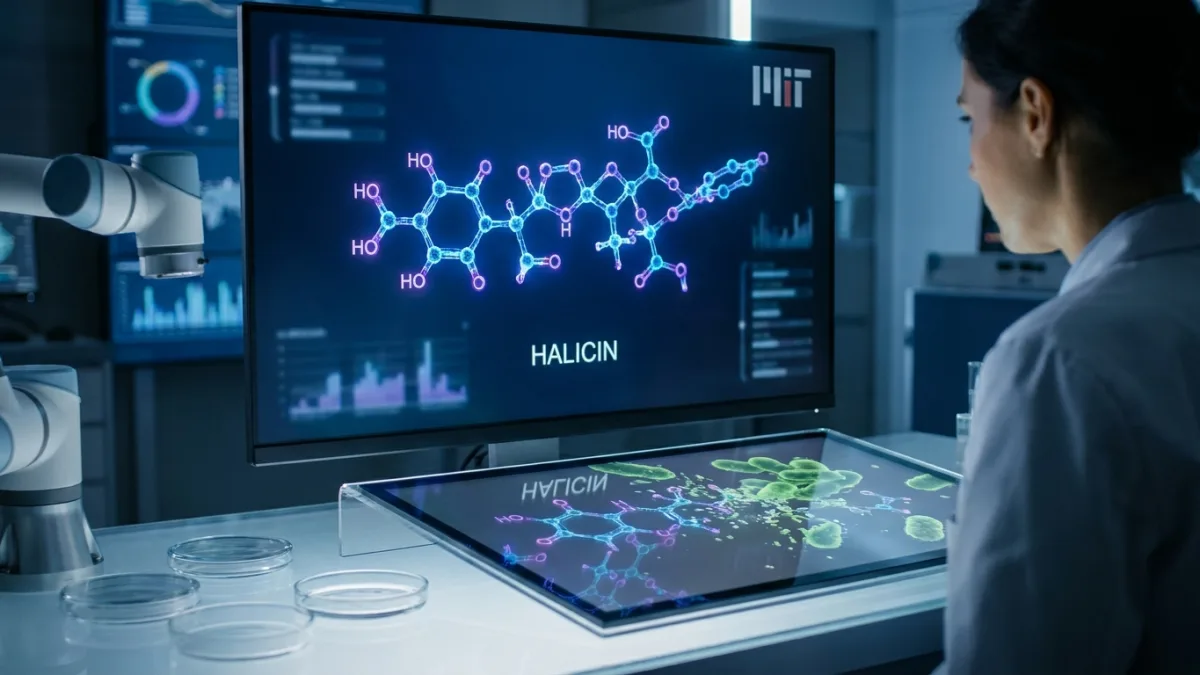
An unprecedented AI antibiotic discovery by researchers at the Massachusetts Institute of Technology (MIT) has yielded a powerful new drug capable of destroying some of the world's most dangerous drug-resistant bacteria. The newly identified compound, named halicin, successfully cleared infections in laboratory mice, including strains resistant to all known antibiotics.
The MIT team trained a deep learning algorithm to identify molecular patterns associated with bacterial destruction. By inputting a library of 2,500 drugs and natural compounds, along with data on their effectiveness against Escherichia coli, the software learned the specific molecular features that make an effective antibiotic.
Once trained, the artificial intelligence scanned a separate library of 6,000 compounds currently under investigation for treating various human diseases. The program was specifically tasked with finding substances that possessed antimicrobial properties but differed substantially from existing antibiotics. Within a few hours, the algorithm pinpointed halicin as a highly promising candidate.
Targeting Multi-Drug-Resistant Pathogens
In subsequent laboratory testing, halicin demonstrated remarkable efficacy against several multi-drug-resistant (MDR) pathogens. The compound successfully killed:
- Mycobacterium tuberculosis, the bacteria responsible for severe lung illness.
- Strains of Enterobacteriaceae that are resistant to carbapenems, a class of antibiotics typically reserved as a last resort for severe infections.
- Clostridioides difficile and Acinetobacter baumannii, which were successfully cleared in mouse models.
The World Health Organization (WHO) has classified drug-resistant infections as one of the most significant threats to global health. The application of artificial intelligence in healthcare research is still in its early stages, but this discovery highlights the technology's potential to rapidly accelerate drug development.
The True Value of Algorithmic Speed in Medicine
The discovery of halicin is not just a medical victory; it represents a fundamental shift in how the pharmaceutical industry approaches drug discovery. Traditional methods of identifying new antibiotics are notoriously slow, expensive, and increasingly yielding diminishing returns as bacteria evolve faster than our chemical pipelines. By processing 6,000 compounds in mere hours, the MIT deep learning model bypasses decades of manual trial and error.
Furthermore, because the AI was explicitly instructed to find molecular structures that differ from current antibiotics, it effectively sidesteps existing bacterial resistance mechanisms. If this algorithmic approach scales, it could transform the economics of drug development, making it financially viable to outpace the mutation rates of superbugs.
This article was written by AI from reporting by kurzweilai.net.