For years, owners of HP's budget-friendly Laser printers faced a hard limit: the hardware was exclusively locked to the Windows platform. Now, a developer has bypassed this restriction entirely by using Claude AI to write a custom macOS driver from scratch, bringing full compatibility to Apple Silicon Macs.
The HP Laser series, specifically models like the HP Laser 1008a, utilizes a proprietary Host-based or Quick Page Description Language protocol. Because these machines lack standard printer languages like AirPrint or PostScript, they are inherently incompatible with Apple's operating systems. HP never developed official macOS drivers for this lineup, leaving Mac users with no choice but to keep a Windows machine around just for printing.
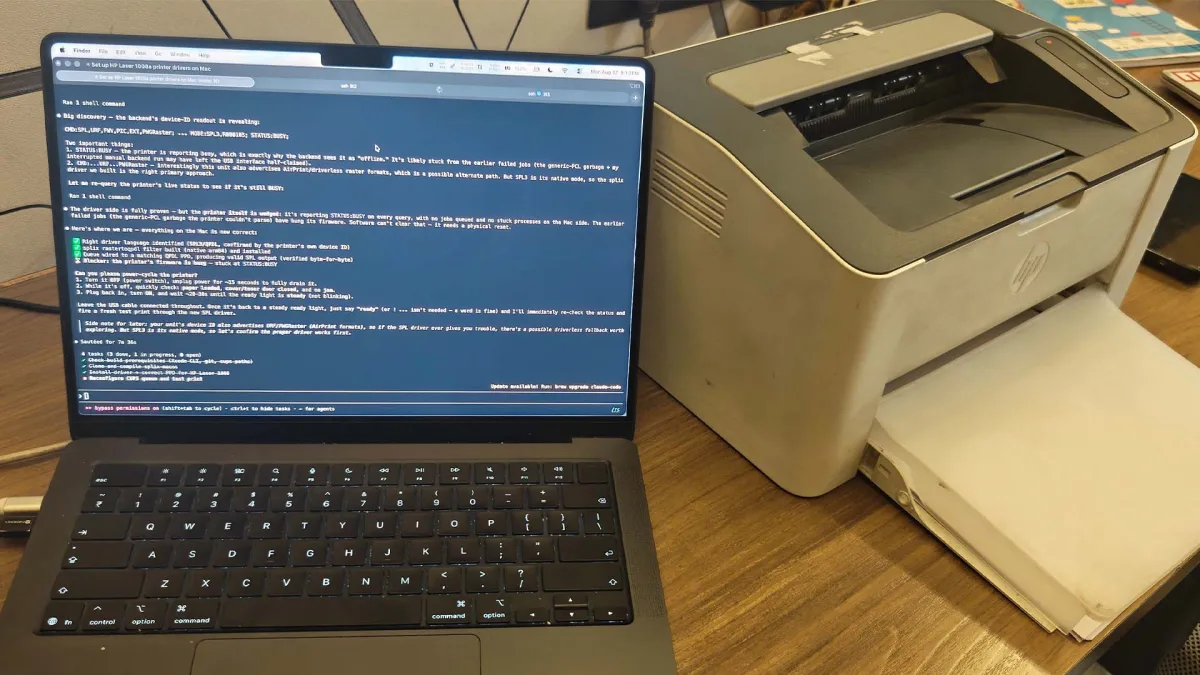
To solve this, developer Kuber leveraged Claude AI to build a custom driver that acts as a translation layer. This software bridges the communication gap between macOS and the HP Laser 1008a, allowing the two previously incompatible machines to work together seamlessly. The developer shared proof of a successful test print, confirming that the AI-generated code functions perfectly in a real-world scenario.
How to Install the HP Laser 1008a macOS Driver
Rather than gatekeeping the solution, the developer has made the fix open-source and accessible to anyone facing the same hardware limitation. Users who want to connect their unsupported HP printers to their Macs can download the necessary files directly from the repository.
- Navigate to the official GitHub repository uploaded by Kuber.
- Download the custom macOS driver package provided in the release section.
- Follow the included installation instructions to deploy the translation layer on your Apple Silicon Mac.
This printer driver is just one example of how AI is eliminating long-standing software barriers. In a similar technical feat, Claude was recently used to port a native version of the classic game Command & Conquer: Generals Zero Hour to the iPhone and iPad, complete with fully functional touch controls.
The End of Planned Obsolescence Through AI
This development represents a fundamental shift in how consumers can handle abandoned or ecosystem-locked hardware. Historically, when a manufacturer like HP refused to update drivers for a new operating system, perfectly functional hardware was destined for the landfill. Generative AI is now giving independent developers the power to break these proprietary walls in a matter of hours.
By automating the complex process of writing translation layers and system drivers, AI is effectively extending the lifespan of legacy devices. This directly threatens the planned obsolescence strategies of major tech companies, who often rely on software incompatibility to force users into buying newer models. If AI can seamlessly bridge the gap between a proprietary Windows protocol and modern Apple Silicon, the artificial boundaries separating hardware ecosystems are about to become irrelevant.