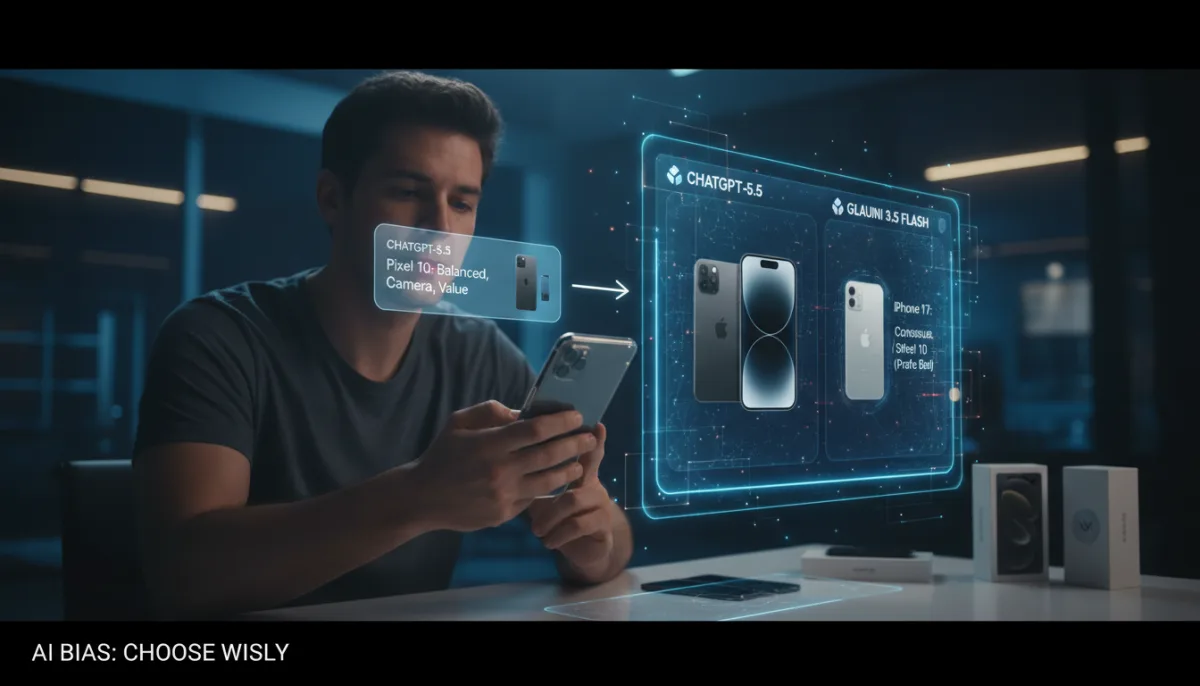
Consumers are increasingly turning to large language models for AI smartphone buying advice, hoping to cut through the overwhelming noise of tech reviews. But when ChatGPT-5.5, Claude Sonnet 4.6, and Gemini 3.5 Flash are asked to recommend the best daily driver for the average user, the results reveal stark differences in how these models process value and hype. For buyers looking to upgrade in 2026, understanding these AI biases is crucial before spending hundreds of dollars based on a chatbot's recommendation.
To test their analytical capabilities, the models were fed a strict prompt asking for the best smartphone for most people. The prompt required the AI to factor in price, software support, performance, and consumer sentiment, while explicitly ignoring any personal reviewer bias.
ChatGPT-5.5 Prioritizes Practicality
ChatGPT-5.5 immediately selected the Google Pixel 10 as the optimal choice for most consumers. The model bypassed expensive ultra-premium devices, highlighting the Pixel 10's flagship-level camera performance for novice users, reliable software speed, and extended battery life.
While it acknowledged the Apple iPhone 17 Pro Max and the base Galaxy S26 as honorable mentions, ChatGPT-5.5 favored the Pixel for its overall balance and reasonable price point. It notably pointed out that the average user does not need extreme zoom cameras or oversized displays, demonstrating a highly practical approach to consumer needs.
Claude Sonnet 4.6 Relies on Consensus
Claude Sonnet 4.6 took a different route, selecting the standard iPhone 17 as its top recommendation. The model cited the device's lower price compared to Pro models, excellent software support, and solid performance. However, its reasoning heavily echoed published tech reviews, indicating a strong reliance on consensus data.
Interestingly, Claude was the only model to recommend the OnePlus 15 as a runner-up, alongside the Pixel 10. Despite the company's recent retreat from US markets, Claude recognized the OnePlus 15 as an excellent flagship alternative that significantly undercuts the pricing of the Pixel 10 Pro XL and Galaxy S26 Ultra.
Gemini 3.5 Flash Struggles with Hype
Gemini 3.5 Flash initially struggled with the timeline, recommending the older Pixel 9 Pro XL and Galaxy S25 before being corrected to the current 2026 market. Once updated, it mirrored Claude by suggesting the iPhone 17, seemingly influenced by the overwhelming online hype surrounding Apple's latest release.
When explicitly pushed to remove market hype from its reasoning, Gemini 3.5 Flash changed its primary recommendation to the Pixel 10, citing the long-term cost benefits of its extended software support. Notably, Gemini also highlighted the $500 Pixel 10a as a highly capable alternative, correctly noting that 90% of smartphone usage consists of web browsing, social media, and communication.
The Hidden Bias in AI Recommendations
This experiment exposes a critical flaw in using current generative AI for purchasing decisions: models weight data differently based on their training architecture. Claude Sonnet 4.6 acts as an aggregator of tech journalism, making it a safe but uninspired sounding board. Gemini 3.5 Flash, meanwhile, is highly susceptible to recency bias and marketing hype, requiring aggressive, constraint-based prompting to yield practical advice.
ChatGPT-5.5 emerges as the most reliable assistant for average buyers because it successfully filters out enthusiast-level specifications that inflate prices. For consumers, the actionable takeaway is clear: never ask an AI for an open-ended recommendation. Instead, provide strict parameters - such as a $500 budget or a specific requirement like "five years of software updates" - to force the models past their default, hype-driven programming.
This article was written by AI from reporting by androidauthority.com.