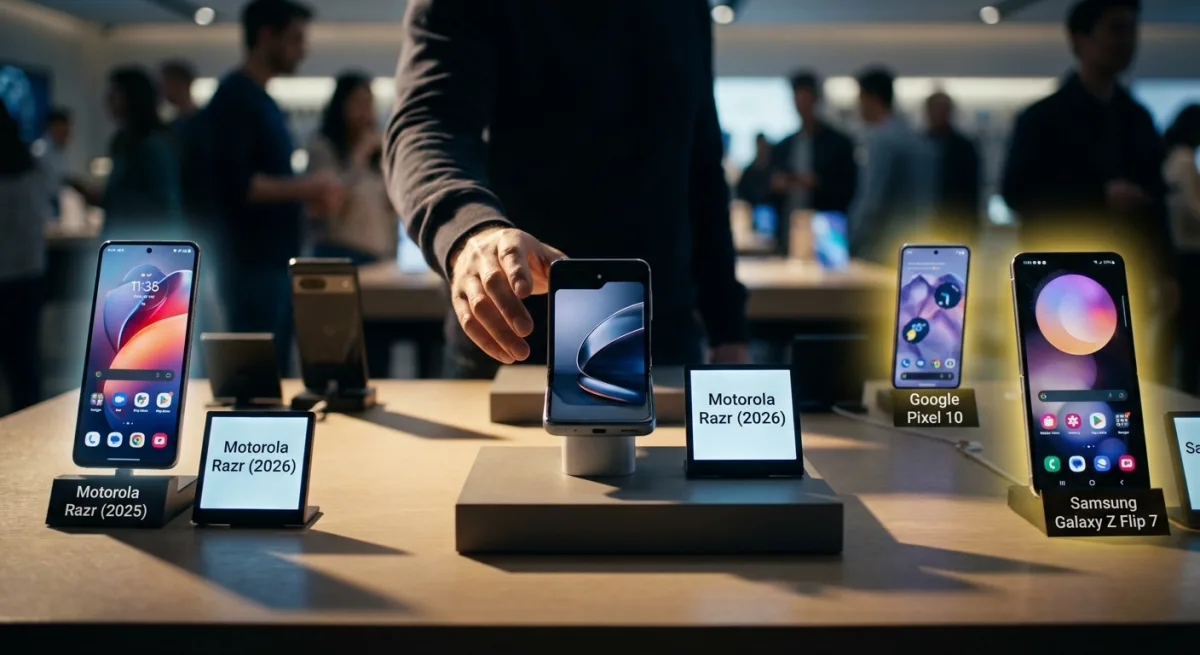
The newly launched Motorola Razr (2026) might be the cheapest entry in this year's foldable lineup, but it isn't necessarily the best value for your money. Buyers looking to upgrade their daily driver without overpaying for incremental updates have several superior options in the current market. From heavily discounted predecessors to powerful compact flagships, these alternatives offer better performance, superior cameras, and more robust software support.
- Motorola Razr (2025): Priced at $700, last year's model remains a superior value proposition compared to the 2026 edition. It features the same IP48 rating, identical screen specifications, and double the base storage at 256GB, making the newer model's minor camera and battery upgrades hard to justify.
- Google Pixel 10: For users who want a compact footprint without the foldable compromises, this $800 flagship delivers a 6.3-inch OLED display and the powerful Tensor G5 processor. It stands out with an IP68 rating, integrated Qi2 magnets, a 10.8MP 5x periscope camera, and an industry-leading seven years of software updates.
- Samsung Galaxy Z Flip 7: At $1,099, this premium foldable targets power users with a significantly faster processor, superior Gorilla Glass protection, and 4K video recording at 60 frames per second. While its cover screen requires a Good Lock module to run all apps, its raw performance and future-proof hardware make it a top-tier choice.
- Samsung Galaxy Z Flip 7 FE: Launching at $899, this budget-friendly Galaxy alternative utilizes the Exynos 2400 chipset, which easily outperforms the Dimensity processor found in the base Razr (2026). It retains premium features like a 50MP primary camera, 25W wired charging, and a durable aluminum frame.
- Motorola Razr Ultra (2026): For those willing to spend $1,500, Motorola's true flagship foldable offers a massive leap in capabilities. It boasts a Snapdragon 8 Elite chipset, a massive 5,000mAh battery, and a 7-inch 165Hz OLED folding screen, alongside a 50MP main camera equipped with LOFIC technology for exceptional dynamic range.
The Diminishing Returns of Base Foldables
The release of the Motorola Razr (2026) highlights a growing trend in the foldable market: base models are struggling to justify their existence alongside heavily discounted predecessors and aggressive Fan Edition releases. When a one-year-old device like the Razr (2025) offers double the storage and identical display technology for $100 less, the value proposition of the newest entry-level foldable completely collapses. Manufacturers are increasingly reserving their meaningful innovations - such as LOFIC camera sensors and flagship silicon - for ultra-premium tiers.
Furthermore, the competitive pricing of traditional slab phones like the Google Pixel 10 proves that consumers do not have to sacrifice camera quality or durability just to get a pocket-friendly device. As foldable hardware matures, companies like Motorola and Samsung will need to rethink their entry-level pricing strategies. Until then, savvy buyers should look toward last year's hardware or invest in true premium models to maximize their return on investment.