

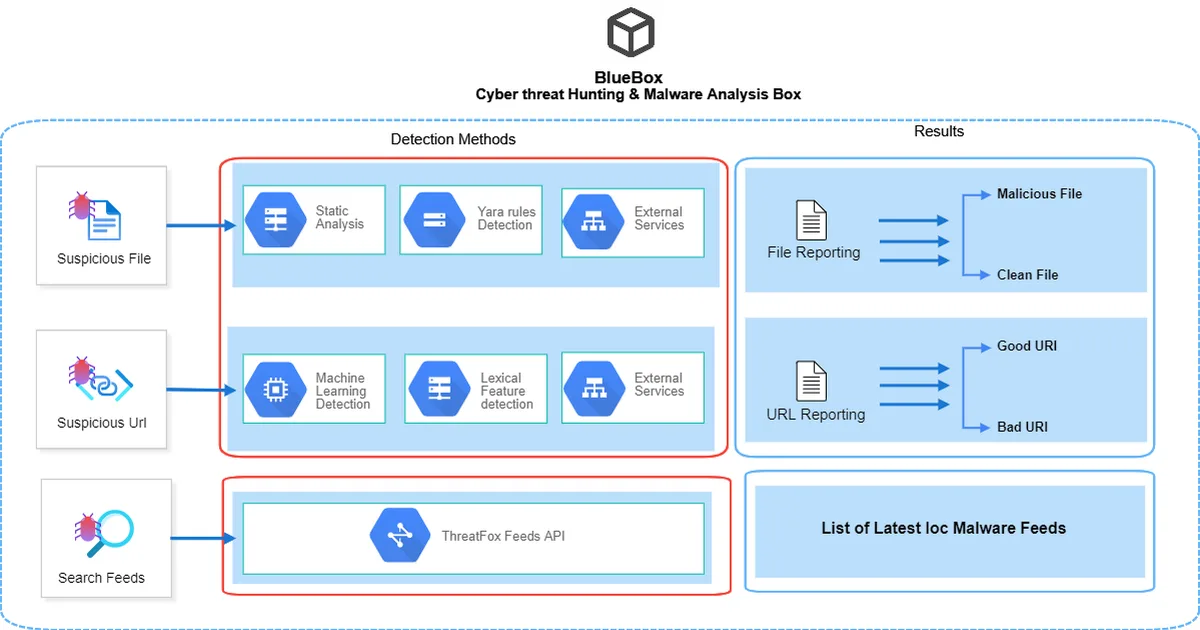
Security researchers and system administrators have a new open-source tool for tracking and analyzing digital threats. BlueBox has launched as a comprehensive threat intelligence platform designed to accelerate malware analysis and observable enrichment for IPs, domains, URLs, and file hashes.
Built to scale out and speed up the retrieval of threat information, the platform serves as an Open Source Intelligence (OSINT) solution. It integrates directly with external sources like VirusTotal to provide a unified dashboard for investigating suspicious files and network indicators. The platform is built on a modern tech stack utilizing Python3, Flask, SQLAlchemy, and Scikit-learn for its machine learning components.
The tool automates several critical stages of threat hunting, offering a centralized interface for both static analysis and real-time data ingestion. Features include, but are not limited to:
- Static file analysis that extracts hashes, suspicious strings, import/export functions, and potentially malicious DLLs.
- Detection using YARA rules targeting cryptographic functions, packed executables, and known malware Indicators of Compromise (IOCs).
- Machine learning-based phishing detection utilizing logistic regression to evaluate URLs and extract lexical features.
- Real-time feeds tracking the latest trending malware IOCs.
How to Install and Configure BlueBox
Because BlueBox is an open-source tool, security teams can deploy it locally to maintain control over their analysis environment. The installation requires cloning the repository and configuring authentication keys for external API integrations.
First, clone the repository and navigate to the directory:
$ git clone https://github.com/svdwi/BlueBox.git
$ cd BlueBox
Next, you must edit the configuration file to input your authentication keys (which can also be found in the Keys/Keys.txt directory). Once configured, run the setup script and launch the application:
$ vim conf.py
$ chmod +x steup.sh
$ ./setup
$ python3 app.py
The Democratization of Threat Hunting
BlueBox represents a growing trend of consolidating enterprise-grade threat hunting capabilities into accessible, open-source frameworks. By combining static analysis with machine learning for phishing detection, it reduces the reliance on fragmented, expensive commercial tools for independent researchers and smaller security operations centers (SOCs).
The integration of Scikit-learn for logistic regression on URLs is particularly notable. It allows defenders to proactively identify malicious infrastructure based on lexical features rather than waiting for external blocklists to update. As threat actors increasingly automate their infrastructure deployment, open-source tools that leverage machine learning locally will become essential for keeping pace with rapid phishing campaigns.
