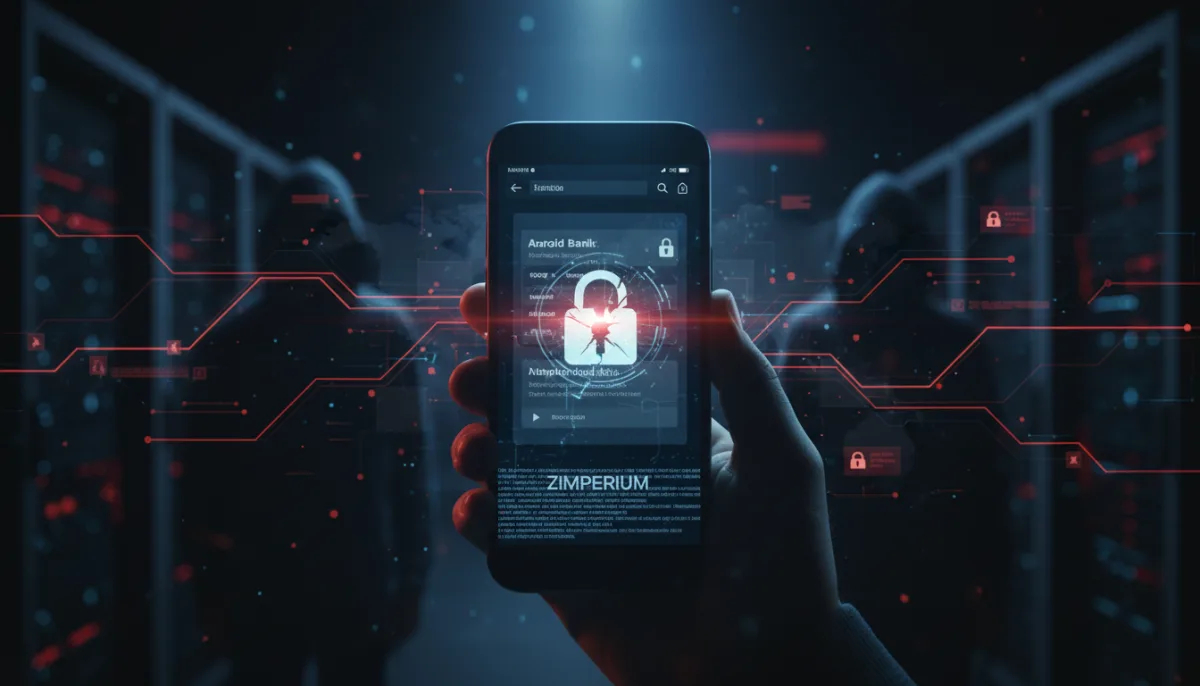
Android banking malware is actively targeting over 1,200 financial applications worldwide, turning trusted smartphones into silent accomplices for financial fraud. A new threat analysis reveals that 34 distinct malware families are currently equipped to bypass multifactor authentication and drain accounts directly from the victim's device. Rather than hacking the bank's servers, these campaigns focus entirely on compromising the user's session.
According to regional findings from Zimperium's zLabs team, the scope of these attacks is massive, spanning 90 countries. While the total number of targeted apps has decreased slightly since 2023, the geographic reach and the sheer variety of malware families have expanded significantly. Furthermore, Android malware-driven fraudulent financial transactions have surged by 67% year over year, highlighting a growing crisis in mobile security.
The EMEA Epicenter and Key Threat Actors
Europe, the Middle East, and Africa (EMEA) account for the vast majority of the observed threat landscape, with over 800 targeted banking and fintech applications across 44 countries in the region. The United Kingdom leads the regional table with 72 targeted apps, followed closely by Spain with 65, Italy with 57, Turkey with 56, and Germany with 55. In the Middle East, the United Arab Emirates tops the list with 38 targeted applications.
The malware ecosystem is dominated by highly specialized families that share overlapping target lists. TsarBot alone targets 450 banking apps in the region, utilizing screen recording and abusing Android Accessibility Services. CopyBara, which targets 446 apps, relies heavily on phone-based social engineering and dynamic forms. Meanwhile, Hook targets 385 apps by deploying virtual network computing for live screen sharing and remote access.
In the United States, the threat is also escalating. The broader 2026 Banking Heist release counted 162 US banking applications under active targeting, a notable increase from the 109 apps identified in 2023. Other specialized variants, such as FluBot and Cabassous, use European delivery and logistics lures to trick users into initiating the infection chain.
How the Attack Bypasses Bank Security
The common attack path begins long before the user ever opens their banking app. A victim typically installs a malicious Android package through a fake download, a phishing link, or a deceptive messaging lure. Once installed, the malware aggressively seeks permissions that expose notifications, text messages, screen content, or accessibility functions.
When the user attempts to log in to their legitimate banking app, the malware deploys a counterfeit login overlay to harvest credentials. Because the malware has access to notifications or SMS, it can easily intercept one-time authentication codes. This creates a massive blind spot for server-side fraud controls, as the bank registers a login from the customer's usual handset, followed by actions performed inside what appears to be a legitimate session.
Accessibility privileges allow the malware to read screen elements, press buttons, and approve prompts autonomously. Remote-control functions even allow an operator to act directly through the victim's device. A comparable real-world case involved a Belgian network that allegedly used phone calls and remote-access software in a phishing operation worth more than €500,000.
The AI Acceleration Factor
While generative AI has not invented new methods of banking fraud, it has drastically accelerated the speed and scale of these attacks. Attackers are leveraging AI to translate and localize lures, write exploit scripts, and generate highly convincing phishing pages that perfectly mimic real financial apps.
The 2026 Verizon Data Breach Investigations Report provides broader support for this trend, noting that vulnerability exploitation became the entry point in 31% of breaches. The report explicitly states that AI is shortening the time needed to weaponize known flaws. Furthermore, mobile social-engineering attacks through text messages and calls achieved a 40% higher success rate than traditional email phishing.
AI compresses multiple phases of the operation into seconds. It can adapt a malicious message to a local dialect, clone a bank's login page, modify the underlying code to evade signature detection, and spin up new domains immediately after earlier versions are blocked by security researchers.
How to Protect Your Device from Banking Trojans
Because these malware families rely on tricking users into granting excessive permissions, defending your device requires strict control over what apps can access. Follow these actionable steps to secure your smartphone against session hijacking:
- Restrict Android Accessibility Services immediately. This prevents malicious apps from reading your screen, intercepting 2FA codes, and automatically clicking approval prompts without your knowledge.
- Disable the ability to install apps from unknown sources. This ensures you only download applications from the official Google Play Store, drastically reducing the risk of sideloading a malicious package.
- Revoke SMS and notification access for non-essential apps. This stops background applications from silently reading your incoming one-time passwords and authentication codes.
- Enable Google Play Protect and keep it active. This allows your device to continuously scan for known malware signatures and suspicious behavior before an app can execute its payload.
The Silent Shift in Fraud Liability
The 67% year-over-year rise in fraudulent transactions reveals a fundamental flaw in how the financial industry approaches mobile security. Traditional multifactor authentication is effectively useless when the device receiving the code is the same device executing the attack. The malware has successfully turned the user's trusted handset into the primary attack surface, making fraudulent transfers look identical to legitimate customer behavior.
This shift places immense pressure on financial institutions to evolve beyond simple app hardening. As regulatory frameworks like DORA (which began applying across the EU in January 2025) push for better ICT risk management, banks must start merging device telemetry with transaction data. A runtime control that detects screen sharing or hooking frameworks is only valuable if it instantly triggers a backend delay on large transfers.
Ultimately, the metric that matters is no longer how many apps are listed in a threat catalog, but how quickly a compromised session can be frozen. Until banks can seamlessly correlate abnormal device signals with transaction risk in real-time, Android banking trojans will continue to exploit the gap between device security and account authorization.