

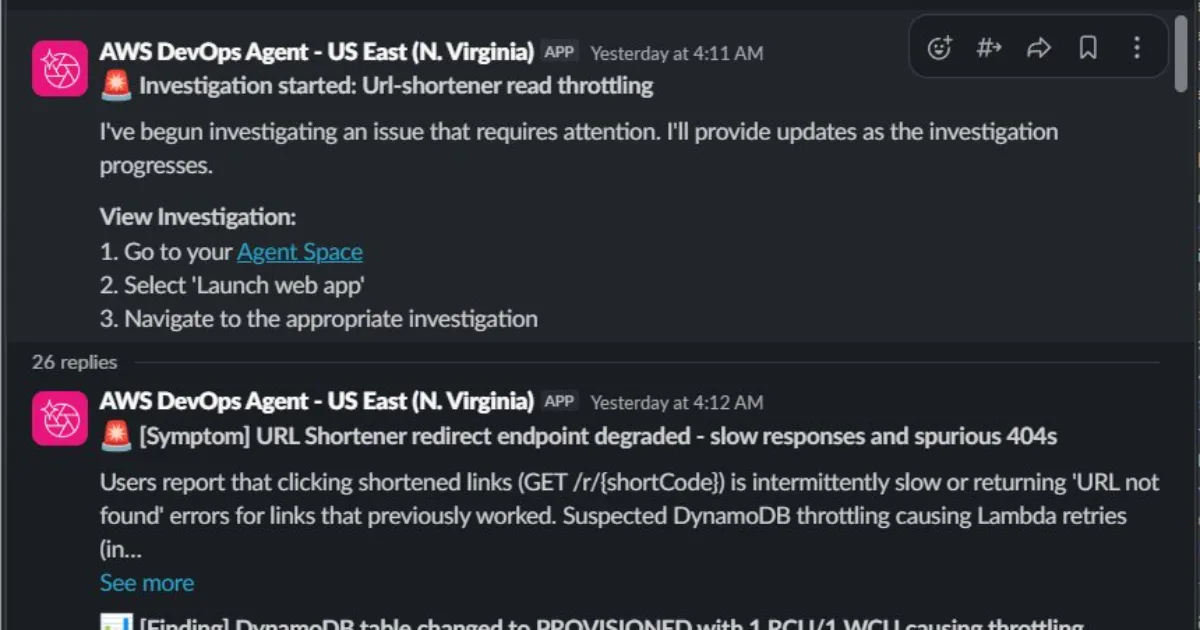
For Site Reliability Engineers (SREs) waking up to a 2 AM pager alert, manually correlating telemetry across multiple services to find a root cause can take hours. To solve this critical bottleneck, AWS has officially announced the general availability of the AWS DevOps Agent, an autonomous, generative AI-powered assistant designed to investigate incidents, analyze deployments, and automate operational tasks. Aimed directly at DevOps teams and system administrators, this tool shifts incident response from a manual, reactive process to an automated workflow, drastically reducing Mean Time to Recovery (MTTR) and helping prevent future outages.
As production environments grow increasingly complex, traditional AI coding tools connected to logs often lack the broader operational context needed to manage systems at scale. Built on Amazon Bedrock AgentCore, the AWS DevOps Agent bridges this gap by learning application relationships and autonomously correlating telemetry, code, and deployment data. According to AWS senior solution architect Madhu Balaji, the agent is not a passive Q&A tool but an autonomous teammate that begins investigating immediately without human prompting when triggered by an event.
Expanded Capabilities and Core Integrations
The transition from preview to general availability brings several major enhancements, most notably the ability to investigate applications hosted in Azure and on-premises environments. The update also introduces support for custom agent skills to extend its capabilities, alongside the generation of custom charts and reports. During its preview phase, the agent demonstrated compelling metrics, with early numbers showing up to a 75% reduction in MTTR and a 94% root cause accuracy rate, according to Sebastian Korfmann, co-creator of Agentic Hamburg.
To ensure the agent can pull signals from wherever a team's operational data lives, AWS has built extensibility through the Model Context Protocol (MCP). The system features built-in integrations with the following platforms:
- CloudWatch and PagerDuty for alarm and alert triggers.
- Dynatrace and ServiceNow for problem tracking and ticketing.
- Datadog, New Relic, Splunk, and Grafana for deep observability and telemetry data.
- GitHub, GitLab, and Azure DevOps for code repository and CI/CD pipeline analysis.
Pricing Structure and Security Agent Launch
With general availability, the AWS DevOps Agent is no longer a free service. Pricing is now based on the cumulative time the agent spends executing operational tasks, billed strictly per second. To ease the transition, AWS Support customers receive monthly DevOps Agent credits based on their previous month's support spending, with the exact percentage determined by their specific support tier. The service is currently live across six regions, including Northern Virginia, Ireland, and Frankfurt.
In a parallel announcement, AWS also made its Security Agent for on-demand penetration testing generally available. This AI-powered security agent continuously analyzes application design, source code, and runtime behavior to automatically execute penetration tests and identify exploitable vulnerabilities before they can be leveraged by attackers.
The Cost of Autonomous Accountability
The introduction of an autonomous SRE agent represents a massive leap for AIOps, but it also introduces friction regarding cost and accountability. As Corey Quinn, chief cloud economist at The Duckbill Group, pointed out, while MTTR drops from hours to minutes, the per-second billing model means that "invoices go from minutes to hours." Organizations are essentially paying a premium for the privilege of having AI handle the grueling 2 AM on-call shifts.
Furthermore, the shift from passive AI suggestions to autonomous execution raises valid concerns within the developer community. In a popular Reddit thread discussing the release, developers questioned the lack of a clear accountability model, with one user specifically asking if this was the same AI that "dropped a production environment last month." For AWS DevOps Agent to achieve widespread enterprise adoption, AWS will need to prove that its 94% root cause accuracy translates to safe, non-destructive autonomous actions in highly volatile, real-world production environments.
