For DevOps teams managing ephemeral containers, IP churn has become a critical failure point that userspace overlays are now solving. While orchestration tools like Kubernetes can spin up workloads in seconds to meet global demand, the underlying reliance on static IP addresses creates a severe architectural mismatch. Every time a container restarts or shifts to a new environment, its physical IP address changes, instantly breaking stateful connections.
This friction is especially damaging for modern distributed workloads. Artificial intelligence applications and autonomous multi-agent systems are inherently transient, frequently migrating across cloud providers for GPU availability or dropping down to local edge devices for data collection. To keep these systems running, engineers are forced to build fragile workarounds to abstract the rigid network topologies.
The Limits of Kernel-Level Routing and DNS
The DevOps community has engineered several solutions to manage internal and cross-environment traffic, but each introduces significant operational tradeoffs. Teams heavily invested in Kubernetes often deploy service meshes like Istio or Linkerd, or rely on HashiCorp Consul for a central registry. When bridging physical networks, overlay VPNs like Tailscale and ZeroTier create secure meshes, while eBPF solutions like Cilium push routing logic deep into the Linux kernel.
However, service meshes require dedicated control plane management, and kernel-level overlays demand root privileges alongside host-level network interface modifications. This creates massive friction in heavily restricted serverless environments or unprivileged continuous integration pipelines where developers cannot modify the host operating system. Furthermore, legacy workarounds like Dynamic DNS fail in high-velocity environments because aggressive ISP caching and propagation delays cause distributed workloads to lose connectivity for minutes during migrations.
How Userspace Overlays Decouple Identity
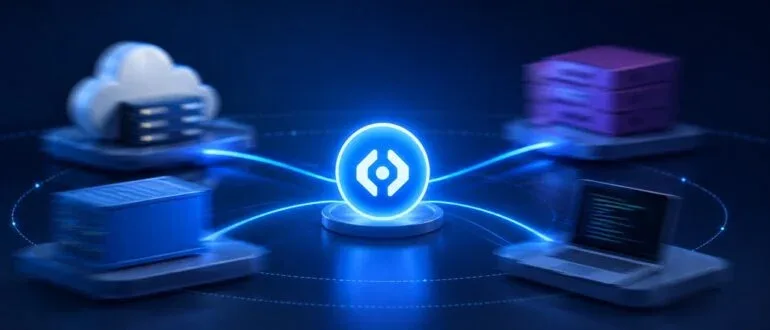
To build truly resilient continuous deployment pipelines, engineering teams are adopting pure userspace overlay networks, such as Pilot Protocol, to bypass kernel constraints entirely. Operating above the operating system kernel, these networks embed peer-to-peer routing directly into the application layer.
- Cryptographic Keypairs: Instead of relying on a cloud provider for a temporary IP, the software node generates a permanent keypair upon initialization. The public key serves as the immutable network address, remaining mathematically identical whether running in an AWS pod, an Azure serverless function, or a local laptop.
- UDP Hole-Punching: Nodes leverage the overlay to negotiate direct peer-to-peer connections through their respective Network Address Translation (NAT) firewalls. This eliminates the need for complex Transit Gateways, IPSec tunnels, or manual port forwarding.
- Zero-Trust Handshake: Before any application data is exchanged, nodes perform an authenticated handshake utilizing Elliptic Curve Diffie-Hellman key exchange and AES encryption.
Implementing this architecture enforces a strict DevSecOps posture by default. Because the network validates the cryptographic signature of the endpoint, malicious actors cannot spoof physical IP addresses. Additionally, listening application sockets are never exposed to the public internet, drastically reducing the external attack surface and eliminating the need to manage thousands of complex access control lists.
The End of Infrastructure-Bound Applications
The transition toward identity-based routing marks a fundamental shift in how distributed systems scale. As autonomous AI agents increasingly drop down to local edge devices for data collection, relying on host-level network interface modifications becomes impossible. Userspace overlays provide the only universal denominator capable of bridging highly restricted environments without triggering administrative bottlenecks.
By embedding routing logic directly into the application layer, developers can finally treat the network as code. This eliminates the administrative debt of subnet management and allows secure, globally distributed systems to deploy with the exact same velocity and automation as the software itself.
This article was written by AI from reporting by devops.com.