

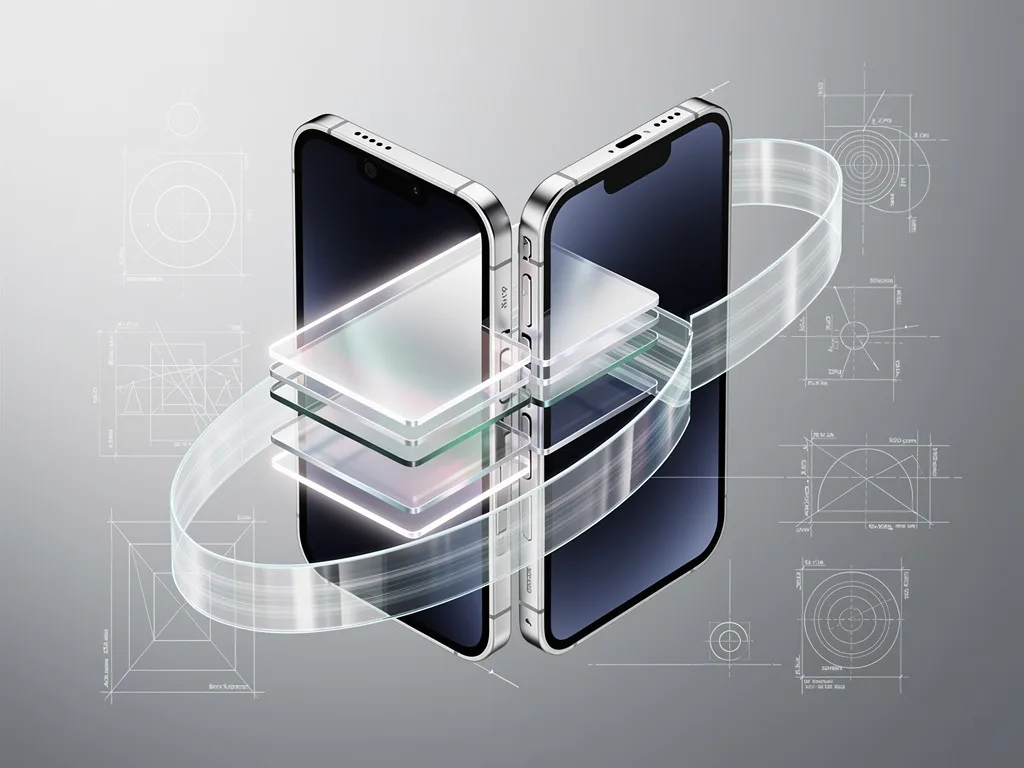
Apple has officially entered the foldable market with the $1,999 iPhone Duo, tackling the notorious display crease that has plagued the industry. By engineering an ultra-thin glass less than 30 micrometers thick, the company aims to deliver a 7.6-inch inner screen that bends thousands of times without shattering. For context, a typical strand of human hair measures between 50 and 100 micrometers. At this extreme thinness, the material stops behaving like traditional glass, allowing the outer surface strain to drop dramatically so it curves instead of breaking.
This breakthrough matters significantly for premium smartphone buyers who have hesitated to adopt foldables from competitors like Samsung, Google, and Motorola due to long-term durability concerns. The secret to the iPhone Duo lies in its material science. Everyday glass is primarily silicon dioxide, which is highly rigid. By introducing boron trioxide - a compound common in laboratory equipment - materials scientists created an amorphous matrix that bends readily. Apple then pairs this with advanced ion exchange processes that compress the surface at a molecular level, resisting crack propagation.
The development of this foldable display relies heavily on Apple's long-standing partnership with Corning, the manufacturer behind the Ceramic Shield technology. Corning's Gorilla Glass lineage traces back to a 1960s formulation called Chemcor, which was revived for the original iPhone in 2007. Recent real-world testing of the iPhone 17 Pro models equipped with Ceramic Shield 2 shows the upgraded material offers three times better scratch resistance than its predecessor, setting a strong foundation for the Duo's flexible screen.
How Apple Engineered the Crease-Free Display
To ensure the hinge feels solid after 100,000 folds and survives years in a pocket, Apple implemented several structural innovations that separate the iPhone Duo from existing foldables:
- Dual-Layer Sandwich: The display utilizes a dual-layer ultra-thin glass approach, with one layer sitting above the flexible OLED and another below it to isolate the display from direct hinge pressure.
- Variable Thickness: The glass is engineered to be thinner directly at the fold zone for maximum flexibility, while the surrounding areas remain thicker to maintain structural rigidity.
- Advanced Adhesives: Optically clear adhesives stay pliable during slow bends but stiffen on impact. They also flow into microscopic gaps to reduce the light scattering that typically makes a display crease visible.
The iPhone Duo, which lands in stores on October 23, is not Apple's only ambitious glass project. Plans for a 2027 model, timed to the original iPhone's 20th anniversary, remain firmly on track. Internally known as V73 and V74, these upcoming Pro variants will feature glass on both the front and back that curves into the sides, held together by a narrow metal band. Early concepts pushed for a pure glass slab, but bonding issues during volume testing led to a compromise that retains structural integrity.
The True Cost of a Crease-Free Display
Apple's refusal to ship a foldable until it solved the display crease problem comes with a steep manufacturing penalty. Production yields for the ultra-thin glass currently hover between 60 and 70 percent in mass manufacturing, handled largely by Lens Technology. Because Apple typically insists on yields of 85 percent or higher before committing to volume, this gap perfectly explains the cautious rollout and the staggering $1,999 starting price.
However, the iPhone Duo is a calculated Trojan horse for Apple's broader hardware ambitions. By absorbing the high costs of boron-enhanced glass and variable-thickness manufacturing now, Apple is subsidizing the supply chain required for its 2027 V73 and V74 models. The competition that once seemed distant for Apple in the foldable space is now immediate, proving that the next decade of smartphones will be defined entirely by materials science and glass technology.
