

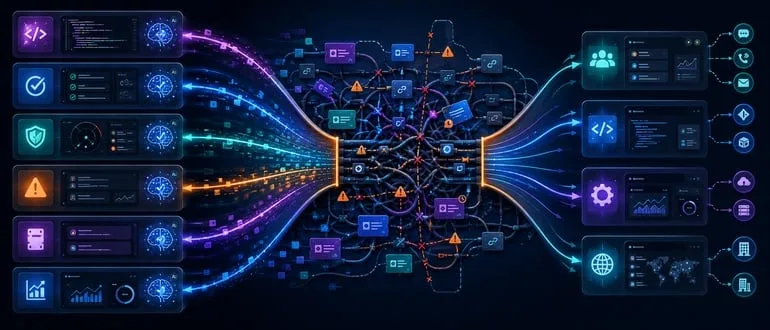
The promise of AI DevOps integration was supposed to eliminate software delivery bottlenecks, but many engineering teams are finding their pipelines are still painfully slow. While AI copilots are writing code, generating tests, and triaging incidents at record speeds, the real friction has shifted to the broken wiring between isolated tools. The end-to-end delivery pipeline has not caught up to the velocity of machine-generated code, leaving critical status updates and escalations lost in the gaps between systems.
The past two years have seen a massive influx of AI into the DevOps stack. Tools like GitHub Copilot, Amazon CodeWhisperer, and Snyk's AI-assisted scans have made individual tasks significantly faster. However, these tools operate in strict silos. A Jira ticket, a Zendesk case, and a ServiceNow incident remain fundamentally disconnected objects maintained by separate teams. When data needs to cross these boundaries, teams are forced to rely on manual data entry, Slack messages, or fragile webhooks that strip away critical context like priority levels and reproduction steps.
Traditional integration infrastructure struggles to keep up with the increased volume and velocity of machine-generated changes. Native connectors, custom scripts, and iPaaS platforms work for simple status syncs, but they break down under complex requirements. As AI automates pull requests and incident triage, faster tools simply create larger backlogs at every handoff point.
How AI-Assisted Integration Bridges the Gap
- Plain-Language Configuration: Instead of spending weeks configuring a Jira-to-ServiceNow integration, tools like Aida allow teams to use conversational prompts. The AI analyzes both systems' schemas and generates working Groovy scripts in hours.
- Status and Custom Field Mapping: Manual mapping fails when "Pending" in Zendesk needs to become "In Progress" in Jira. AI analyzes data types and usage patterns to automatically propose conditional logic for complex status transitions and custom fields.
- Cross-Company Integration: Managed Service Providers (MSPs) can route Jira escalations to specific client Azure DevOps projects based on organization identifiers, ensuring data privacy while maintaining global visibility.
- Error Handling and Troubleshooting: When APIs time out or hit rate limits during bulk operations, AI-powered troubleshooting analyzes the context and suggests immediate fixes based on specific sync rules, turning day-long outages into 15-minute resolutions.
- Closing the Sales-to-Support Loop: Account data and SLA details can replicate automatically between Salesforce and Freshdesk or Zendesk. Critical VIP tickets can even auto-create P1 Jira bugs with full conversation summaries attached.
The Next Era of Pipeline Architecture
The bottleneck in software delivery has definitively moved from code generation to system integration. Organizations that continue to treat integration as an in-house scripting afterthought will see diminishing returns on their heavy AI investments. Moving forward, engineering teams will likely need to adopt "integration latency" as a core performance metric alongside traditional DORA metrics to truly measure pipeline health.
As AI increases the sheer velocity of code creation, the platforms that win the next decade will not just be the ones that write the best functions. They will be the ones that seamlessly translate context, custom fields, and security policies across the entire enterprise architecture without human intervention. Treating cross-company data exchange with the same rigor as internal CI/CD pipelines is no longer optional; it is the only way to realize the full ROI of generative AI in software development.
