A spent SpaceX Falcon 9 upper stage has slammed into the lunar surface, blasting open a 60-foot crater and providing scientists with a rare, real-time look at lunar geology. The unplanned collision, which occurred on August 5, 2026, was captured in unprecedented detail by NASA’s Lunar Reconnaissance Orbiter (LRO) and the Republic of Korea’s Danuri spacecraft. The rocket originally launched Firefly Aerospace’s Blue Ghost 1 lunar lander on January 15, 2025, before solar activity and gravitational forces pushed the discarded stage into a collision course with the Moon.
Because the Moon lacks an atmosphere to burn up incoming debris, its surface is continually reshaped by kinetic strikes. NASA estimates that natural meteoroids carrying similar energy strike the lunar surface roughly once every six days. However, human-made impacts of this scale are exceptionally rare, offering researchers a perfectly timed opportunity to test planetary defense tracking systems and observe the immediate aftermath of crater formation.
The 10-Second Window for Precision Imaging
Capturing the fresh impact scar required extreme orbital precision. Engineers had to tilt the LRO so its narrow-angle cameras pointed exactly at the crater while the spacecraft raced 60 miles above the lunar surface at a speed of 1 mile per second. Because the orbiter circles the Moon from pole to pole every two hours, controllers had to wait for the slowly rotating lunar surface to align the impact zone directly beneath its flight path.
Timing was the most unforgiving factor. If the LRO's camera activated just 10 seconds too early or too late, the 60-foot crater would have appeared 10 miles away from the center of the frame. By observing the site from multiple angles between August 11 and 12, changing sunlight and shadows revealed that the crater is less than 10 feet deep, which is slightly shallower than NASA’s initial 12-foot estimate.
Crater Rays Expose Hidden Lunar Layers
The LRO’s narrow-angle camera, capable of detecting objects as small as 3 feet across, allowed researchers to isolate the exact geological changes caused by the collision. The impact churned up distinct layers of lunar material, creating a visible pattern of bright and dark rays spreading outward from the center.
The darker streaks consist of dust and rock excavated from the upper 1.5 feet of the surface. This top layer has been heavily altered over time by solar wind, galactic cosmic rays, and countless micrometeorite strikes. In contrast, the brighter deposits near the crater's rim were blasted up from greater depths. Because this deeper material had been sheltered underground, it was exposed to space weathering for far less time, appearing significantly fresher than the surrounding terrain.
A Global Tracking Network Proves Its Worth
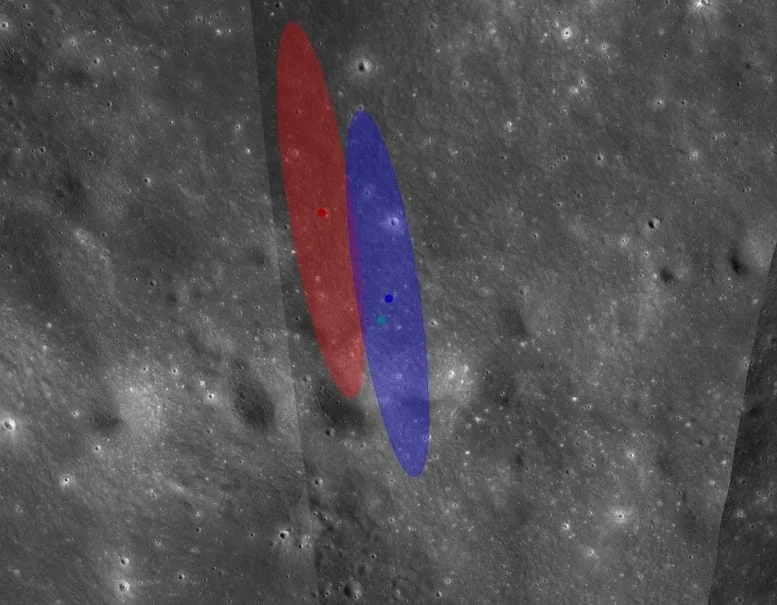
Locating the exact impact site required a coordinated international effort. Independent astronomers first reconstructed the rocket’s trajectory using publicly available data. NASA’s Center for Near Earth Object Studies, based at the Jet Propulsion Laboratory, then refined the path. This exercise allowed NASA to evaluate the same tracking technologies normally used to monitor asteroids and comets that might threaten Earth.
NASA shared its predicted impact location with the Republic of Korea’s Danuri team, which used its high-resolution LUTI camera to photograph the crater just hours after the strike. The actual impact site was found only 0.6 miles from NASA’s prediction. Using Danuri's coordinates, NASA pinpointed the crater's exact center at 19.4759°N, 266.7138°E, at an elevation of 1,677 feet (511 meters).
The Hidden Scientific Value of Space Debris
While discarded rocket stages are widely viewed as a dangerous orbital debris problem in Low Earth Orbit (LEO), this event highlights a paradoxical benefit when that debris reaches the Moon. Instead of being a hazard, the Falcon 9 stage acted as a free, highly predictable kinetic impactor. Dedicated missions to excavate lunar soil - like NASA's LCROSS mission in 2009 - cost hundreds of millions of dollars. Here, scientists received a deep-surface excavation at zero additional cost.
Furthermore, the event served as a flawless dry run for Earth's planetary defense networks. The fact that independent astronomers, NASA's JPL, and South Korea's space agency could seamlessly hand off trajectory data and locate a 60-foot crater within a 0.6-mile margin of error proves that our international tracking infrastructure is highly capable. If a rogue asteroid of similar size were on a collision course with Earth, this exact collaborative framework would be our first line of defense.
This article was written by AI from reporting by scitechdaily.com.