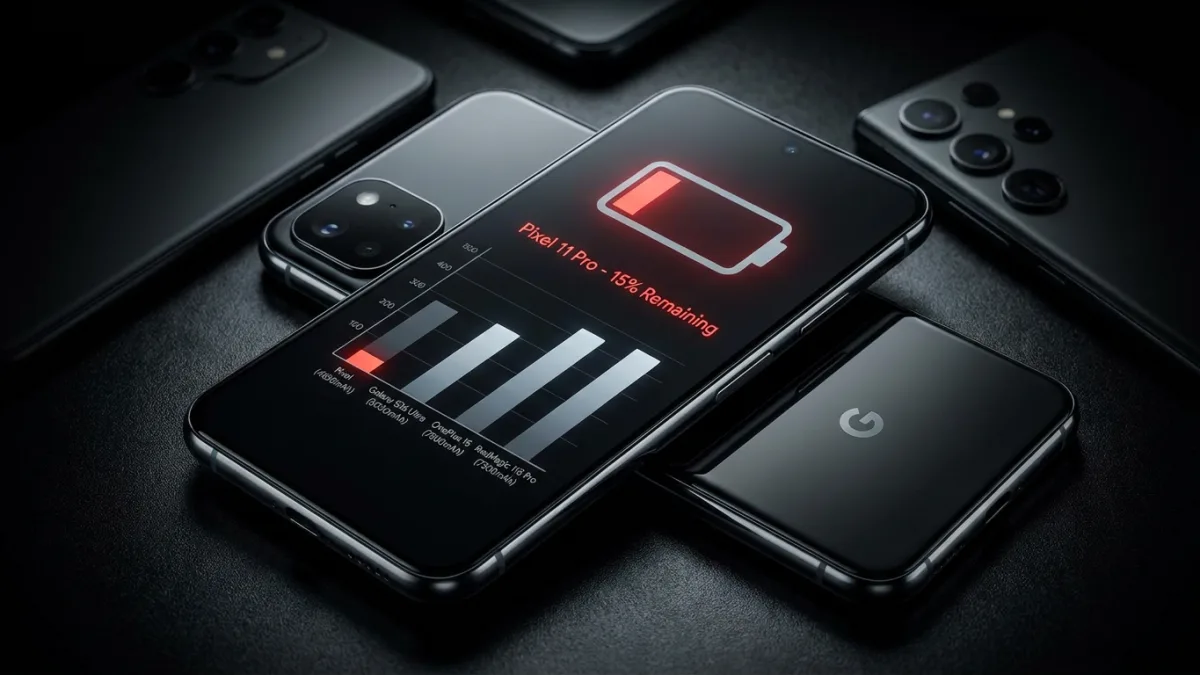
Google's Pixel 11 Pro delivers a respectable 4,850 mAh battery and heavily optimized Tensor AI efficiency, but it still falls short of true all-day endurance for heavy users. Independent lab tests from GSMArena, PhoneArena, and NanoReview reveal that several competitors - ranging from mainstream Samsung flagships to silicon-carbon powerhouses - outlast Google's premium device in gaming, browsing, and overall standby time. For buyers prioritizing longevity over Google's software ecosystem, the current Android market offers significantly larger capacities at comparable or lower price points.
- Samsung Galaxy S26 Ultra: Featuring a 5,000 mAh battery, Samsung claims 31 hours of video playback. While GSMArena notes the Pixel 11 Pro edges it out in YouTube playback (25 hours and 20 minutes versus 24 hours and 48 minutes), the S26 Ultra dominates in gaming endurance, with PhoneArena showing the Pixel achieving less than half the gaming battery life of Samsung's flagship.
- Samsung Galaxy S26: Despite a smaller 4,300 mAh battery, it competes fiercely. GSMArena logs 27 hours and 37 minutes in calls and 9 hours and 27 minutes in gaming (beating the Pixel's 23 hours and 50 minutes and 9 hours and 13 minutes). PhoneArena gives the S26 a better overall battery life of 6 hours and 37 minutes compared to the Pixel's 5 hours and 44 minutes, though the Pixel wins in video playback (11 hours and 4 minutes versus 8 hours and 54 minutes).
- Samsung Galaxy S26 Plus: Priced identically to the Pixel at $1,099, its 4,900 mAh battery delivers 16 hours and 24 minutes of overall usage in GSMArena's tests, beating the Pixel's 15 hours and 38 minutes. It also wins in gaming across all sources, hitting 10 hours and 18 minutes in PhoneArena's tests against the Pixel's 4 hours and 23 minutes, though the Pixel slightly leads in GSMArena's video playback (25 hours and 20 minutes versus 25 hours and 12 minutes).
- OnePlus 15: Utilizing a massive 7,300 mAh silicon-carbon battery, it crushes the Pixel across the board. GSMArena records 23 hours and 7 minutes of total usage, 32 hours and 57 minutes of video, and 13 hours and 5 minutes of gaming. NanoReview confirms the dominance with 28 hours and 44 minutes of overall life, while PhoneArena logs 14 hours and 16 minutes of gameplay.
- Nothing Phone (4a): Launching at roughly $500 (£379), this 5,080 mAh device offers comparable endurance for half the price. While GSMArena shows it trailing the Pixel in overall usage (13 hours and 33 minutes) and video (21 hours and 48 minutes), PhoneArena reports superior overall life (7 hours and 10 minutes), browsing (18 hours and 44 minutes), and gaming (6 hours and 50 minutes) despite its older Snapdragon 7s Gen 4 chip.
- Nothing Phone (4a) Pro: Available for about $600 with a Snapdragon 7 Gen 4, it features the same 5,080 mAh capacity. NanoReview highlights a massive 132 hours of standby time versus the Pixel's 86 hours. PhoneArena logs better overall life (7 hours and 22 minutes) and browsing (16 hours and 22 minutes), though GSMArena still gives the Pixel the edge in overall usage (15 hours and 38 minutes versus 15 hours and 16 minutes).
- RedMagic 11S Pro: This $849 gaming phone packs a 7,500 mAh battery (55% larger than the Pixel). GSMArena measures 20 hours and 18 minutes of overall life, 27 hours and 24 minutes of YouTube, and 13 hours and 7 minutes of gaming. PhoneArena shows it doubling the Pixel's overall battery life with 10 hours and 1 minute total. NanoReview's tests on the identical-battery RedMagic 11 Pro also show it defeating the Pixel in every category.
- Xiaomi 17T Pro: Equipped with a 7,000 mAh battery, it sweeps the Pixel in all tests. GSMArena records 21 hours and 41 minutes overall, 28 hours and 21 minutes of video, and 12 hours and 17 minutes of gaming. NanoReview logs 24 hours and 44 minutes of video and 9 hours and 34 minutes of gaming, while PhoneArena shows 9 hours and 43 minutes total.
- Realme GT 8 Pro: Another 7,000 mAh powerhouse, it achieves 20 hours and 23 minutes of overall life, 28 hours and 26 minutes of video, and 10 hours and 45 minutes of gaming in GSMArena's testing. NanoReview adds that it hits 24 hours and 49 minutes of video playback and 8 hours and 34 minutes of gaming, consistently outperforming the Pixel's 22 hours and 7 minutes and 6 hours and 33 minutes in those respective tests.
- Honor Magic8 Pro: Featuring a 7,100 mAh silicon-carbon battery, it beats the Pixel in all categories. GSMArena logs 19 hours and 7 minutes overall, 27 hours and 44 minutes of video, and 11 hours and 7 minutes of gaming. NanoReview records 24 hours and 12 minutes of video and 8 hours and 32 minutes of gameplay, while PhoneArena confirms the sweep with 8 hours of overall battery life.
The Testing Methodology Behind the Numbers
Battery life cannot be defined by a single metric, as it fluctuates based on chipset efficiency, software optimization, and user habits. To establish a reliable baseline, the data aggregates controlled in-house lab testing from GSMArena and PhoneArena with crowdsourced user benchmarks from NanoReview. This dual approach balances measurable, repeatable lab conditions with the unpredictable nature of real-world usage.
Devices were selected based on their ability to consistently outperform the Pixel 11 Pro across multiple categories, with a specific focus on models available to U.S. consumers. While the Pixel 11 Pro performs respectably given its physical constraints, the aggregated data highlights alternative options for users who require true all-day endurance without relying on mid-day charging.
The Silicon-Carbon Chemistry Gap
The performance delta between the Pixel 11 Pro and its competitors exposes a growing geographical divide in battery hardware. U.S.-focused flagships like the Pixel 11 Pro (4,850 mAh) and the Galaxy S26 Ultra (5,000 mAh) are hitting a capacity ceiling with traditional lithium-ion chemistry. To compensate, Google relies heavily on the Tensor G6 chip and software-level AI optimization to stretch endurance, which explains why the Pixel still manages to win specific low-drain tests like GSMArena's video playback.
However, software efficiency cannot indefinitely mask a raw hardware deficit. Devices like the OnePlus 15 (7,300 mAh) and Honor Magic8 Pro (7,100 mAh) are leveraging high-density silicon-carbon batteries to brute-force their way to multi-day endurance without increasing device thickness. If Google and Samsung do not transition to silicon-carbon chemistry in their upcoming hardware cycles, their AI-driven power management will be entirely eclipsed by the sheer physical capacity of their international competitors.