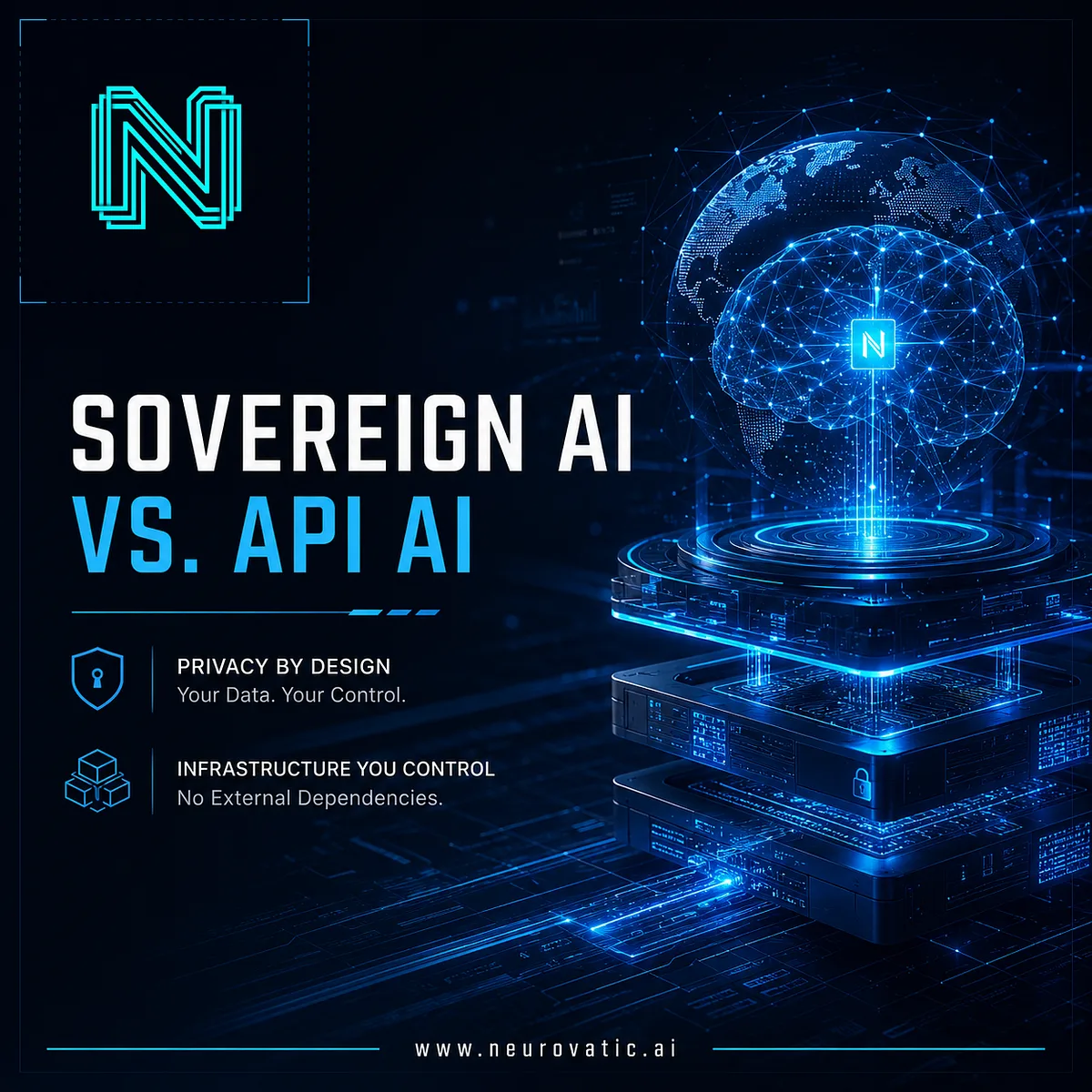
Enterprises are realizing that relying solely on cloud-based AI APIs exposes them to data privacy risks and vendor lock-in. As artificial intelligence becomes deeply embedded in critical operations, the shift toward Sovereign AI is accelerating to regain control over infrastructure and governance. Rather than replacing API-based solutions entirely, this self-hosted approach provides a necessary alternative for organizations with strict security and regulatory requirements.
While cloud AI services offer fast access to advanced language models with minimal setup, they introduce dependencies on external providers for pricing, uptime, and feature evolution. For mission-critical systems, these dependencies can become operational liabilities.
How to Evaluate the Shift to Sovereign AI
Transitioning from cloud APIs to a self-hosted architecture requires a strategic assessment of your operational needs. Follow these steps to determine if your enterprise is ready for the switch:
- Control sensitive data processing by moving away from external cloud services.
This ensures compliance with strict regulatory obligations in healthcare and finance by keeping proprietary information on self-hosted deployments. - Establish infrastructure independence to avoid vendor lock-in.
This enables your organization to manage pricing, service availability, and model lifecycles according to internal requirements rather than external provider changes. - Optimize for predictable performance by utilizing local inference.
This removes external network latency, which is critical for applications requiring deterministic response times like industrial automation and cybersecurity. - Design robust governance and auditability mechanisms.
This ensures alignment with emerging AI regulations that demand transparency, accountability, and detailed logging of algorithmic decision systems. - Take ownership of model customization and deployment schedules.
This provides the flexibility to fine-tune models with proprietary knowledge and integrate them as core infrastructure rather than external productivity tools.
Exploring the NEUROVATIC Architecture
To address the growing demand for infrastructure control, NEUROVATIC is developing a comprehensive Sovereign AI ecosystem. This architecture is designed to give organizations maximum authority over their intelligent systems.
The long-term framework includes several complementary components, some of which are currently under active research:
- SIGMA: Proprietary language intelligence specifically designed for self-hosted deployment.
- UNDECA: A distributed cognitive architecture that coordinates specialized AI capabilities.
- NPoI (Neural Proof of Intelligence): A research initiative exploring verifiable AI decision provenance and auditability.
- NV-CHAIN: Blockchain infrastructure supporting governance, integrity, and distributed coordination.
- AEGIS: A security and validation framework designed to strengthen trust across the entire AI lifecycle.
Organizations prioritizing rapid deployment may still prefer cloud services, but those handling highly sensitive information are increasingly exploring these distributed intelligence frameworks. For a deeper technical breakdown, you can review the official NEUROVATIC whitepaper.
The Hidden Cost of Cloud Dependency
The enterprise pivot toward Sovereign AI highlights a maturing market where convenience is no longer the sole driving factor. As regulatory frameworks begin to enforce strict data provenance and auditability standards, relying on a black-box API for core business logic is becoming a significant legal and operational risk.
Furthermore, the push for local inference in sectors like robotics and industrial automation proves that network latency remains a physical bottleneck for real-time AI. By investing in self-hosted architectures and verifiable systems like NPoI, enterprises are not just protecting their data; they are future-proofing their infrastructure against unpredictable cloud pricing and sudden model deprecations.
This article was written by AI from reporting by medium.com.