Deploying Apple Private Cloud Compute beyond proprietary data centers to Google Cloud solves the massive privacy hurdle of mobile AI processing. This major infrastructure shift allows Apple to scale its Apple Intelligence workloads without sacrificing its strict user privacy guarantees.
For everyday iPhone and Mac users, this means complex AI tasks - like agentic tool use and advanced reasoning - will process faster by leveraging Google's massive cloud footprint. Apple has designed this partnership so that your personal data remains cryptographically sealed, even when processed on hardware Apple doesn't physically own.
The Hardware Powering Apple's External Cloud
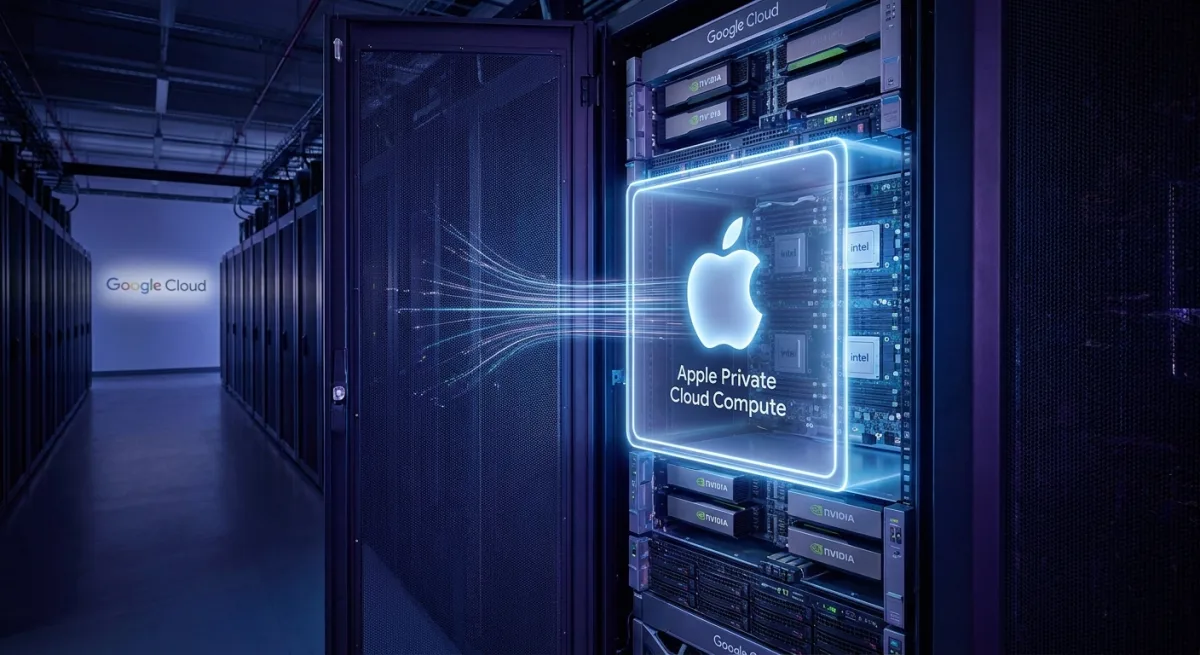
Historically, Apple restricted its cloud AI processing to custom Apple silicon servers housed within its own highly secure data centers. However, the sheer computational demand of next-generation Apple Foundation Models has forced a pragmatic evolution. Apple is now deploying its secure software stack onto Google Cloud systems equipped with NVIDIA GPUs.
To maintain its strict security posture, Apple worked closely with Google and NVIDIA to implement a highly specialized hardware stack. This setup relies on NVIDIA Confidential Computing, Intel CPUs with Trust Domain Extensions (TDX), and Google's Titan security chip. Together, these technologies create a secure enclave that prevents Google, or anyone else, from accessing the data being processed.
Our core PCC requirements remain exactly the same: stateless computation, enforceable guarantees, no privileged runtime access, non-targetability, and verifiable transparency. What's new with PCC on Google Cloud is the implementation: NVIDIA Confidential Computing with NVIDIA GPUs, Intel CPUs with TDX, and Google's Titan chip.
- Apple
How Apple Secures Apple Private Cloud Compute on Google Cloud
To ensure that Google Cloud servers do not compromise user privacy, Apple has established a multi-layered verification system. This system ensures that Apple maintains absolute control over the software running on external hardware.
- Cryptographic Ledger: Apple maintains a cryptographically verifiable ledger of all Google Cloud hardware allowed in the PCC fleet, neutralizing supply chain attacks.
- Stateless Computation: User data is never written to non-volatile storage and is wiped immediately after the AI task is completed.
- No Privileged Access: Neither Google administrators nor Apple engineers have administrative or runtime access to the active PCC nodes.
- Public Inspection: Apple is making the PCC on Google Cloud binaries available for public security research and inspection.
Additionally, Apple is expanding its Apple Security Bounty Program to cover these new cloud nodes. Security researchers will have access to live PCC nodes in a dedicated research mode, with financial rewards for discovering potential vulnerabilities.
The Pragmatic Surrender of the Apple Ecosystem Wall
This expansion of Apple Private Cloud Compute represents a massive, albeit necessary, shift in Apple's corporate philosophy. For decades, Apple's primary selling point has been absolute control over both hardware and software. By outsourcing its most sensitive AI workloads to Google's infrastructure, Apple is admitting that its own silicon manufacturing and data center footprint cannot scale fast enough to compete with the rapid rise of generative AI.
However, this is not a defeat; it is a highly sophisticated compromise. By enforcing cryptographic verification and confidential computing standards on Google's hardware, Apple is setting a new industry benchmark for hybrid cloud security. If successful, this model proves that tech giants can collaborate on massive AI infrastructure without forcing consumers to surrender their personal data privacy.
Ultimately, this partnership benefits Google as much as Apple. It positions Google Cloud as the premier, trusted infrastructure for confidential AI processing, potentially attracting other privacy-conscious enterprise clients. For Apple, it ensures that Apple Intelligence remains competitive with Google's own Gemini-powered Android ecosystem, without requiring Apple to spend tens of billions of dollars building out its own global server farms overnight.
This article was written by AI from reporting by macrumors.com.