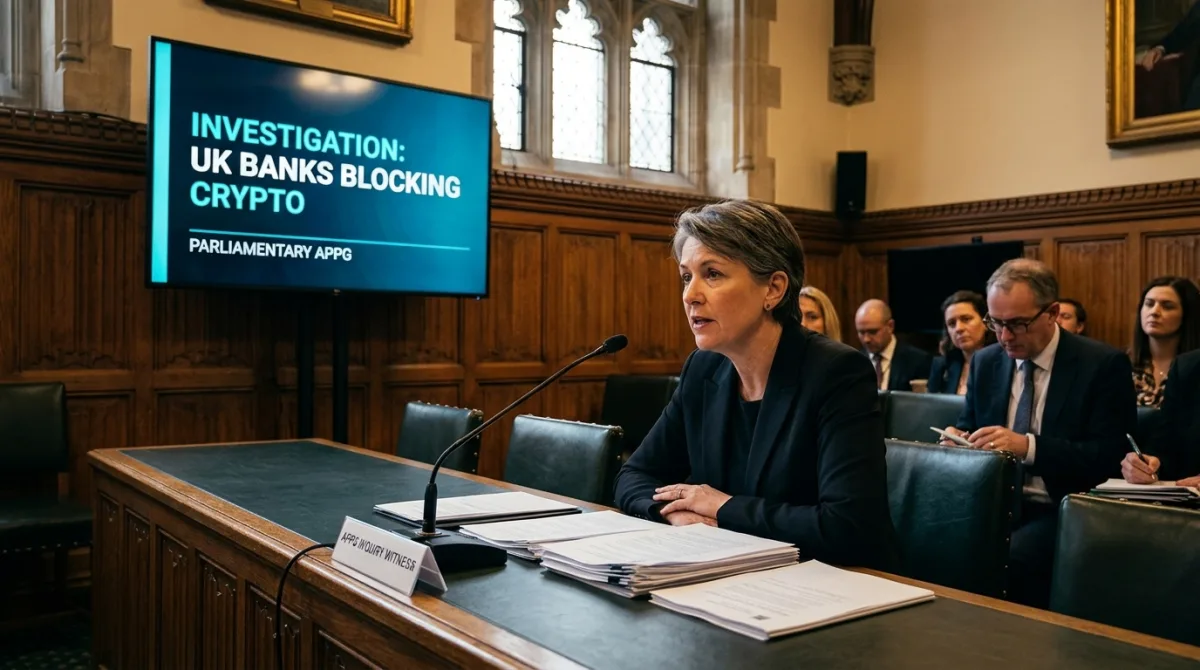
Crypto businesses in the United Kingdom are facing a severe bottleneck as major banks increasingly block or delay transactions, prompting a formal parliamentary inquiry. The Crypto and Digital Assets All-Party Parliamentary Group (APPG) has launched an investigation to determine if these banking restrictions are disproportionately harming investment, competition, and economic growth. The group is accepting written submissions from banks, payment providers, and crypto firms until August 31 before publishing its recommendations.
The inquiry follows a damning January survey by the UK Cryptoasset Business Council (UKCBC), which highlighted the scale of the banking freeze. The survey included data from 10 major platforms: Coinbase, Kraken, Gemini, OKX, Bitpanda, Luno, Uphold, Wirex, Zumo, and Xapo Bank. These respondents reported that banks blocked or delayed 40% of transactions directed to crypto platforms. Furthermore, 70% of the surveyed firms stated that these hostile banking conditions had directly reduced their willingness to invest, expand, or hire within the UK.
The financial impact on individual platforms has been staggering. One unnamed exchange reported nearly £1 billion (approximately $1.35 billion) in declined transactions over a single year, a figure that only accounts for rejected card payments and open banking transfers. Seven of the ten surveyed firms described the UK banking environment for digital asset businesses as becoming increasingly hostile.
Proportionality has a simple test. Does the measure distinguish a high-risk case from a low-risk one? These measures do not.
- Yuriy Brisov, Partner, Digital & Analogue Partners
The Clash Between Regulation and Banking Access
The banking sector's aggressive stance is heavily influenced by the UK's reimbursement rules for authorized push payment (APP) fraud. Since October 2024, payment providers have been required to reimburse eligible fraud victims for losses of up to £85,000 per claim. This strict liability gives banks a strong financial incentive to implement blanket bans and fixed transaction caps on crypto-linked transfers, rather than investing in nuanced, individual risk assessments.
This banking blockade directly contradicts the government's timeline for regulatory integration. The Financial Conduct Authority (FCA) is set to begin accepting authorization applications from crypto firms on September 30, with HM Treasury's full Cryptoassets Regulations regime expected to take effect in October 2027. However, industry experts argue that regulatory approval is meaningless without basic financial infrastructure. Brisov warned that "a country that calls itself a crypto hub cannot keep its payment system closed to the industry it licenses."
The Illusion of a Global Crypto Hub
The UK government's ambition to become a "global crypto hub" is fundamentally incompatible with its current banking infrastructure. While the FCA's upcoming September 30 licensing window provides regulatory clarity, a license is practically useless if a business cannot open a basic corporate bank account or process user deposits. The £85,000 APP fraud reimbursement rule has inadvertently weaponized compliance, making it cheaper for banks to blanket-ban crypto rather than build sophisticated risk-assessment models.
If the Treasury does not mandate banking access for FCA-registered firms, the 2027 regulatory regime will simply oversee an industry that has already relocated. Companies are not going to wait three years for the privilege of being locked out of the financial system. Without immediate intervention to force banks to distinguish between regulated exchanges and offshore platforms, the UK risks losing its competitive edge to more accommodating jurisdictions like the UAE or the EU under the MiCA framework.
This article was written by AI from reporting by cointelegraph.com.