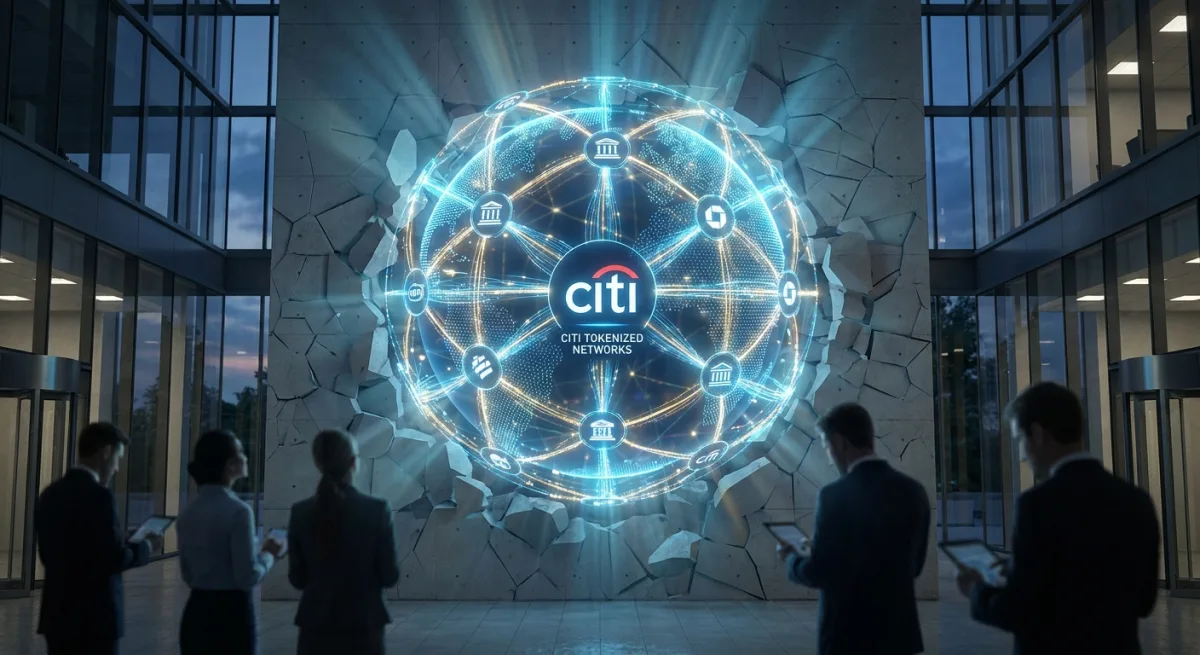
Corporate clients managing global finances are demanding real-time, cross-border payments, but current fragmented crypto systems risk recreating the very inefficiencies they were meant to solve. Citigroup's head of digital assets, Ryan Rugg, has issued a stark warning: Citi tokenized money initiatives and broader industry efforts will fail to reach their potential if they remain trapped inside single-bank silos.
Speaking at the Consensus Miami 2026 conference, Rugg highlighted that large corporate clients are rejecting isolated, single-bank solutions. Companies that juggle hundreds or thousands of bank accounts globally require systems that work seamlessly across multiple financial institutions, rather than being restricted to a proprietary network.
The Danger of Fragmented Crypto Systems
While traditional banks have started issuing tokenized deposits and building internal blockchain platforms, many of these operate strictly within closed networks. Rugg noted that clients do not want "just a Citi token"; they demand a multi-bank ecosystem that simplifies moving money for payroll, suppliers, and investments.
According to a survey conducted by Citi, corporate demand for faster, always-on payments is basically unanimous. To address this, Citi has developed its own tokenized platform and connected it to a 24/7 U.S. dollar clearing system that includes over 300 banks. However, internal upgrades alone are insufficient for global scale.
To prevent the blockchain industry from recreating legacy banking bottlenecks, Rugg outlined several critical requirements for the future of tokenized finance:
- Shared Infrastructure: The industry must build unified networks - similar to Swift's global messaging system - designed "for the industry, by the industry."
- System Integration: Banks must modernize traditional infrastructure and actively connect it with emerging digital asset systems.
- Regulatory Clarity: Large financial institutions require 100% permissible legal frameworks before rolling out new blockchain products.
Wall Street's Growing Crypto Integration
Despite the challenges of fragmentation, traditional finance is steadily embracing digital assets. During a separate panel at Consensus Miami 2026, executives from Ondo, Robinhood, and Babylon Labs confirmed that Wall Street firms are actively integrating crypto infrastructure.
These industry leaders argued that tokenized treasuries and stablecoin-based products already offer clear advantages over legacy systems, providing 24/7 market access. However, institutional adoption remains constrained by the lack of unified networks and regulatory green lights.
The Push for a Unified Blockchain Standard
The current trajectory of tokenized finance is at a critical inflection point. Rugg’s warning underscores a fundamental truth: blockchain's primary value proposition is decentralized interoperability, yet banks are instinctively building walled gardens. If financial institutions continue to launch proprietary tokens on isolated networks, they will simply digitize the friction of the correspondent banking system.
The successful integration of a 24/7 U.S. dollar clearing system with 300 banks proves that multi-institution networks are viable. However, achieving a true global standard will require fierce competitors to collaborate on shared infrastructure. Until regulatory frameworks provide absolute certainty, institutional adoption will likely remain a parallel track rather than a complete replacement of traditional finance.