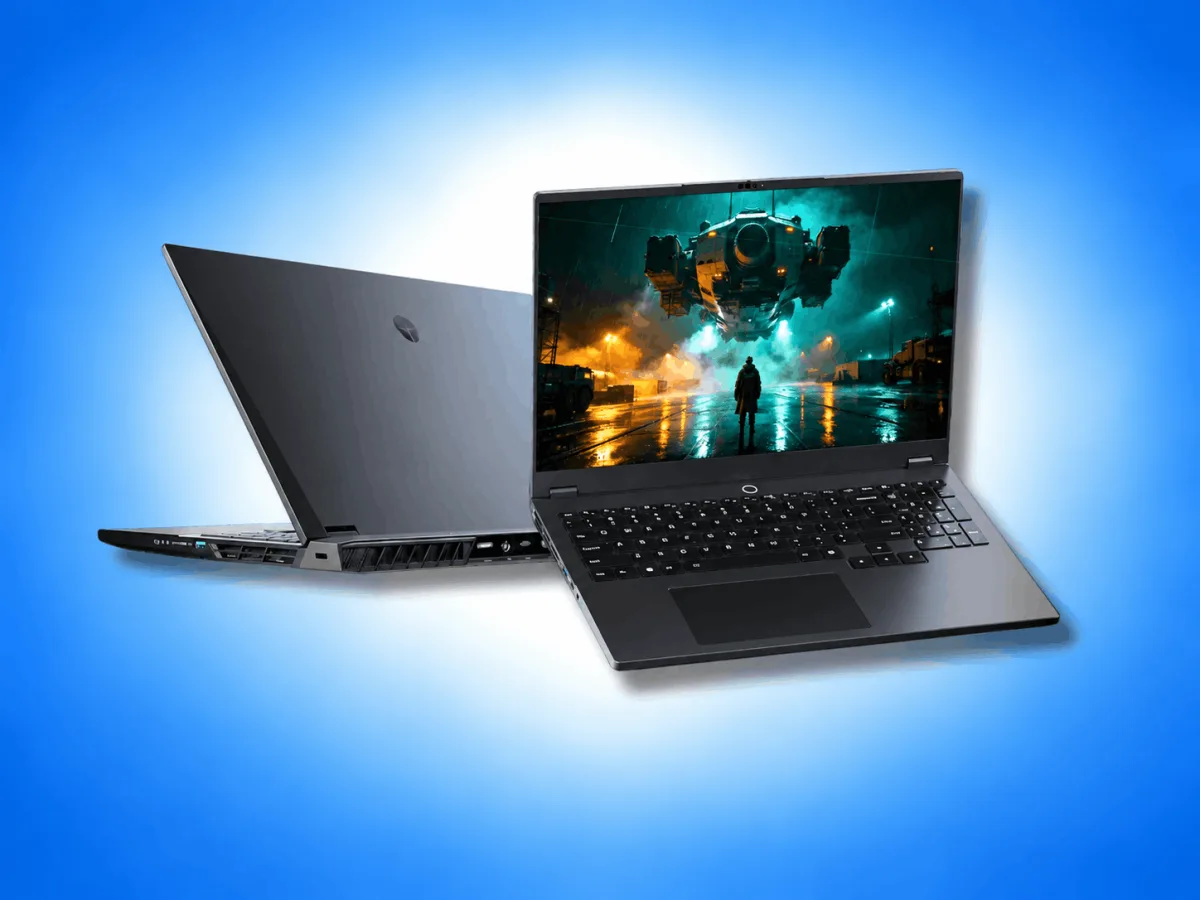
Professionals running massive AI models locally often hit a hard ceiling with standard laptop memory, forcing them to rely on expensive cloud compute. The newly launched Thunderobot AI Master M7000 shatters this bottleneck by combining AMD's top-tier silicon with specialized flash storage technology to handle massive datasets directly on the device. The 16-inch mobile workstation officially went on sale in China on September 21 at 10:00 a.m. local time.
The system is powered by the AMD Ryzen AI Max+ 395, a 16-core, 32-thread processor capable of reaching boost clocks up to 5.1 GHz. It features Radeon 8060S integrated graphics supporting up to 48 GB of graphics memory, alongside an XDNA 2 NPU rated at up to 50 TOPS. According to benchmark comparisons, the Ryzen AI Max+ 395 delivers a 131% relative performance score when measured against the standard Ryzen AI Max 390 baseline.
The workstation's defining feature is its integration of Phison's aiDAPTIV+ technology, which uses middleware to manage data between system memory and flash storage. The standard retail model includes 64 GB of memory (expandable up to 128 GB), 768 GB of main storage, and a dedicated 85 GB AI SSD. Thunderobot states this specific hybrid memory setup allows the machine to run the GPT-OSS-120B AI model locally, aided by the included Herdsman local inference engine and FlowAI PC software.
Visuals are handled by a 16-inch 16:10 display featuring a 2560 x 1600 resolution and a 165 Hz refresh rate. The panel delivers 500 nits of brightness and covers 100% of the sRGB color gamut. To sustain heavy workloads, the chassis houses a 99 Wh battery and supports a performance power limit of up to 160 W, all within a frame that weighs 2.45 kg (5.4 lb) and measures 24.9 mm (0.98 inches) thick.
Connectivity is geared toward professional expansion, highlighted by an OCuLink port that allows users to connect an external GPU. The port selection also includes USB4, USB-C, USB-A, HDMI, 2.5GbE Ethernet, and a microSD UHS-II card reader.
Pricing and Storage Configurations
The base model, featuring 64 GB of RAM, 768 GB of storage, and the 85 GB AI SSD, starts at 19,999 yuan (approximately $2,986) after national subsidies. For users requiring massive local datasets, Thunderobot offers configurations scaling up to 8 TB of storage. International availability has not yet been announced.
| Storage Capacity (with 64 GB RAM) | Price in Yuan (CNY) | Approximate USD |
|---|---|---|
| 1 TB | 24,999 yuan | $3,732 |
| 2 TB | 26,199 yuan | $3,912 |
| 3 TB | 27,499 yuan | $4,106 |
| 4 TB | 28,899 yuan | $4,314 |
| 5 TB | 30,399 yuan | $4,539 |
| 6 TB | 31,999 yuan | $4,778 |
| 7 TB | 33,699 yuan | $5,031 |
| 8 TB | 35,499 yuan | $5,300 |
The Local AI Compute Race Shifts to Storage
The integration of Phison's aiDAPTIV+ is the most significant hardware shift in this release, overshadowing even the powerful AMD Ryzen AI Max+ 395 chip. By treating high-speed flash storage as a direct extension of system memory for AI workloads, Thunderobot is bypassing the physical limitations and extreme costs of packing 128GB or more of unified RAM into a portable chassis. This middleware approach solves the exact bottleneck that prevents standard laptops from running large language models locally.
While the $2,986 starting price - scaling up to $5,300 for the 8 TB model - is steep for general consumers, it represents a fraction of what enterprise cloud inference costs over a single year. If this storage-as-memory architecture proves stable under sustained workloads, it will likely become the blueprint for next-generation mobile workstations. Competitors like HP and Dell will be forced to adopt similar hybrid memory strategies to remain relevant in the rapidly expanding local AI development market.