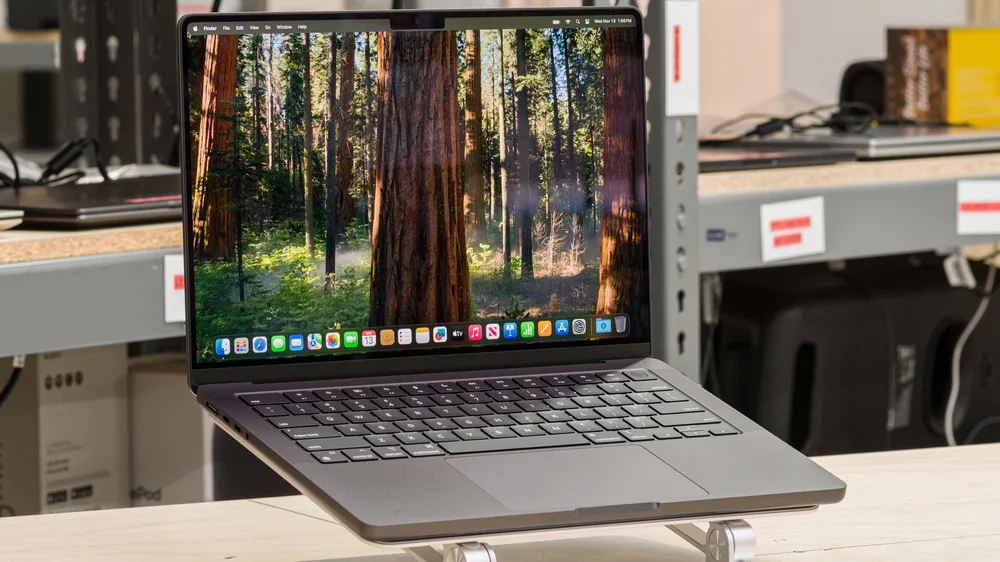
Apple's newly released M5 Max chip inside the 2026 MacBook Pro delivers a staggering 123 percent boost in SSD write speeds, making it a monumental upgrade for users still relying on three-year-old hardware. While the physical design of the $6,149 16-inch MacBook Pro remains identical to last year's model, the internal architecture introduces a radical shift with the debut of Apple's new "super cores." This hardware evolution is specifically targeted at professional video editors, 3D animators, and software developers who are pushing older Apple silicon, like the M2 Max, to its absolute limits.
For these power users, the massive leap in data transfer rates and multi-threaded processing translates directly into hours saved on rendering and file management. However, for those who recently purchased the M4 generation, the year-over-year CPU gains are far more iterative. The true story of the M5 Max lies in its storage breakthroughs and its aggressive targeting of the three-year upgrade cycle.
Unprecedented SSD Read and Write Speeds
The most noticeable real-world improvement in the 2026 MacBook Pro lineup lies in its storage performance. Apple claimed that its new models can deliver up to twice the sustained read and write speeds compared to the M4 laptops, and rigorous testing confirms this leap. The 4TB SSD in the 16-inch M5 Max MacBook Pro sustained a 13.6GB/s read speed and an astonishing 17.8GB/s write speed.
This represents an 86 percent increase in read speeds and a 123 percent increase in write speeds over the 4TB drive found in the late 2024 M4 Max review unit. Similar storage performance gains were also observed in the 2026 MacBook Air equipped with the base M5 chip. For professionals transferring massive 8K video files or compiling massive codebases, this storage bottleneck removal is a game-changer.
The New "Super Core" Architecture
Beyond storage, Apple has fundamentally redesigned its processor architecture. The review configuration of the 16-inch MacBook Pro features an M5 Max chip with 18 CPU cores, 40 GPU cores, and 128GB of memory. The previous M4 Max featured 16 CPU cores split between 12 performance cores and four efficiency cores.
For the M5 generation, Apple introduced a third type of processing core dubbed the "super core." The M5 Max utilizes six super cores alongside 12 redesigned performance cores that are optimized for power-efficient, multi-threaded workloads. Notably, standard efficiency cores have been entirely removed from the Pro and Max tiers, remaining exclusively on the base M5 chip.
Benchmark Breakdown: M5 Max vs. Previous Generations
In single-core CPU tests, the new super core architecture gives the M5 Max an 8 to 9 percent edge in benchmarks like Geekbench 6 and Cinebench compared to the M4 Max. Multi-core performance sees a 10 percent boost in Geekbench and a 14 percent increase in Cinebench 2026, aided by the 12.5 percent increase in total core count. Graphics performance also sees substantial gains, with the 40-core GPU delivering a 26 percent improvement using the OpenCL framework and an 18 percent boost in Metal graphics rendering.
| Metric | Apple M5 Max (16-inch) | Apple M4 Max (16-inch) | Apple M2 Max (16-inch) |
|---|---|---|---|
| CPU Cores | 18 | 16 | 12 |
| Geekbench 6 Single-Core | 4330 | 4011 | 2787 |
| Geekbench 6 Multi-Core | 29143 | 26422 | 14833 |
| Sustained SSD Read | 13.6 GB/s | 7.3 GB/s | Not Tested |
| Premiere 4K Export | 1 min, 10 sec | 1 min, 18 sec | 1 min, 39 sec |
In practical terms, the M5 Max shaved eight seconds off a 4K Premiere Pro export test compared to the M4 Max, finishing in just 1 minute and 10 seconds. When compared to the 2023 M2 Max, the M5 Max cut the export time of a five-minute video by a full 30 percent.
My Take
The M5 Max is a targeted strike at the upgrade cycle. If you own an M4 Max or even an M3 Max, the year-over-year CPU gains of around 10 percent do not justify the $6,149 investment, unless your workflow is entirely bottlenecked by SSD transfer speeds. However, the narrative changes completely when looking at older hardware.
Compared to the 2023 M2 Max, the M5 Max offers 55 percent faster single-core performance and nearly double the multi-core power. This proves Apple is no longer designing chips to convince last year's buyers to upgrade. Instead, they are setting a three-year trap that makes the performance delta - especially with the introduction of super cores and 17.8GB/s write speeds - impossible for professionals to ignore.
Frequently Asked Questions
How much faster is the M5 Max SSD compared to the M4 Max?
The M5 Max delivers 13.6GB/s read speeds (an 86 percent increase) and 17.8GB/s write speeds (a 123 percent increase) compared to the M4 Max.
What are the new super cores in the M5 Max?
Apple introduced a new "super core" for high-end performance. The M5 Max features six super cores and 12 performance cores, while entirely dropping standard efficiency cores from the Max tier.
Should I upgrade from an M2 Max to the M5 Max?
Yes, the M5 Max offers nearly double the multi-core performance, 55 percent faster single-core speeds, and a 30 percent faster 4K video export time compared to the M2 Max.