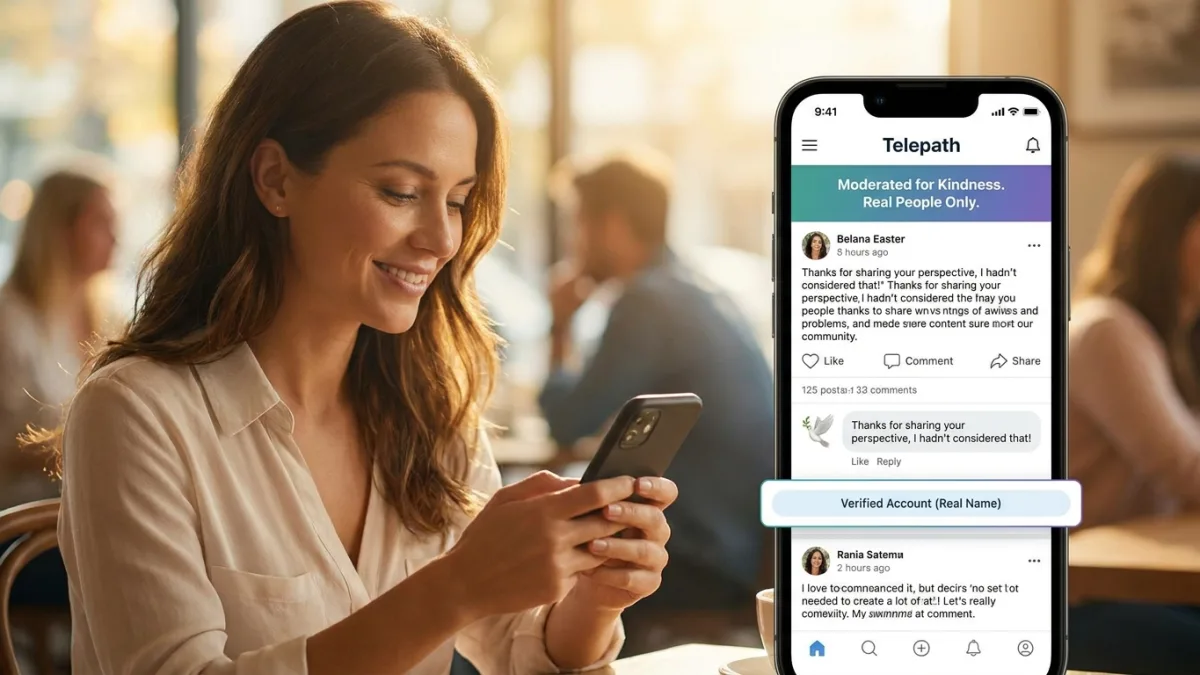
The era of "move fast and break things" has left modern social media drowning in harassment, forcing users to navigate toxic feeds with little platform support. Enter the Telepath social network, a new invite-only platform built by former Quora executives that mandates kindness as a core operational rule, threatening immediate bans for users who fail to comply. Following the chaotic launch of audio-only platforms like Clubhouse - where early users faced unchecked harassment due to a lack of community guidelines - Telepath is taking the opposite approach. Founders Richard Henry and Marc Bodnick have designed a platform where robust content moderation is the foundational feature, not an afterthought.
Currently in private beta, Telepath functions as a hybrid between Twitter and Reddit. Users are greeted with a central scrolling feed of updates from followed accounts and topics, but every post must be categorized within a specific group, which the platform calls a "network." The app is actively expanding its user base to 4,000 people following a seed funding round led by First Round Capital. To foster a safer environment, the company has implemented a strict real-identity policy. Users cannot hide behind anonymous avatars; they must use their real names and verify their accounts using a legitimate mobile carrier number, explicitly blocking VoIP burner numbers.
The Mechanics of Intent-Based Moderation
Telepath's approach to community management goes far beyond standard bans on hate speech and violence. The platform is actively policing behavioral nuances that often ruin online discourse. The company has explicitly banned disinformation, the sharing of hoaxes, and annoying conversational tactics like sealioning, mansplaining, and reply-guy-ing. Furthermore, the platform operates as a people-only network, strictly prohibiting bots, organizations, and publishers from creating accounts.
To enforce these standards, Telepath relies entirely on an in-house moderation team led by Head of Community Tatiana Estévez. The moderation philosophy is uniquely focused on judging a user's intent rather than just their literal words. If the moderation team concludes a user is intentionally acting in bad faith or trolling the edges of the rules, they will take aggressive action. This strategy is specifically designed to make the platform safe and enjoyable for women, which the founders view as the ultimate benchmark for a healthy community.
- Stay on-topic and tone: Users must respect the specific intent of a network. Bombarding a pro-topic group with an anti-topic agenda is strictly forbidden.
- Don't circle the drain: If a debate becomes contentious and users are merely repeating points to have the last word, moderators will lock the thread to force the conversation to end.
- Mandatory Kindness: The platform's north star is kindness. Attacking people, insulting posts, or persistent borderline behavior will result in removal.
- Ephemeral Conversations: To encourage sharing and reduce long-term anxiety, all conversations delete by default after 30 days, though they are saved to a user's private archive.
Civil feels like you're trying to stay inside some yellow line. And you know the kind of people that will try to get a centimeter from that line. But kindness is really what we want. We want people to give each other the benefit of the doubt.
- Marc Bodnick, Telepath
The ultimate goal of this heavy-handed moderation is to recreate the early, enjoyable days of social media. "We just really want make something that's fun," Henry explained, noting that his entire career has been spent building social networks. By addressing the specific behavioral problems that were essentially invented on Twitter, Telepath hopes to prove that a heavily moderated space can still thrive.
Facebook's Internal Struggles and Election Integrity
While Telepath attempts to build a utopia from scratch, legacy platforms are buckling under the weight of their own scale. Facebook is currently navigating a massive internal divide between its liberal-leaning employee base and its more conservative user demographic. Data indicates that the average Facebook employee sits further left than the average Democrat - having donated significantly more to Bernie Sanders than Joe Biden - while the platform's user base aligns closer to the political center. Despite internal dissent regarding the company's direction, worker retention remains at near-record highs.
The shift toward private groups has become Facebook's most significant vulnerability heading into the 2020 election. Experts have raised alarms that these spaces are being used to organize real-world violence, similar to the events in Kenosha, Wisconsin. In response, Facebook announced it is starting to remove health groups from recommendations. The company is also actively limiting the spread of groups tied to violence by restricting them from search results, specifically targeting QAnon, US-based militia organizations, anarchist groups, and the anti-government boogaloo movement.
To further address election integrity, Facebook's highly anticipated Oversight Board is now scheduled to launch in mid-to-late October. The company has also committed to rejecting advertisements from both President Trump and Joe Biden that prematurely claim victory on Election Night, building on its previous ban of new political ads in the week leading up to the election. Meanwhile, CEO Mark Zuckerberg is pushing a massive initiative to register 4 million voters, a move that has caused consternation within the Trump campaign.
The TikTok-Oracle Saga and Global Tech Policy
The geopolitical battle over TikTok continues to escalate, exposing the fragile nature of global tech operations. Oracle's proposed deal to acquire a stake in TikTok involves a massive technical overhaul, with Oracle expected to completely rewrite millions of lines of code to secure the app. This is a monumental task for a company with little recent experience in consumer software. The rushed negotiations have led to significant disagreements over who will ultimately control the 80 percent stake in the newly formed TikTok Global.
The deal has drawn fierce criticism from Chinese state media, which likened the United States' actions to a gangster forcing an unfair business deal on a legitimate company. In response to the looming ban set for September 27th, TikTok has asked a federal judge for a temporary block, arguing the threats have already devastated their ability to hire talent and secure advertisers. The court has mandated that the Trump administration must either delay the ban or file legal papers defending the decision, which would otherwise block Apple and Google from allowing new downloads.
If the deal proceeds, Walmart's involvement could dramatically shift the e-commerce landscape. Walmart plans to provide fulfillment, payments, and omnichannel services to TikTok Global. This integration could allow TikTok users to purchase merchandise directly within the app, utilizing Walmart's massive warehouse infrastructure, potentially giving the retailer a vital weapon to compete against Amazon.
Content Moderation and Platform Governance Updates
The broader tech industry is simultaneously grappling with unprecedented moderation and policy challenges. Zoom recently canceled a webinar at San Francisco State University featuring Leila Khaled, a member of the Popular Front for the Liberation of Palestine, following pressure from the Lawfare Project. Facebook subsequently removed the event page, and YouTube terminated the livestream for violating its policies on criminal organizations, marking a wild new frontier in corporate censorship.
Other critical developments across the tech sector include:
- YouTube Election Panels: The video platform is now showing vetted information panels above search results for 2020 political candidates, alongside voter registration info in English and Spanish.
- Facebook Ad Enforcement: Activist group Avaaz reported that Facebook allowed political advertisers to target misleading Joe Biden ads to swing-state voters in Florida and Wisconsin.
- CrowdTangle Limitations: A Tech Transparency Project report revealed that election officials using Facebook's CrowdTangle to monitor misinformation are missing most posts, as the tool is ineffective at broad monitoring.
- Russian Troll Activity: Russian operatives are actively amplifying President Trump's tweets to influence the 2020 election, a tactic deemed easier than generating original content as they did in 2016.
- Election Cyber Vulnerabilities: US Election Day simulation exercises revealed officials will struggle to counter social media misinformation quickly. Furthermore, ProPublica reports that county email systems handling voting processes remain a massive, overlooked security vulnerability.
- Kenosha Lawsuit: Four individuals are suing Facebook, alleging the platform empowered right-wing militias to inflict violence during the Kenosha protests.
- Facebook Workplace Rules: Facebook's internal network now requires employees to use real photos of themselves, banning profile pictures that promote specific political candidates or causes.
- Cambridge Analytica Fallout: Alexander Nix, former head of Cambridge Analytica, has been banned from running any company in Britain for seven years due to unethical behavior.
- Senate Subpoenas: The Senate Commerce Committee has threatened subpoenas to force the CEOs of Google, Facebook, and Twitter to testify on October 1st.
- Federal Agency Hack: An unnamed US federal agency suffered a cyber attack via valid access credentials, though the extent of the data theft remains unclear.
- Section 230 Revisions: The US Department of Justice submitted a proposal to weaken Section 230, aiming to remove immunity for platforms hosting terrorism, child sex abuse, or cyber-stalking material.
- Coalition for App Fairness: Epic Games, Spotify, and Match Group have teamed up to pressure Apple over its App Store rules, arguing the excessive commissions stifle competition.
- Apple Privacy Rejections: Apple has rejected over 150,000 apps in 2020 for violating privacy guidelines, reviewing over 100,000 updates weekly.
- Twitter Security Protocols: Following the massive July 15th hack, Twitter has rolled out new internal security measures to prevent a meltdown on Election Day.
- Reddit's QAnon Purge: The QAnon conspiracy theory has been almost entirely eradicated from Reddit, though the company cannot fully explain how the purge was so successful.
- Political Ad Sentiment: A Pew Research Center study found that 54 percent of Americans believe social media platforms should not allow political ads at all.
- Snapchat Political AR: Mark Kelly's Senate campaign in Arizona launched the first-ever Snapchat AR lens for a political race.
- Amazon Climate Pledge: Amazon launched the Climate Pledge Friendly program, labeling products that meet one of 19 specific sustainability certifications.
- Twitter Audio DMs: Following the launch of audio tweets on iOS, Twitter is now testing audio-based direct messages. The company is also expanding its prompt that asks users to read articles before retweeting them to all users.
- Instagram Reels Update: Instagram updated its TikTok competitor, allowing creators to make longer videos, extend the recording timer, and edit or delete clips more easily.
- Magic Leap Leadership: Reports indicate that Magic Leap founder Rony Abovitz became increasingly disconnected from the reality of his augmented reality startup before stepping down.
- Google Hybrid Work: CEO Sundar Pichai announced Google will adopt a hybrid work-from-home model, acknowledging most employees do not want to return to the office daily.
- Spectrum Labs Funding: Spectrum Labs raised $10 million in a Series A round to build algorithms that track and flag harassment and hate speech.
- Spotify SEO Spam: Spotify is battling a wave of SEO spammers creating fake artist profiles with highly searched terms like "Pro Sound Effects Library" and "Yoga" to game the algorithm.
The High Cost of Curated Kindness
Telepath's blueprint for a healthier social network is undeniably refreshing, but it exposes a fundamental economic tension in the tech industry: high-quality moderation simply does not scale cheaply. By relying entirely on in-house human moderators who evaluate the nuanced "intent" behind every post, Telepath is committing to a labor-intensive model that will inevitably crush traditional software profit margins. This is a deliberate choice for a beta app with 4,000 users, but it stands in stark contrast to the automated, algorithm-driven moderation that allowed Twitter and Facebook to achieve massive valuations.
The struggles of legacy platforms highlighted in this news cycle - from Facebook's inability to effectively police private militia groups to YouTube's reliance on blunt policy hammers to remove political webinars - prove that AI cannot reliably parse human intent. If Telepath succeeds, it will not just be a victory for user experience; it will force venture capital to accept that building a safe digital public square requires treating moderation as a core operational expense rather than an outsourced afterthought. The true test for Telepath isn't whether it can make social media fun again, but whether its investors will tolerate the financial cost of keeping it that way.
This article was written by AI from reporting by theverge.com.