Laptop battery life claims rarely match reality, leaving remote workers and students tethered to wall outlets despite promises of "all-day" endurance. However, the 2026 lineup of notebooks has finally bridged the gap between marketing and real-world performance, with some models exceeding 30 hours on a single charge. By cross-referencing official manufacturer claims with rigorous testing from outlets like PCMag and CNET, a clear tier of ultra-efficient machines has emerged.
The current market leaders achieve these massive leaps not just by increasing battery capacity, but through highly efficient next-gen processors. Whether you need a budget-friendly daily driver or a heavy-duty workstation, these four laptops represent the absolute pinnacle of battery endurance in 2026.
HP OmniBook 5 14-inch
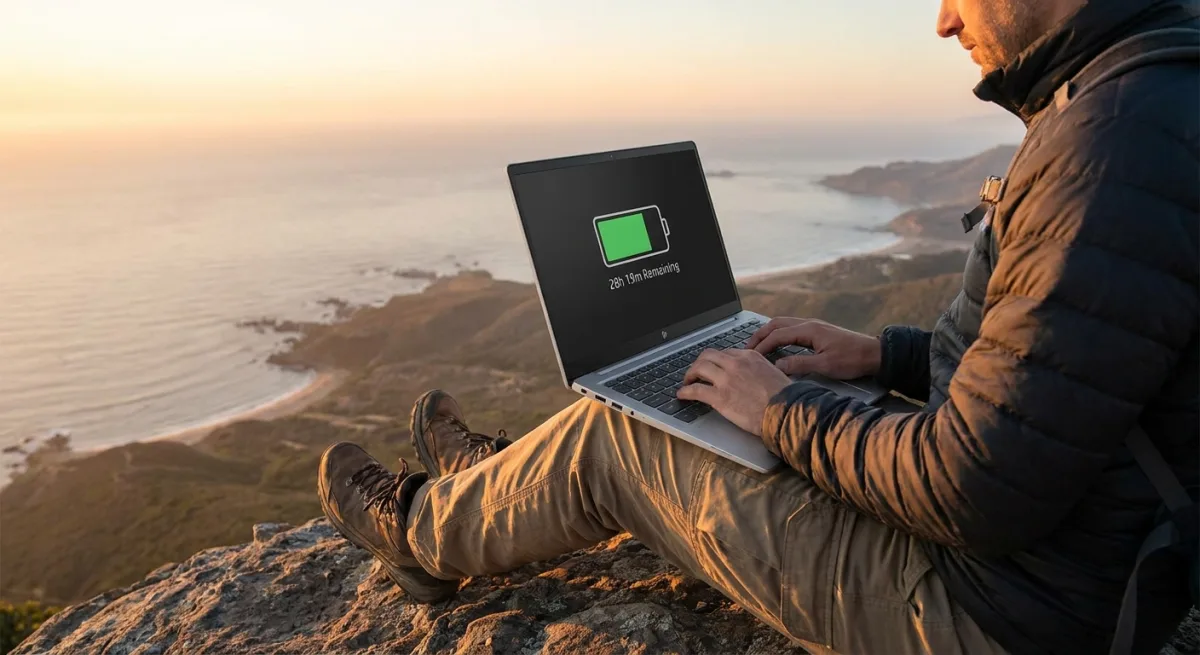
The HP OmniBook 5 14-inch is currently the undisputed champion of value and endurance. While HP officially claims up to 26 hours and 30 minutes of video playback, real-world testing has shattered those expectations. PCMag recorded a staggering 34 hours and 40 minutes of battery life, and CNET reported 28 hours and 19 minutes of continuous use. When the battery does eventually drain, fast charging technology restores it from zero to 50% in just 30 minutes.
Priced at an aggressive $799, the laptop delivers exceptional hardware for the cost, including 32 GB of RAM, a 1 TB SSD, and a crisp OLED panel. Reviewers at TechRadar noted the display covers 194.5% of the sRGB color gamut, though its peak brightness caps at 300 nits, making it better suited for indoor environments. Weighing just 2.85 pounds, it also features a 1080p webcam with a physical privacy shutter and an infrared sensor for biometric logins.
Lenovo Yoga 9i Gen 10 Aura Edition
Convertible laptops rarely dominate battery tests, but the Lenovo Yoga 9i Gen 10 Aura Edition defies that trend. Powered by the highly efficient Intel Core Ultra 7 258V processor, this 2-in-1 device delivers up to 29 hours of video playback on paper. Independent testing backs this up, with CNET recording 25 hours and 45 minutes, and PCMag logging nearly 22 hours of continuous operation.
The laptop features a robust aluminum build, with zero bending, flexing, or twisting in the lid, keyboard deck, or base plate.
- PCMag
Available for $2,399.99, the premium price tag reflects its versatile design and high-end specifications. It includes a bundled stylus, a 120 Hz OLED touchscreen, 32 GB of RAM, and a 1 TB M.2 NVMe SSD. Despite a slim 0.63-inch profile, it houses two Thunderbolt 4 ports and a unique 360-degree rotating soundbar with Dolby Atmos support, though it notably omits an SD card reader.
MacBook Pro (M5 Pro) 16-inch
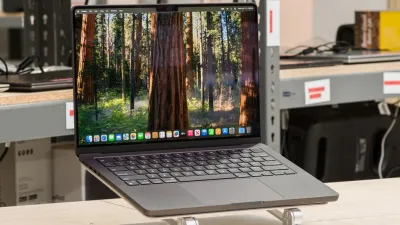
Apple continues its dominance in the premium segment with the 16-inch MacBook Pro featuring the M5 Pro chip. Priced at $2,527, it houses a massive 100-watt-hour lithium-polymer battery that Apple claims provides up to 24 hours of video streaming. Real-world benchmarks align perfectly, with CNET recording 24 hours and 59 minutes, and Tom's Guide hitting 21 hours and 10 minutes.
Equipped with an 18-core CPU and a 20-core GPU, this machine is built for heavy workloads like 3D rendering, local AI image generation, and complex data crunching. The Liquid Retina XDR display remains a standout feature, offering a 120 Hz refresh rate and up to 1,600 nits of peak brightness for HDR content. For those prioritizing battery life on a tighter budget, the M4 Pro variant with 24 GB of RAM is currently available for $1,899, offering a substantial $600 discount.
MSI Prestige 14 Flip AI Plus
The MSI Prestige 14 Flip AI Plus has redefined expectations for Windows laptops. While officially rated for 30 hours, PCMag's hands-on testing revealed an astonishing 42 hours and 6 minutes of nonstop usage, with CNET also recording a highly respectable 25 hours and 18 minutes. Priced at $1,529.99, this 2-in-1 device owes its extraordinary endurance to Intel's new Panther Lake architecture.
This is one of the first laptops to utilize Intel's 18A manufacturing process, shifting to 2 nm nodes that drastically improve power preservation and thermal management. Beyond battery life, the integrated Intel Arc B390 graphics deliver surprising gaming performance, hitting 60 frames per second in titles like Shadow of the Tomb Raider without requiring a discrete GPU. It rounds out its spec sheet with 32 GB of RAM, a 1 TB SSD, and a 60 Hz OLED display.
The 2nm Architecture Shift Changes Everything
The staggering 42-hour battery life recorded on the MSI Prestige 14 Flip AI Plus is not just an outlier; it is a glaring signal that the silicon manufacturing war has fundamentally shifted. For years, laptop manufacturers relied on software optimization and physically larger batteries to squeeze out extra hours. Now, Intel's transition to the 18A manufacturing process (2 nm nodes) proves that hardware-level efficiency is the only viable path forward for true multi-day computing.
This development puts immense pressure on Apple and AMD. While the M5 Pro chip remains a powerhouse for heavy rendering tasks, Apple's 24-hour benchmark is suddenly looking standard rather than exceptional. Furthermore, the fact that HP can offer 34 hours of real-world endurance for just $799 means that "all-day battery" is no longer a premium feature reserved for $2,000+ machines. Consumers should now view 20 hours of battery life as the absolute baseline for any new laptop purchase in 2026.