

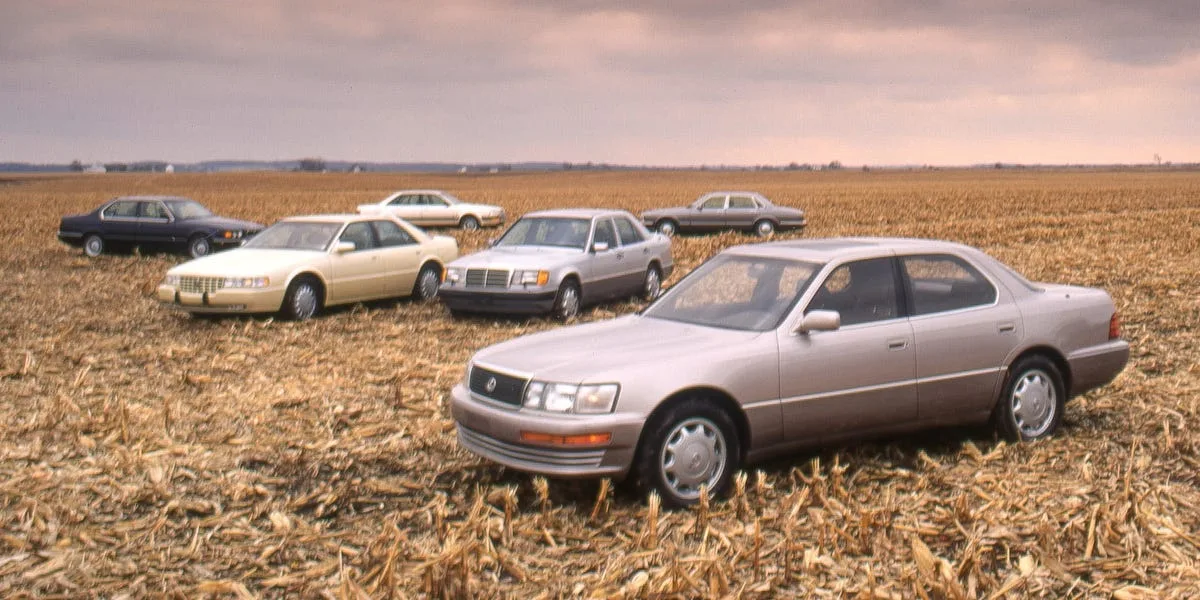
Dining at the luxury sedan table in 1993 required deep pockets and a taste for prime automotive engineering. During this era, flagship vehicles were not just modes of transportation; they were rolling status symbols designed to project wealth, taste, and technological superiority. A retrospective comparison of six heavyweights - the Audi V8 Quattro, BMW 740i, Cadillac STS, Jaguar XJ6, Lexus LS400, and Mercedes-Benz 400E - reveals a fiercely competitive landscape where manufacturers were rapidly upgrading their powertrains to win over the world's most demanding drivers.
To determine the ultimate luxury cruiser of the early 90s, these six sedans were subjected to a grueling road trip from Chicago to Galena, Illinois. The test evaluated everything from high-speed Autobahn-style stability to the tactile feel of the interior leather. The results highlight a pivotal moment in automotive history: the exact point when European automakers struck back against the Japanese disruption that had upended the market just a few years prior.
Head-to-Head: 1993 Luxury Flagship Specifications
Before diving into the driving dynamics, it is crucial to look at the raw numbers that defined this high-priced segment. The data below reflects the exact as-tested specifications and performance metrics from the original evaluation.
| Vehicle | As-Tested Price | Engine | Horsepower | 0-60 mph | Top Speed |
|---|---|---|---|---|---|
| BMW 740i | $60,251 | 4.0L V8 | 282 hp | 6.8 sec | 148 mph |
| Mercedes-Benz 400E | $63,022 | 4.2L V8 | 275 hp | 7.0 sec | 148 mph |
| Lexus LS400 | $56,524 | 4.0L V8 | 250 hp | 8.3 sec | 143 mph |
| Cadillac STS | $45,654 | 4.6L V8 | 295 hp | 6.5 sec | 143 mph |
| Audi V8 Quattro | $60,080 | 4.2L V8 | 276 hp | 7.7 sec | 126 mph |
| Jaguar XJ6 | $56,081 | 4.0L Inline-6 | 223 hp | 8.1 sec | 138 mph |
6th Place: Jaguar XJ6 - Classy but Outgunned
It may seem like heresy to place a pedigreed British icon at the bottom of the rankings, but the Jaguar XJ6 was simply outmatched by the relentless technological march of its rivals. Priced at $56,081, the XJ6 was the only car in this group relying on a six-cylinder engine. Its 4.0-liter inline-6 produced just 223 horsepower, resulting in a noticeable performance disadvantage and a lack of the refined auditory drama expected in this class.
The sound of this car reminds me of our long-term Jeep Grand Cherokee.
- Jeff Dworin, Car and Driver
Despite the powertrain deficit, the Jaguar retained its traditional charm. The ride was appropriately plush, with soft springs that smothered high-frequency surface ripples better than the stiffer German competitors. It also pulled an impressive 0.81 g on the skidpad. However, the suspension became floaty at high speeds, allowing generous body roll in fast corners. Inside, the cabin suffered from a lack of space and baffling ergonomic decisions, such as power seat controls hidden deep in the transmission tunnel at knee level.
5th Place: Audi V8 Quattro - The All-Weather Contradiction
The Audi V8 Quattro arrived with an impressive spec sheet: a new 4.2-liter V8 engine, an electronically controlled four-speed automatic transmission, and the distinct advantage of an all-wheel-drive (AWD) system. At $60,080, it was a formidable all-weather sports sedan, but it suffered from contradictory driving dynamics that compromised its luxury mission.
The 276-horsepower V8 sounded lusty and pulled hard above 3,000 rpm, but the torque converter stalled early, resulting in sluggish off-the-line acceleration (0-60 mph in 7.7 seconds). The ride was firmly restrained and occasionally gruff over coarse pavement, yet the Servotronic steering felt artificially light and disconnected. Furthermore, the braking performance was unexceptional, requiring 199 feet to stop from 70 mph. While the AWD system made it a champion in the snow, its top speed was electronically limited to 126 mph to match its V-rated tires, leaving it trailing on dry pavement.
4th Place: Cadillac STS - American Muscle in a Luxury Suit
Stepping into the Cadillac Seville Touring Sedan (STS) immediately after driving the European and Japanese models revealed a car that prioritized aggressive performance over hushed refinement. The STS was the bargain of the group at $45,654 - undercutting its closest rival by over $10,000 - yet it packed the most powerful engine in the test. The 4.6-liter Northstar V8 delivered a ferocious 295 horsepower, rocketing the heavy sedan to 60 mph in a class-leading 6.5 seconds.
However, that raw power came with significant compromises. The front-wheel-drive (FWD) architecture struggled to contain the nearly 300 horsepower, resulting in noticeable torque steer (Torque Steer) during hard acceleration. The cabin was aerodynamically noisy, and the big tires roared across rough textures, registering a loud 77 dBA at full throttle. While it lacked the ultimate poise and steering feel of its competitors, the STS offered undeniable value, massive interior space, and thrilling straight-line speed.
3rd Place: Lexus LS400 - The Paragon of Isolation
When the Lexus LS400 debuted, it shattered the luxury establishment by offering superior refinement at a massive discount. By 1993, the landscape had shifted. The strength of the yen pushed the LS400's as-tested price to $56,524 - a 32 percent increase from its 1989 debut. While it was no longer the undisputed bargain of the century, it remained an absolute masterpiece of engineering isolation.
The 4.0-liter V8 slurred through its gears so unobtrusively that the tachometer was often the only proof the transmission had shifted. The cabin was a tomblike sanctuary, recording an astonishingly low 67 dBA at full throttle. However, the optional air suspension (Air Suspension) felt disconcertingly bubbly on its Touring setting, creating a teetering motion on the open road. Ultimately, the Lexus prioritized absolute tranquility over driver involvement, which cost it points against the more engaging German sedans.
2nd Place: Mercedes-Benz 400E - The Meticulous Autobahn Cruiser
The Mercedes-Benz 400E was a masterclass in understated performance. By dropping a 4.2-liter V8 into the relatively compact W124 chassis, Mercedes created a taut, damped, and incredibly powerful sleeper sedan. At $63,022, it was the most expensive car in the test, but it was still $25,000 cheaper than its legendary sibling, the 500E, making it a compelling investment.
The driving experience was defined by deliberate, weighty controls. The throttle linkage was gradual, allowing for perfectly smooth departures, while the steering loaded up beautifully in corners. As the engine approached its 5,700-rpm peak, the 275-horsepower V8 took on a hard, exciting edge, pushing the car to 60 mph in 7.0 seconds. The suspension remained remarkably neutral even under hard mid-corner braking, delivering a sense of unshakable stability that only a 1990s Mercedes could provide.
1st Place: BMW 740i - The Ultimate Driving Machine Prevails
The BMW 740i took the crown by perfectly balancing sybaritic comfort with genuine driving thrills. The secret weapon was BMW's brilliant new 4.0-liter, 32-valve aluminum V8 engine. Paired with a five-speed automatic transmission - the only one in its class at the time - the 282-horsepower powertrain ensured the car was always in the optimal gear, delivering relentless acceleration (0-60 mph in 6.8 seconds) and a mellifluous exhaust note.
Despite utilizing an aging platform with a tall, wind-catching greenhouse, the 740i's chassis dynamics were unmatched. It offered a slightly more plush and fluid ride than the Mercedes, yet it managed to shrink its considerable mass when pushed hard through corners. The interior was incredibly roomy, heavily swathed in leather and wood, and featured an intimate, driver-focused cockpit. It was the sheer joy of driving that pushed the BMW past the Mercedes by a single point.
The V8 Arms Race That Defined Modern Luxury
Looking back at this 1993 comparison reveals the exact moment the luxury auto industry pivoted toward the modern performance era. The Lexus LS400 had previously caught the Germans sleeping, offering V8 smoothness at a six-cylinder price. This 1993 rematch proves how aggressively BMW and Mercedes-Benz retaliated. By developing highly sophisticated, multi-valve V8 engines (the 4.0L and 4.2L respectively), the European marques reclaimed their dynamic superiority, proving that absolute silence wasn't enough to win the segment - driver engagement was mandatory.
Furthermore, this test highlights the fascinating mechanical dead-end of the Cadillac STS. General Motors attempted to fight the European rear-wheel-drive standard with a massive 295-horsepower V8 routed entirely through the front wheels. While it resulted in spectacular straight-line speed and a bargain price tag, the inherent physics of front-wheel drive prevented the STS from achieving true dynamic parity. This era cemented the rear-wheel-drive V8 architecture as the undisputed gold standard for flagship sedans - a template that would remain virtually unchallenged until the dawn of the electric vehicle revolution.
