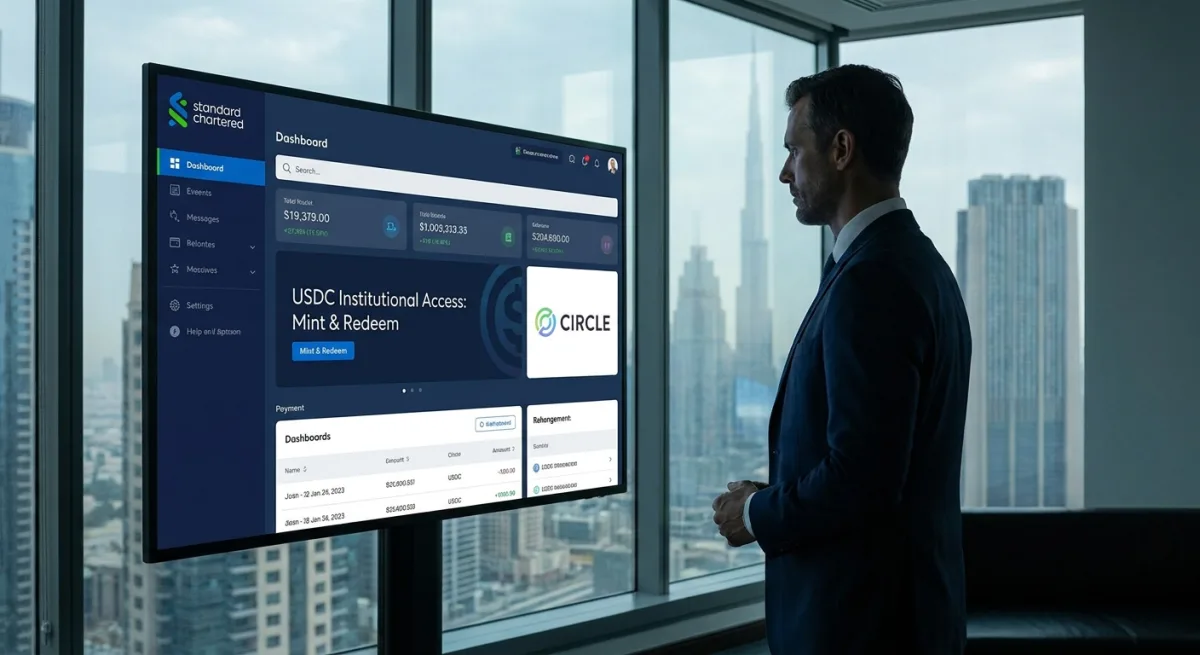
Standard Chartered has partnered with Circle to allow institutional clients to mint and redeem the USDC stablecoin directly through its banking platform. This integration marks the first time a Global Systemically Important Bank (G-SIB) has offered direct stablecoin access under traditional banking compliance and governance frameworks. Designed specifically for corporate and investment clients, the system eliminates the need to open separate accounts with Circle, streamlining the onboarding process for digital assets.
By embedding USDC access directly into its institutional offering, Standard Chartered is consolidating banking, custody, and digital asset services into a single pipeline. This capability enables clients to execute on-chain settlement, manage treasury operations, and handle liquidity management without leaving the bank's secure ecosystem. The infrastructure is also designed to support broader payment-related use cases as corporate demand for blockchain-based financial tools grows.
Initial Rollout in Dubai's Financial Hub
The service is officially launching through Standard Chartered’s operations in the Dubai International Financial Centre (DIFC). According to Standard Chartered, the bank plans to expand this capability to other global markets, contingent on regulatory approvals and specific client demand. The move highlights the increasing integration of stablecoin infrastructure into traditional banking systems, as financial institutions compete to control the distribution of digital assets.
Ultimately, this is about enabling broader institutional participation in digital asset markets through the frameworks, controls and regulatory oversight that have long supported confidence in global financial markets.
- Roberto Hoornweg, Standard Chartered
This partnership arrives during a period of intensifying competition in the stablecoin sector. Circle CEO Jeremy Allaire recently defended the network effects of USDC against emerging rivals like Open USD (OUSD). Allaire noted that while Circle works closely with many OUSD founding members, he expects them to remain significant USDC partners, underscoring the ongoing battle over distribution, liquidity, and revenue models in the digital asset space.
The TradFi Takeover of Crypto Infrastructure
This integration signals a fundamental pivot in how traditional finance (TradFi) interacts with digital assets. For years, major banks viewed stablecoins as a shadow-banking threat to be heavily regulated or avoided. Now, by bringing USDC minting directly in-house, Standard Chartered is effectively co-opting crypto infrastructure to modernize its own treasury and settlement services. This proves that the future of stablecoins relies heavily on traditional banking distribution channels, rather than replacing them entirely.
Furthermore, choosing Dubai's DIFC for the initial rollout is a calculated strategic move. While regulatory environments in the US and Europe remain fragmented or overly restrictive regarding bank-issued digital assets, the UAE has established clear, actionable frameworks for institutional crypto operations. This allows Standard Chartered to test and scale its USDC integration in a compliant, high-liquidity market before attempting to navigate the regulatory hurdles of Western financial hubs.