Three upcoming SpaceX Starlink launches and Blue Origin’s first-ever attempt to fly a reused New Glenn booster headline a packed week of six orbital missions. For telecommunications watchers and satellite internet users, this rapid launch cadence directly translates to expanded low-Earth orbit (LEO) broadband capacity and direct-to-cell connectivity. The integration of previously flown boosters across multiple companies underscores a maturing space economy where rapid reusability is the baseline for deploying massive satellite constellations.
Blue Origin’s Historic New Glenn Reuse
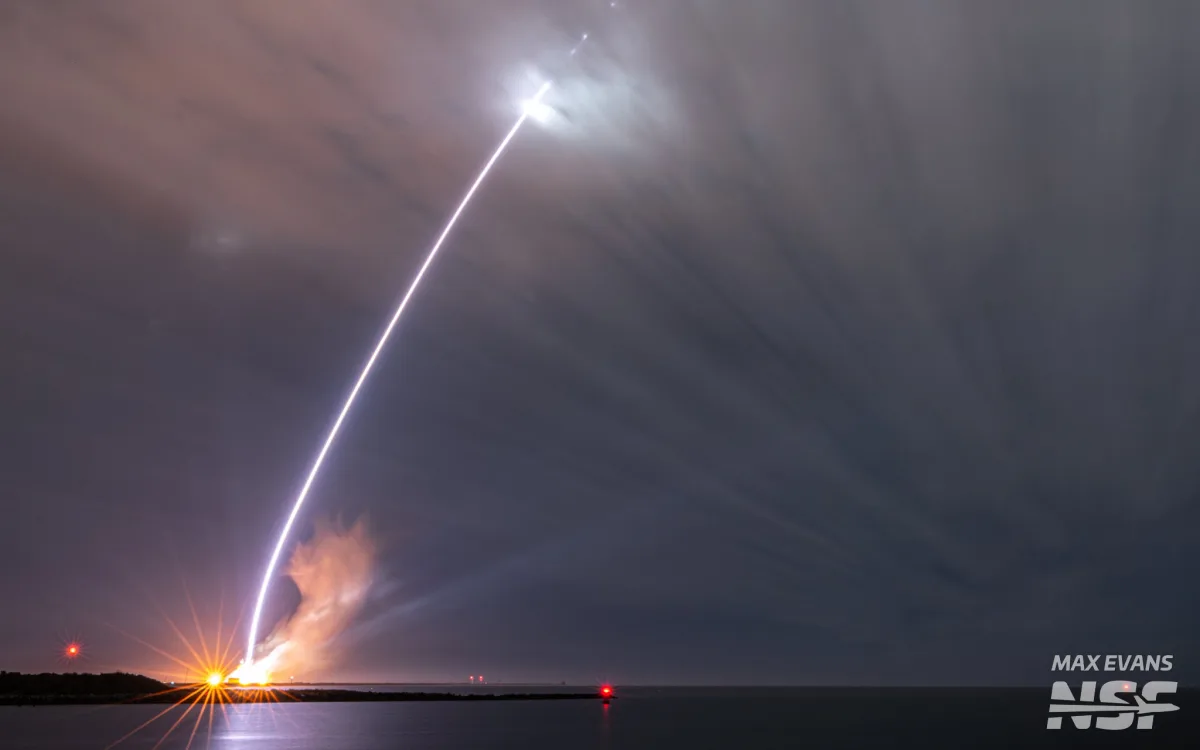
On Friday, April 17, Blue Origin will launch its partially reusable New Glenn rocket from Launch Complex 36 (LC-36) at Cape Canaveral. This mission marks a major technical milestone: the first reuse of a New Glenn first-stage booster. The booster, designated GS1-SN002 and named Never Tell Me The Odds, previously flew on New Glenn’s second mission in November 2025.
Following stage separation, the booster will attempt a landing on the recovery platform Jacklyn, stationed downrange in the Atlantic Ocean. The payload is a 6,100 kg BlueBird Block 2 FM2 satellite, also known as BlueBird 7. This massive satellite will join a growing constellation designed to provide cellular broadband services directly to mobile devices across the United States.
SpaceX Starlink Expansion
SpaceX is executing three separate Falcon 9 missions to deploy a total of 79 Starlink satellites. The first mission, Starlink Group 10-24, lifts off on April 14 from Space Launch Complex 40 in Florida, carrying 29 satellites. It utilizes booster B1080, making its 25th flight before landing on the Just Read The Instructions droneship.
Operations then shift to Vandenberg Space Force Base in California for Starlink Group 17-27 later on April 14. Booster B1082 will fly for the 21st time to deliver 25 satellites, landing on the droneship Of Course I Still Love You. A third mission, Starlink Group 17-22, concludes the week on April 18, with booster B1097 making its eighth flight to loft another 25 satellites. If schedules hold, this will mark the 630th Falcon 9 mission to date.
Other Notable Updates
- Lijian-1: A Chinese commercial launch is scheduled for April 14 from the Jiuquan Launch Center, utilizing a four-stage solid-propellant rocket to deploy an unknown payload.
- Chang Zheng 2D: Launching on April 17 from Jiuquan, this two-stage rocket utilizing hypergolic propellants will fly a southern trajectory with an undisclosed payload.
The Future of LEO Telecommunications
The simultaneous deployment of Starlink and BlueBird satellites highlights a critical shift in the telecommunications sector. Companies are no longer just launching experimental hardware; they are actively building out massive, high-bandwidth LEO networks that bypass traditional ground infrastructure. Blue Origin's deployment of the 6,100 kg BlueBird satellite specifically targets the lucrative direct-to-cell broadband market, directly challenging SpaceX's own cellular Starlink ambitions.
Furthermore, Blue Origin's successful reuse of the Never Tell Me The Odds booster will validate their operational economics, proving they can compete with the Falcon 9's relentless cadence. With SpaceX aiming for its 90th orbital launch attempt of the year by mid-April, the barrier to entry for space-based ISPs has never been lower. This rapid deployment promises consumers more robust global connectivity and will continue driving down the cost per gigabyte of satellite data.
This article was written by AI from reporting by nasaspaceflight.com.