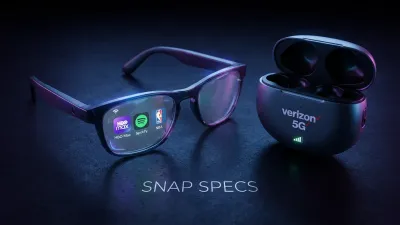
Snap Inc. SPECS are redefining the wearable tech landscape by offering a fully standalone augmented reality experience that leaves the smartphone behind. Equipped with integrated AI tools and a massive private spatial display, these AR glasses are designed to seamlessly blend digital workspaces and shared experiences into your everyday view.
Spatial Display and Dual Snapdragon Processing
The standout feature of the Snap Inc. SPECS is its spatial display, boasting a 51-degree field of view capable of rendering 16 million colors. This optical setup projects an image equivalent to a 24-inch desktop monitor or a massive 115-inch cinema screen, allowing users to work, stream, or browse without needing a laptop.
Powering this visual experience are dual Snapdragon processors. Snap has dedicated one chip entirely to computer vision and the other to running its signature Lenses. This dual-chip architecture ensures rapid hand tracking and keeps motion-to-photon latency down to an ultra-low 7 milliseconds.
Adaptive Electrochromic Design
Despite packing standalone computing power, the glasses maintain a highly wearable form factor. Constructed from durable Swiss TR90 polymer, the SPECS weigh between 132 and 136 grams, depending on the chosen frame size.
To accommodate varying lighting conditions, Snap integrated electrochromic lenses that automatically shift from clear to tinted in just 10 seconds. This rapid adaptation makes the glasses equally functional for indoor productivity and outdoor use.
Battery Life and Charging Ecosystem
Power management is a critical hurdle for standalone AR, and Snap addresses this with a robust charging ecosystem. The glasses themselves deliver up to four hours of mixed use on a single charge.
However, the included charging case holds an additional four full charges. This extends the total on-the-go battery life to an impressive 20 hours before users need to find a wall outlet.
The Standalone AR Push
Snap’s decision to make the SPECS fully standalone marks a pivotal shift in the augmented reality hardware race. By utilizing dual Snapdragon processors to eliminate the need for a tethered smartphone, Snap is directly challenging the limitations that have plagued earlier smart glasses.
The 136-gram weight is particularly significant; while heavier than standard sunglasses, it is drastically lighter than mixed reality headsets currently on the market. If Snap can cultivate a robust developer ecosystem for its Lenses, these glasses could bridge the gap between bulky VR headsets and lightweight, display-less smart glasses, offering a genuine glimpse into the future of everyday spatial computing.