Long after a nuclear reactor is powered down, its radioactive fuel continues to emit a faint, ghostly signal that easily passes through solid rock and shielding. For the first time, scientists have successfully detected this residual antineutrino flux from offline reactors, unlocking a revolutionary method for monitoring spent nuclear fuel.
This breakthrough is critical for nuclear inspectors and global security agencies. Because antineutrinos cannot be easily blocked or concealed, they provide an unforgeable way to verify reactor activity and track radioactive inventories even when a facility is completely dark.
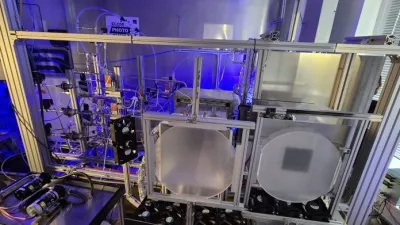
The study, published in Physical Review Letters and led by researchers at the Max Planck Institute for Nuclear Physics (MPIK), utilized the Double Chooz experiment in northern France. The detector sits underground, roughly 400 meters from the two reactor cores of the Chooz nuclear power plant.
Antineutrinos interact only extremely rarely with matter. However, when one interacts within the Double-Chooz detector, a characteristic double-light signal is produced that can be distinguished from background events.
- Thierry Lasserre, Max Planck Institute for Nuclear Physics
Inside the detector, more than 30 cubic meters of liquid scintillator wait for these elusive particles. When an antineutrino interacts, it produces a positron that generates an immediate flash of light, followed shortly by a second flash from a captured neutron. This closely timed double-flash allows scientists to filter out cosmic rays and natural radioactivity.
The 5.9 Sigma Breakthrough
To isolate this faint "afterglow," the research team analyzed 17.2 days of data collected while both Chooz reactors were completely shut down. The results were striking: the detector recorded 106 candidate events, with an uncertainty margin of 18 events.
This detection reached a statistical significance of 5.9 sigma, well above the rigorous standard required to claim a discovery in particle physics. Detailed reactor simulations had predicted 88 events with an uncertainty of seven, making the observed data a highly accurate experimental benchmark.
"Detecting the tiny residual signal after shutdown required exceptionally low backgrounds and careful analysis techniques," Dr. Anthony Onillon explained, noting that previous experiments mainly focused on operating reactors where the antineutrino flux is much larger.
A New Era for Nuclear Non-Proliferation
The implications of this measurement extend far beyond the French facility. Future detectors could use this exact methodology to independently verify reactor status worldwide. Initial results from the JUNO-TAO project, presented at Neutrino 2026, already indicate that teams are analyzing reactor-off data to isolate emissions specifically from spent fuel.
Interestingly, the Double Chooz detector was originally built to study neutrino oscillations. The facility previously helped measure the mixing angle θ13, a fundamental value in understanding the differences between matter and antimatter. Now, it has cemented its legacy by proving that a dark reactor is never truly silent.
The Ultimate Unforgeable Signature
The successful detection of a 5.9 sigma antineutrino signal from an offline reactor fundamentally alters the landscape of nuclear non-proliferation. Historically, international inspectors have relied on physical cameras, seals, and heat signatures to monitor spent-fuel assemblies in cooling pools. These conventional methods can be tampered with, spoofed, or blocked by uncooperative states.
Antineutrinos change the math entirely. Because these particles pass through shielding and rock without leaving a physical trace, a rogue state cannot hide a secret stockpile of spent nuclear fuel simply by turning off the lights and locking the doors. The radioactive decay will continue to broadcast its presence to any sufficiently sensitive detector nearby.
As next-generation detectors like JUNO-TAO come online, this benchmark from Double Chooz provides the exact mathematical foundation needed to build remote monitoring networks. In the near future, verifying compliance with international nuclear treaties may no longer require boots on the ground - just a liquid scintillator listening to the whispers of decaying atoms.