

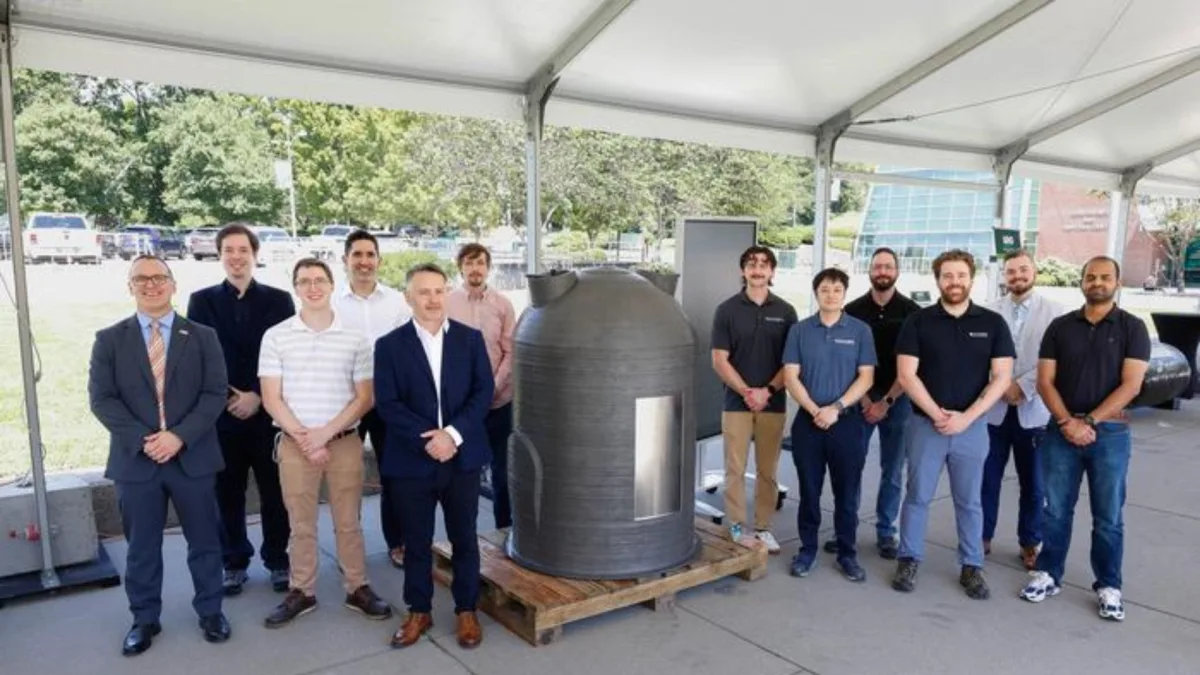
America's industrial sector is facing a critical bottleneck, with irregular supply chains and a shortage of skilled workers causing extreme delays in infrastructure projects. To combat this, researchers at the Oak Ridge National Laboratory (ORNL) have successfully deployed a giant three-armed robot named MedUSA to manufacture a 3-by-5-foot steel nuclear pressure vessel. By guiding molten steel into place, the system demonstrated how heavy 3D printing can bypass traditional manufacturing hurdles.
The breakthrough was showcased during the Materials and Manufacturing Innovation Days (M2IND), an event that gathered over 350 leaders from the energy, manufacturing, and technology sectors, alongside representatives from four Department of Energy offices. The primary objective was to identify ways to remove administrative and technical obstacles, turning laboratory innovations into factory-floor realities before critical infrastructure timelines collapse.
Currently, acquiring major custom components for sectors like hydropower can take over ten years. Standard reactor vessels rely on large-scale forging and welding, processes that are severely constrained by domestic capacity limits in the United States. The 3D-printed vessel serves as a direct test case to evaluate additive manufacturing as a viable, high-speed alternative.
We want to make sure we have input from industry to help guide our research and ensure that the work at Oak Ridge and the Manufacturing Demonstration Facility (MDF) is valuable to U.S. manufacturers and takes into account the supply chains needed to commercialize new technologies.
- Ryan Dehoff, MDF Director
Replacing Traditional Materials with Polymer Models
Beyond the steel pressure vessel, the ORNL event featured a second massive 3D-printed nuclear energy structure. In collaboration with the University of Maine, researchers printed a 12-foot model of an impact limiter using a glass-fiber polymer.
This massive component is designed to protect spent nuclear fuel shipping containers during transport. By utilizing strong plastic polymers instead of traditional wood designs, the team aims to enhance durability while simultaneously reducing reliance on standard material supply chains.
The Shift from Physical Printing to Digital Qualification
While printing a complex domed geometry is a significant engineering feat, forum participants emphasized that manufacturing the part is only half the battle. Getting these 3D-printed components certified for real-world use is where momentum typically stalls, as regulatory bodies require extensive proof of safety and reliability.
To bridge this gap, ORNL announced a joint research effort with the Idaho National Laboratory to standardize digital qualification methods across different facilities. Researchers plan to utilize real-time sensors, machine learning, and defect-tracking algorithms during the actual build process.
This data-driven approach is designed to give regulators the exact metrics needed to certify 3D-printed nuclear and energy components in months rather than years. New partnerships with energy titans like SLB and Kairos Power have already been signed to accelerate this transition.
The Regulatory Data Bottleneck
The true paradigm shift happening at ORNL isn't just the physical extrusion of molten steel - it is the attempt to rewrite how the nuclear industry handles compliance. By integrating machine learning and real-time defect tracking directly into the MedUSA robot's build process, ORNL is trying to replace post-production physical testing with in-situ digital verification.
If successful, this will force regulatory bodies to adapt to algorithmic safety proofs rather than traditional metallurgical stress tests. However, the nuclear sector is notoriously conservative. Even with backing from SLB and Kairos Power, the challenge will be convincing regulators that sensor data from a 3D print is as trustworthy as a physically forged and X-rayed steel vessel.
If the digital qualification framework fails to gain regulatory approval, these robotic advancements will remain confined to the laboratory floor, leaving the U.S. grid vulnerable to the same decade-long supply chain delays it currently faces.
