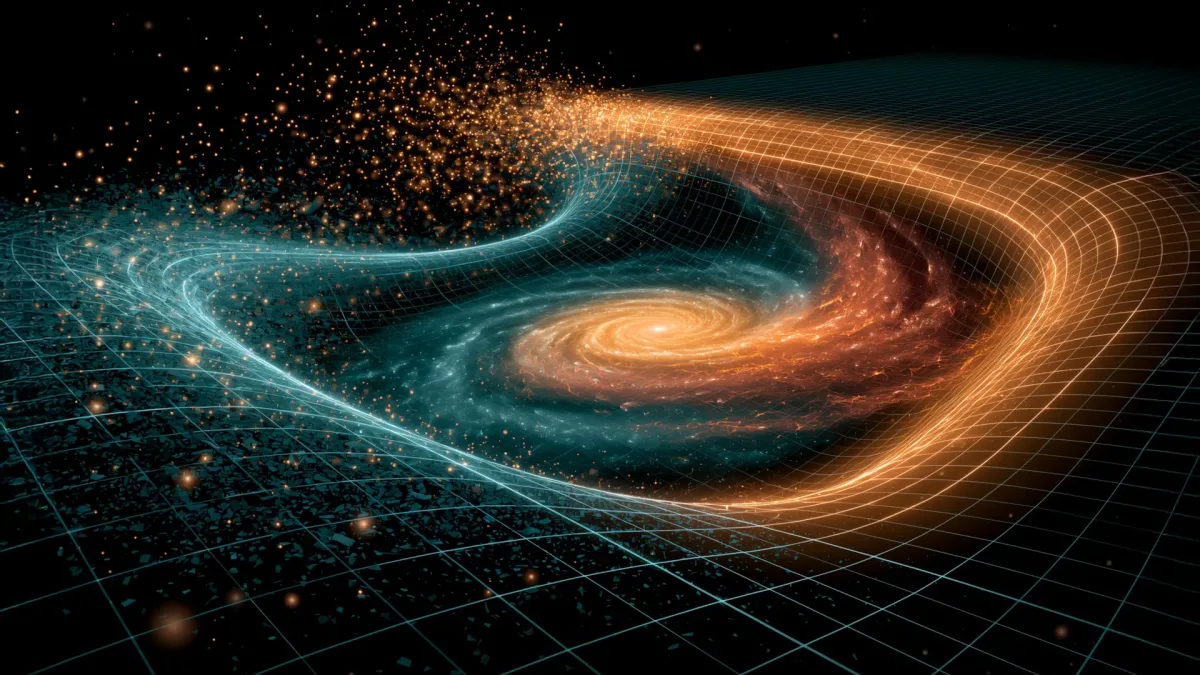
How did the Universe manage to forge intricate galaxies, planets, and eventually living organisms while strictly obeying the second law of thermodynamics? This fundamental paradox - that total entropy, or disorder, must always increase - has baffled cosmologists for decades. Now, a new theoretical framework called Gravity from Entropy (GfE) suggests that the emergence of cosmic complexity is not a violation of physical laws, but a natural byproduct of an expanding spacetime.
Led by Professor Ginestra Bianconi at Queen Mary University of London and published in the journal Physical Review D, the research reexamines the origins of gravity. Instead of treating gravity merely as a fundamental force or the curvature of spacetime, the GfE theory posits that gravity emerges from the microscopic, quantum-level properties of spacetime geometry. It builds upon the 1970s discoveries by Jacob Bekenstein and Stephen Hawking, which first proved that black holes possess entropy and emit thermal radiation, linking gravity directly to thermodynamics.
The breakthrough in Bianconi's analysis lies in a crucial volumetric distinction. While the second law dictates that the Universe's total entropy must increase over time, the GfE framework reveals that the amount of entropy per unit of volume actually decreases as the Universe expands. This localized drop in entropy density provides the exact thermodynamic conditions required for highly organized structures - from star systems to biological life - to develop locally without breaking the overarching rules of the cosmos.
The Dark Energy Connection
Under standard, low-energy conditions, the equations of Gravity from Entropy perfectly mirror General Relativity. However, when pushed to extreme cosmological limits, the theory produces a dynamic, changing dark energy contribution. In this model, dark energy acts as the internal energy of the Universe, while a metric known as Quantum Geometric Relative Entropy (QGRE) represents the local entropy per unit of volume.
This mathematical relationship suggests that the quantum state underlying gravity has an inherent thermal character, naturally giving rise to effective temperature and pressure. As the Universe's volume grows, total entropy is spread increasingly thin across expanding space, allowing localized pockets of extreme complexity to flourish.
This work reveals how the Gravity from Entropy theory can tackle the challenging question to reconcile the second principle of thermodynamics with the emergence of complexity in our Universe.
- Ginestra Bianconi, Professor, Queen Mary University of London
The Thermodynamic Blueprint for Life
If the Gravity from Entropy framework holds up to observational scrutiny, it fundamentally rewrites our understanding of cosmic evolution. By framing dark energy not just as a mysterious repulsive force, but as a dynamic thermodynamic component of spacetime itself, researchers can now test these predictions against large-scale cosmological observations.
More importantly, this theory shifts the philosophical baseline of astrobiology. Life and complexity are often viewed as fragile anomalies fighting an uphill battle against the Universe's inevitable march toward thermal equilibrium. Instead, GfE suggests that the expansion of the Universe acts as a pressure-release valve for entropy. The very act of cosmic expansion creates the localized thermodynamic "safe zones" required for matter to organize. In this view, the emergence of complex life is not a cosmic accident, but a mathematically inevitable feature of quantum gravity.
This article was written by AI from reporting by sciencedaily.com.