Physicists have successfully utilized advanced quantum simulators to experimentally verify a 40-year-old mathematical framework known as conformal field theory. By manipulating chains of strontium atoms, researchers directly measured the precise energy levels of synthetic quantum matter at the critical point of phase transition, proving decades-old predictions about universal quantum behavior.
At the exact moment matter changes phases - such as water boiling or a magnet losing its pull - drastically different materials begin following identical mathematical rules. Physicists call this phenomenon "universality," where microscopic details vanish and only essential features remain. For roughly 40 years, scientists have relied on conformal field theory to predict the precise ratios separating energy levels during these transitions, but these spacings had never been measured experimentally until now.
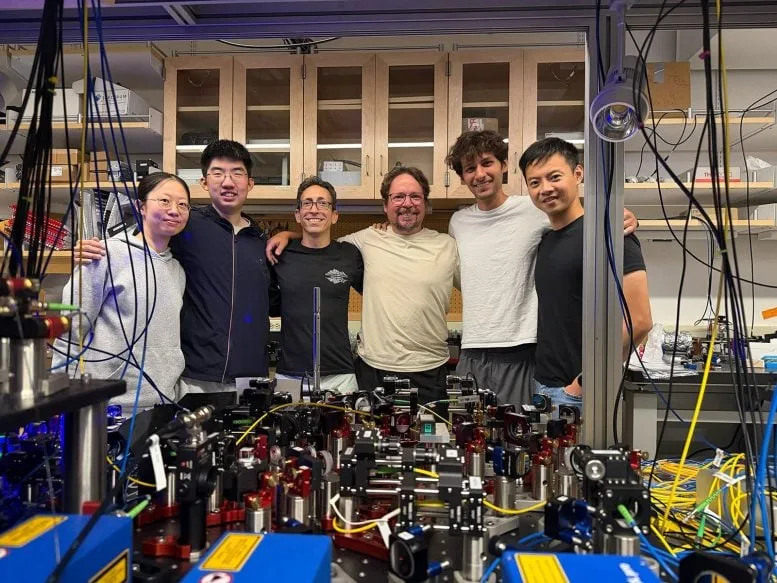
In a breakthrough published in Nature, researchers from Caltech, Université Paris-Saclay, and the Technical University of Munich built a specialized quantum system to test these theories. The team used technology originally developed for quantum computing, specifically arrays of neutral atoms held in place by laser beams known as optical tweezers. A related system in the Caltech lab recently trapped 6,100 atoms in a single array.
The experiment arranged up to 35 strontium atoms in a line, using additional lasers to push them into high-energy Rydberg states. This caused neighboring atoms to interact strongly, making the entire chain behave collectively. The researchers then adjusted the lasers until the system reached the critical point predicted by the Ising and tricritical Ising conformal field theories - models that describe universal behavior when a quantum system reaches a critical point near absolute zero.
To measure the energy levels, the team developed a technique called many-body modulation spectroscopy. By gently driving the atomic chain with varying laser frequencies and recording the atoms' responses, they reconstructed the energy ladder. The process is similar to rubbing a wet finger around a wine glass, which resonates only at the correct frequency.
"We repeated the experiment on chains of up to 35 atoms, and the rungs came out as predicted by the Ising conformal field theory: the spectra collapsed onto a single universal curve once rescaled for size," explained Xiangkai Sun, a co-lead author of the study. By sorting the excitations by their symmetry, the team also exposed a second family of hidden energy levels, further validating the tricritical Ising theory.
The next step is to point this at systems where nobody knows the response of the system quantitatively - including regimes that classical computers can't reach.
- Manuel Endres, Caltech
The full findings and methodology are detailed in the official DOI: 10.1038/s41586-026-10904-x publication.
Beyond 1D: The Quantum Leap into Uncharted Physics
This experiment marks a fundamental shift in how we use quantum technology. For the past decade, quantum simulators have largely been viewed as stepping stones toward fully fault-tolerant quantum computers. However, this Caltech study proves that these simulators are already mature enough to function as discovery engines for fundamental physics, capable of testing mathematical frameworks that have remained purely theoretical since the 1980s.
The real implication lies in the team's next target: expanding from one-dimensional chains to two-dimensional grids. In 1D, physicists already knew the answers conformal field theory would provide, allowing them to calibrate and verify the simulator's accuracy. In 2D, the math breaks down, and classical supercomputers lack the processing power to simulate the quantum states.
By pointing these optical tweezer arrays at 2D systems, researchers will transition from verifying old math to discovering entirely new physics. This could accelerate the discovery of exotic phases of matter, potentially unlocking new materials for superconductors or advanced sensors that are currently impossible to model on traditional silicon hardware.
This article was written by AI from reporting by scitechdaily.com.