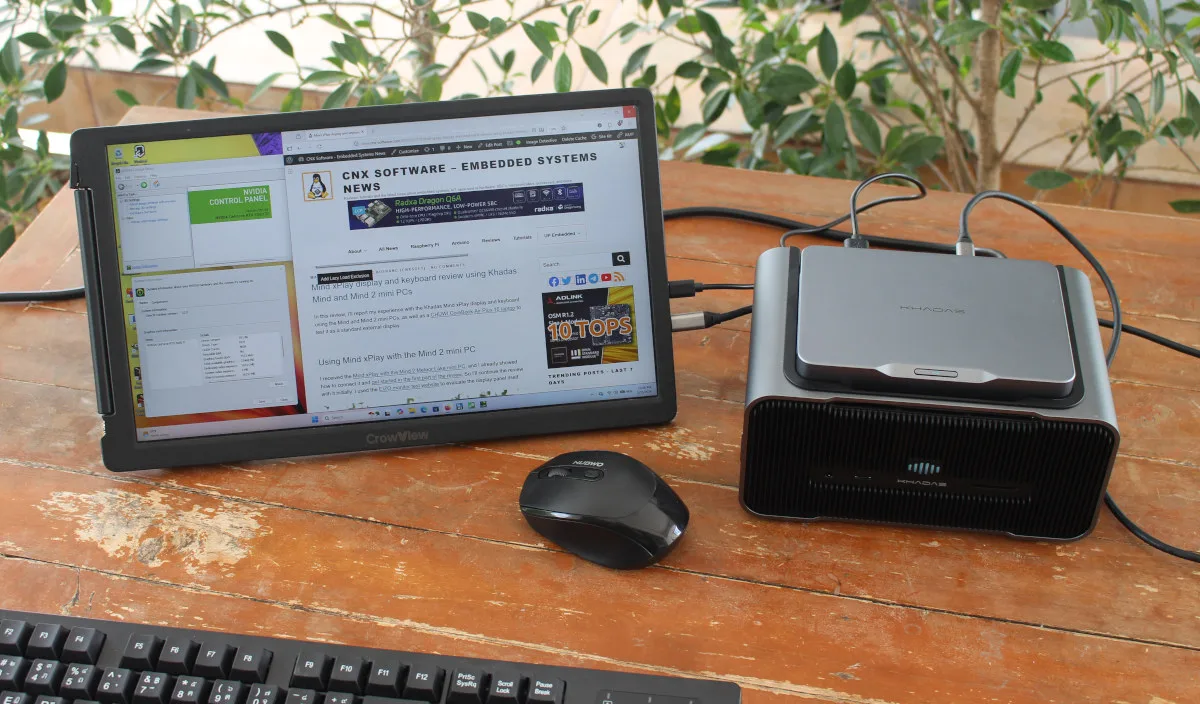
The quest for desktop-class performance in a mini PC form factor often ends in thermal throttling or weak integrated graphics. The Khadas Mind Graphics 2 dock solves this by pairing a modular NVIDIA GeForce RTX 5060 Ti with the Mind 2 mini PC, transforming a portable workstation into a high-end gaming and AI powerhouse. Designed for power users, AI developers, and gamers who demand modularity, this setup enables seamless transitions between on-the-go productivity and heavy 3D rendering at home.
As AI workloads and AAA games demand increasingly massive VRAM, modular eGPU solutions are becoming the ultimate bridge for ultra-compact systems. By utilizing the proprietary Mind Link (PCIe x8) connector, Khadas aims to bypass the traditional bandwidth bottlenecks associated with Thunderbolt-based enclosures, unlocking the full potential of the Intel Core Ultra 7 155H processor.
How to Fix Initial Driver and Display Issues
When first connecting the Mind Graphics 2 dock to the Mind 2 mini PC, the NVIDIA GeForce RTX 5060 Ti may be detected but disabled, displaying a device error in Windows. Additionally, the HDMI output from the dock might fail to produce a signal out of the box. To resolve this, you must bypass the dock temporarily by connecting your display directly to the USB-C DP port on the Mind 2 mini PC.
Once connected, open the Mind app on the mini PC and upgrade the dock's firmware to version 1.9. More importantly, you must download and install the specific patch (khadas-nv-43-fix.zip) from the official Khadas drivers page. After applying the patch, the Device Manager will correctly recognize the RTX 5060 Ti, the built-in speakers, the 2.5Gbps Ethernet port, and the Realtek USB 3.0 card reader.
3D Graphics and Gaming Benchmarks
The addition of the RTX 5060 Ti delivers a massive 4x to 6x performance leap over the integrated Intel Arc graphics found in the Core Ultra 7 155H. In the 3DMark Fire Strike benchmark, the eGPU setup scored an impressive 30,659 points, earning an "Excellent" rating, compared to a mere 7,444 points in standalone mode. The more demanding Steel Nomad test saw a jump from 651 to 3,487 points.
For real-world gaming performance, the Final Fantasy XV benchmark was run at Standard Quality (1080p). The standalone mini PC managed a standard score of 3,487 points, but once docked, the system skyrocketed to 15,542 points, achieving an "Extremely High" performance rating. Even with all custom settings maxed out, the dock maintained a "High" rating with 6,028 points.
AI Workloads and MLPerf Performance
Local AI models see significant acceleration, with the NVIDIA GPU yielding about 5x higher performance in terms of tokens per second compared to the integrated NPU. Using MLPerf Client 1.6.1, the Llama 3.1 8B Instruct model hit 73.9 tokens per second, while the Phi 3.1 Mini Instruct model reached a blistering 116.4 tokens per second.
Geekbench AI testing revealed 2.5x to 3x performance gains in single and half precision. However, the quantized (INT8) score of 16,329 points was surprisingly lower than the 19,698 points achieved by the Intel GPU using OpenVino. This discrepancy is likely due to DirectML's current handling of NVIDIA INT8 support rather than a hardware limitation.
Performance Comparison: Intel Arc vs. RTX 5060 Ti
| Benchmark | Mind 2 (Standalone) | Mind 2 + Graphics 2 Dock | Performance Ratio |
|---|---|---|---|
| 3DMark Fire Strike | 7,444 | 30,659 | 4.12x |
| 3DMark Steel Nomad | 651 | 3,487 | 5.36x |
| Unigine Superposition | 3,817 | 24,895 | 6.52x |
| Final Fantasy XV | 3,487 | 15,542 | 4.46x |
| MLPerf Llama 3.1 8B (TPS) | 14.6 | 73.9 | 5.06x |
| MLPerf Phi 3.1 Mini (TPS) | 25.5 | 116.4 | 4.56x |
Connectivity, Audio, and Port Limitations
The dock is equipped with excellent built-in stereo speakers that continue to function even when the displays are turned off, alongside a dual-mic array and a fingerprint reader for automatic sign-in. Quad-display setups work flawlessly by utilizing the dock's HDMI 2.1 and DisplayPort connections in tandem with the mini PC's USB-C port.
However, the rear 40 Gbps USB-C port fails to recognize Thunderbolt mass storage devices when connected via the Mind Link, and it does not successfully fallback to 10 Gbps USB speeds as intended. Furthermore, while the 2.5GbE port handles unidirectional transfers perfectly at 2.35 Gbps, its performance collapses during full-duplex bidirectional tests, dropping to just 196 Mbps on the receiving end.
The High Price of Modular Freedom
The Khadas Mind Graphics 2 successfully delivers on the promise of modular computing, turning a 1.1-liter mini PC into a machine capable of running Llama 3.1 locally and maxing out modern games at 1080p. The engineering behind the PCIe x8 Mind Link is genuinely impressive, bypassing the traditional bandwidth bottlenecks that plague standard Thunderbolt eGPUs and providing a seamless desktop experience.
Yet, this modularity comes at a steep premium. At $1,349 for the dock alone, and nearly $2,450 for the complete Mind 2 system, buyers are paying a massive "miniaturization tax." While the performance multiplier is undeniable, the niche appeal is limited to professionals who absolutely require a single compute core that travels between a laptop shell and a desktop GPU dock. For most users, buying a dedicated high-end desktop and a separate ultrabook for the same total price remains the more practical choice.
This article was written by AI from reporting by cnx-software.com.