The GitLab DevOps platform is undergoing a massive overhaul to handle the unprecedented volume of code generated by artificial intelligence tools. Announced at the Transcend 2026 conference, these updates are designed to help software engineering and DevSecOps teams regain control over their workflows. As AI coding agents become more autonomous, organizations are increasingly struggling with cost overruns, security vulnerabilities, and pipeline chaos.
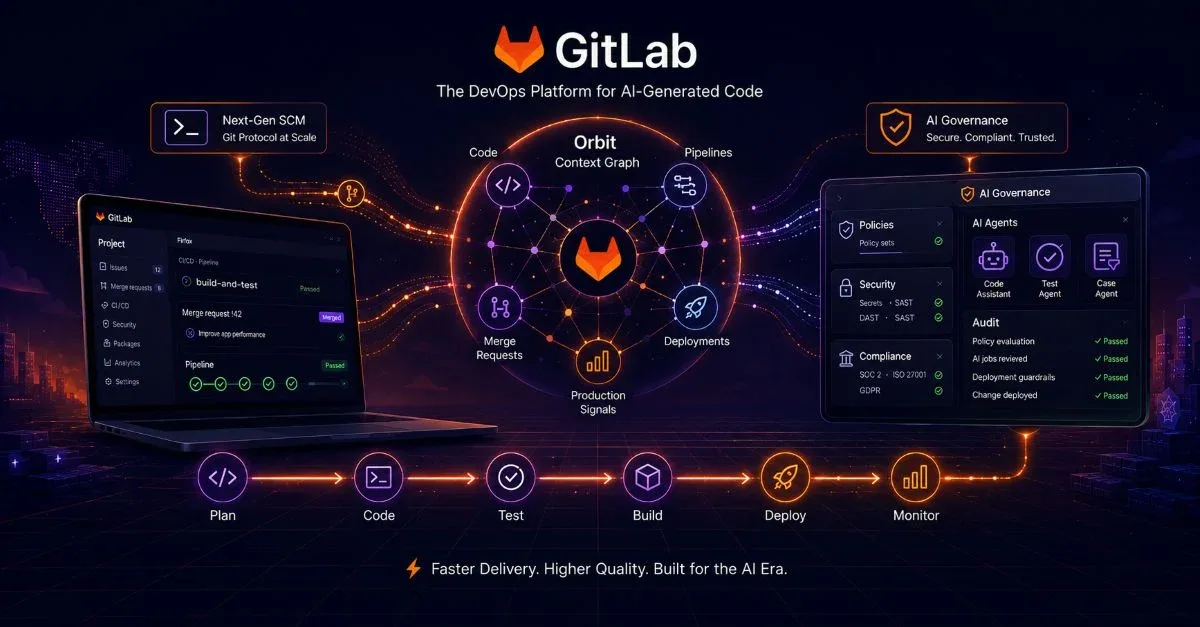
To address these bottlenecks, GitLab introduced its Next Generation Source Code Management system. This revamped implementation of the Git protocol utilizes a distributed architecture for processing and storage. According to Manav Khurana, Chief Product and Marketing Officer at GitLab, this upgrade allows AI agents to complete tasks 50 times faster by limiting server-side queries strictly to what each specific task requires.
GitLab Orbit and Token Optimization
A major highlight of the event is the public beta launch of GitLab Orbit, a context graph that maps code, work items, pipelines, deployments, and production signals. This mapping allows AI coding tools to query the entire DevOps lifecycle far more efficiently.
In the current landscape of generative AI, token consumption directly correlates with enterprise costs. Khurana noted that GitLab Orbit can deliver responses 11 times faster while requiring up to 4.5 times fewer tokens. This drastic reduction in token usage is critical for teams looking to scale their AI operations without breaking their IT budgets.
Governing the AI Workforce
Speed and cost are only part of the equation; security remains the ultimate hurdle for autonomous code generation. To solve this, GitLab is rolling out an AI Governance framework, currently in private beta. This system assigns a distinct identity, a policy path, and an audit record to every single action taken by an AI agent.
DevSecOps teams now have real-time visibility into an agent's inputs, reasoning, tool calls, and any anomalous patterns across the organization. Administrators can enforce strict policies, such as mandatory code scans, across the entire workflow before any AI-generated code reaches a production environment.
GitLab’s Transcend updates attach identity, policy, and an audit record to every agent action, shifting the platform from automating pipelines to governing the agents inside them.
- Mitch Ashley, VP of Software Lifecycle Engineering, The Futurum Group
To support this shift, the company also introduced GitLab Flex. This new licensing model combines traditional user seats and AI credits into a single annual commitment. DevOps teams can dynamically shift their spending between human seats and AI compute as their needs evolve, eliminating the friction of constant contract renegotiations.
Treating AI as a Synthetic Employee
The announcements at Transcend 2026 signal a fundamental shift in how the industry views artificial intelligence. By introducing the AI Governance framework, GitLab is no longer treating AI as just a smart autocomplete tool; it is treating it as a "synthetic employee" that requires the exact same zero-trust auditing and policy enforcement as a human developer. This is a critical evolution for enterprise security.
Furthermore, the combination of GitLab Orbit's token reduction and the GitLab Flex licensing model highlights the hidden crisis of the AI boom: unpredictable API costs. While competitors focus heavily on raw code generation speed, GitLab is addressing the operational reality that autonomous agents can quickly drain budgets if left unchecked. By bounding AI autonomy with strict visibility and financial controls, GitLab is positioning its platform as the necessary control plane for the next decade of software engineering.