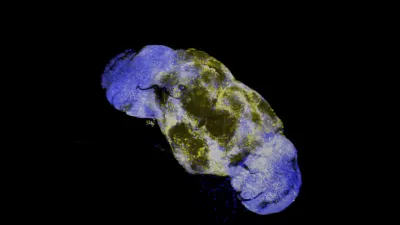
Astronomers have successfully detected a globular cluster stellar stream outside the Milky Way for the first time, unlocking a powerful new method for mapping dark matter across the universe. Found within the ultra-diffuse galaxy UGC9050-Dw1, this faint ribbon of stars provides a rare glimpse into the invisible mass that shapes cosmic evolution.
These stellar streams are long, coherent structures of stars that preserve the evolutionary history of a galaxy. Because they produce very little light, they have historically been impossible to spot beyond our own galaxy. However, recent improvements in large astronomical datasets and analysis methods have turned these faint structures into highly effective tools for tracing dark matter.
Not only can we now search for globular cluster stellar streams in other galaxies, but in the long term, we may also be able to measure the dark matter content of more ultra-diffuse galaxies.
- Sarah Pearson, Associate Professor, DTU Space
Tracking the Globular Cluster Stellar Stream in UGC9050-Dw1
The research team, led by PhD student Julie Kiel Holm of the Niels Bohr Institute and Associate Professor Sarah Pearson of DTU Space, focused their efforts on UGC9050-Dw1. This ultra-diffuse galaxy is inherently faint, making the detection of an even fainter globular cluster stellar stream a significant observational feat. By analyzing the stream's behavior, the researchers could estimate both the distribution and total mass of the galaxy.
Their analysis confirmed that UGC9050-Dw1 contains substantial amounts of dark matter, aligning perfectly with existing theoretical expectations for ultra-diffuse galaxies. The findings, which prove that this mapping technique works beyond our local cosmic neighborhood, were officially published in the journal Nature (DOI: 10.1038/s41586-026-10878-w). The study received funding from the Villum Foundation and the European Research Council.
The Next Era of Extragalactic Observation
The discovery in UGC9050-Dw1 is not just a singular anomaly; it represents a fundamental shift in how astrophysicists will weigh distant galaxies. Until now, our understanding of how dark matter interacts with stellar streams was strictly confined to the Milky Way, limiting our models to a sample size of one. This breakthrough proves that a well-established local tool can be exported to the wider universe.
With next-generation observatories like the Euclid Space Telescope and the Nancy Grace Roman Space Telescope coming online, this proof-of-concept technique will likely be deployed at scale. By comparing stellar streams across diverse galactic environments, researchers can finally test whether dark matter behaves uniformly across the cosmos or if its properties shift depending on the host galaxy's unique structure.