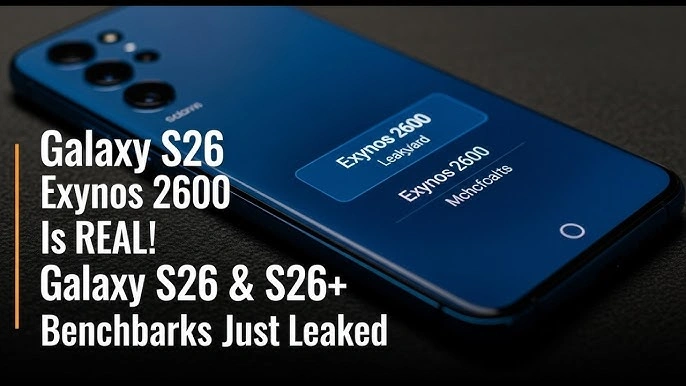
Exynos 2600 Emerges as Galaxy S26 Powerhouse
Samsung's latest Exynos 2600 chipset has posted Vulkan GPU benchmark scores that directly match Qualcomm's flagship Snapdragon 8 Elite Gen 5, positioning it as a top contender for the upcoming Galaxy S26 series. This parity in graphics performance, combined with efficiency gains from its 2nm process, suggests Samsung's in-house silicon could finally rival or surpass external suppliers in key areas.
Breakdown of Exynos 2600 Architecture
The Exynos 2600 is built on Samsung's industry-first 2nm Gate-All-Around (GAA) process node, enabling 25-30% better power efficiency over the 3nm Exynos 2500 launched in June 2025. Its deca-core CPU configuration includes one Arm C1-Ultra prime core at 3.8GHz, three C1-Pro high-performance cores at 3.25GHz, and six efficiency-focused C1-Pro cores at 2.75GHz. This setup delivers 39% higher CPU performance than its predecessor, with enhanced instructions-per-clock (IPC) for responsive multitasking.
The star of the show is the Samsung Xclipse 960 GPU, rumored to leverage AMD's RDNA4 architecture. It offers double the compute power and 50% better ray tracing compared to the Exynos 2500's Xclipse 950 (RDNA3-based). Early ray tracing benchmarks indicate the Exynos 2600 outperforms the Snapdragon 8 Elite Gen 5 by 10-15%, critical for gaming and high-end visuals.
- CPU: 1x C1-Ultra (3.8GHz) + 3x C1-Pro (3.25GHz) + 6x C1-Pro (2.75GHz)
- GPU: Xclipse 960 with advanced ray tracing
- Process: 2nm GAA for superior efficiency
- Memory: LPDDR5X RAM, UFS 4.1 storage
Benchmark Showdown: Vulkan and Beyond
In Vulkan GPU tests, the Exynos 2600 achieves scores on par with the Snapdragon 8 Elite Gen 5, as seen in devices like the Vivo iQOO 15. This marks a major leap from prior Exynos generations, which often trailed Snapdragon in graphics-intensive tasks. Geekbench 6 results from a presumed Galaxy S26 (SM-S942N) prototype reveal single-core scores around 3,336 and multi-core at 11,369, surpassing the prior Snapdragon 8 Elite (2,852 single/9,431 multi) and even challenging Apple's A19 in the iPhone 17 (3,626 single/9,240 multi).
These figures come from test devices running Android 16 with 12GB RAM, confirming the base Galaxy S26 will maintain high memory specs amid rising costs. The chipset's Neural Processing Unit (NPU) boasts 32K MAC units, delivering 113% better generative AI performance with reduced latency and power drawideal for on-device AI features in One UI 8.5.
Implications for Galaxy S26 Lineup
Expected in South Korean Galaxy S26 and S26 Plus models, the Exynos 2600 may extend to European variants (SM-S942B), reducing Samsung's reliance on Qualcomm. While the S26 Ultra sticks with Snapdragon 8 Elite Gen 5 globally, base models gain from Heat Path Block (HPB) technology for better thermal management, addressing past Exynos overheating concerns.
The Image Signal Processor (ISP) enhances low-light video, noise reduction, and detail capture at lower power, supporting pro-level photography. Storage upgrades to UFS 4.1 ensure faster load times, making the Galaxy S26 a benchmark-beating flagship for gamers and creators.
Why Exynos 2600 Stands Out in 2026 Flagships
For consumers, this means Galaxy S26 devices with Exynos 2600 will handle demanding games, AI tasks, and 8K video without compromise. Its efficiency edge could translate to longer battery life, a perennial flagship battleground. Samsung's vertical integrationdesigning CPU, GPU, NPU, and ISPallows tailored optimizations for Galaxy hardware, potentially closing the Snapdragon gap permanently.
Early leaks position the Exynos 2600 as a best-in-class mobile SoC, especially for regions getting the Korean variant. With Vulkan parity and ray tracing leads, it elevates the Galaxy S26 from solid performer to GPU leader, challenging Snapdragon dominance and Apple's silicon in raw power.
This article was written by AI from reporting by gizmochina.com.