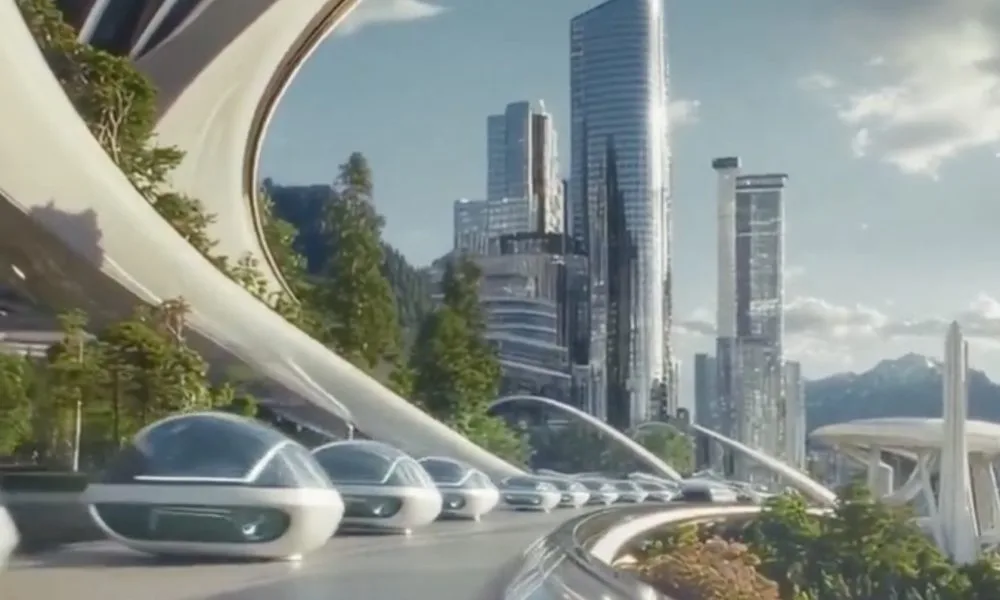
Texas commuters facing the grueling two-and-a-half-hour drive between Austin and San Antonio may soon see their travel time slashed to under 30 minutes. Elon Musk has announced that The Boring Company is developing a "precursor Hyperloop" tunnel to connect the two cities, targeting speeds exceeding 200 mph. Musk posted the idea on X on Sunday, framing the roughly 80-mile corridor as the next major infrastructure target for his tunneling enterprise.
The Austin to San Antonio Hyperloop Plan
Unlike traditional mass transit, the proposed system relies on point-to-point express travel. The Boring Company picked up the idea in the same thread, confirming the operational strategy.
Because Loop/Hyperloop is express (i.e. no intermediate stops), one could travel from an Austin parking lot to a favorite San Antonio restaurant in about 30 minutes. As long as they both have Loop stations.
- The Boring Company
This station model mirrors the company's Las Vegas network, utilizing small, garage-style stops rather than massive central terminals. While The Boring Company previously floated Texas tunnels in 2021 and saw pitches in Chicago, Los Angeles, and New York stall, its financial footing has drastically changed. The firm recently closed a $3 billion funding round led by United Arab Emirates investors, pushing its valuation to nearly $23 billion.
This capital injection provides the runway needed for speculative projects, alongside active builds like the Nashville downtown-to-airport tunnel, where a second boring machine finished commissioning in June.
Tesla Optimus: Mass Production Accelerates in China
Beyond infrastructure, Musk's robotics ambitions are rapidly moving toward commercial scale. On September 16 and 17, Tesla’s robotics team audited and certified three Chinese manufacturers in Ningbo, Zhejiang province, for Optimus mass production. The certified partners include Tuopu Group for actuators and chassis, Ningbo Joyson Electronic for sensors, and Zhejiang Sanhua Intelligent Controls for thermal management.
The audit triggered fresh orders for an initial batch of roughly 5,000 units, building on Sanhua's previous $685 million order for linear actuators - enough to supply an estimated 180,000 robots. Supply chain reports indicate Tesla aims to produce 1,000 Optimus units a week by late September, scaling to between 2,000 and 2,500 units weekly by the end of the year.
To support this, Tesla converted Fremont factory floor space previously used for the Model S and Model X into a dedicated Optimus line in just four months, targeting one million units annually. A second facility at Gigafactory Texas is nearing structural steel completion on its north end, designed to eventually support 10 million units a year. While commercial sales are slated for the second half of 2027, the Solactive China Humanoid Robotics Index rose 1.4% on the news, despite being down roughly 30% for the year.
SpaceX Targets Orbit with Starship Flight 14
In the aerospace sector, SpaceX is preparing for its most ambitious test yet, targeting September 22 for Starship Flight 14. The 75-minute launch window opens at 7:15 a.m. Central time at Starbase in South Texas. Unlike the 13 previous suborbital missions, Flight 14 is designed to achieve genuine Earth orbit.
The flight plan calls for Starship to circle the planet approximately six times at an altitude near 275 kilometers over ten hours, before executing a deorbit burn for a splashdown in the Pacific Ocean west of Chile. The mission will also attempt to deploy the first working batch of Starlink V3 satellites into actual service, with each satellite boasting roughly one terabit per second of downlink capacity.
While Flight 13 carried 20 of these satellites, they reentered with the ship due to the suborbital trajectory. Flight 14 will not attempt a tower catch of the ship - a milestone delayed for a few months - but the Super Heavy booster will target an offshore landing in the Gulf of America.
Other Notable Updates
Musk's weekend announcements also included several operational and merchandise updates:
- Glowing Merchandise: Musk wrote in a thread that the next Boring Company item will be "Uranium in Uranus" merch that glows in the dark, with a Geiger counter sold separately as an "optional strap-on." Past novelty items include the Not-a-Flamethrower, which sold 20,000 units for $10 million, and $100 Burnt Hair perfume.
- Vegas Loop Expansion: The Boring Company plans to double its operational stations in Las Vegas by the end of the year, backed by a new hiring push.
- Prufrock-5 Timeline: The company's tunnel boring machine recently completed a test tunnel in Bastrop, Texas, and is scheduled to relaunch on a new assignment in November.
The Capital Shift Fueling Musk's Empire
The sheer volume of updates across The Boring Company, Tesla, and SpaceX highlights a critical transition in Musk’s operational strategy: the shift from speculative engineering to heavily capitalized execution. The Boring Company’s $3 billion UAE-led funding round is the linchpin here. Past Hyperloop pitches in Chicago and Los Angeles stalled largely because the company lacked the massive balance sheet required to absorb early infrastructure risks.
Now, armed with a $23 billion valuation, the firm can actually afford to break ground on an 80-mile Texas corridor without waiting for municipal subsidies. Simultaneously, Tesla’s aggressive certification of Chinese suppliers for Optimus proves that the humanoid robot is no longer an internal R&D project.
By locking in Tuopu Group and Sanhua for mass production components, Tesla is applying its proven automotive supply chain playbook to robotics. The target of 2,500 units a week by year-end is staggering for a product category that barely existed commercially two years ago. Across all three companies, the underlying theme is clear: the prototyping phase is ending, and the race for high-volume manufacturing has officially begun.