Elon Musk believes artificial intelligence will surpass collective human intelligence within five years, prompting a radical shift in his approach to AI safety. In a sweeping 90-minute interview with The Economist, the xAI founder outlined a new strategy for policing AI development while reflecting on his controversial, short-lived stint in government.
Despite previously estimating a 10% to 20% chance that AI could wipe out humanity, Musk revealed he has reached a philosophical turning point. Acknowledging that the momentum behind generative AI and robotics is now unstoppable, he has decided to embrace the inevitable rather than fight it.
There really won't be anything that AI can't do better than humans, apart from being human, perhaps. It's hard to imagine that the chimpanzee would be in charge.
- Elon Musk, CEO, xAI
Let's enjoy the ride, is my philosophy at this point,
Musk said, suggesting that even if a global stop button existed for AI development, we probably shouldn't press it.
He noted with some irony that his past attempts to steer AI safely - including co-founding OpenAI - ultimately accelerated the technology's rapid advancement.
Policing the AI Race
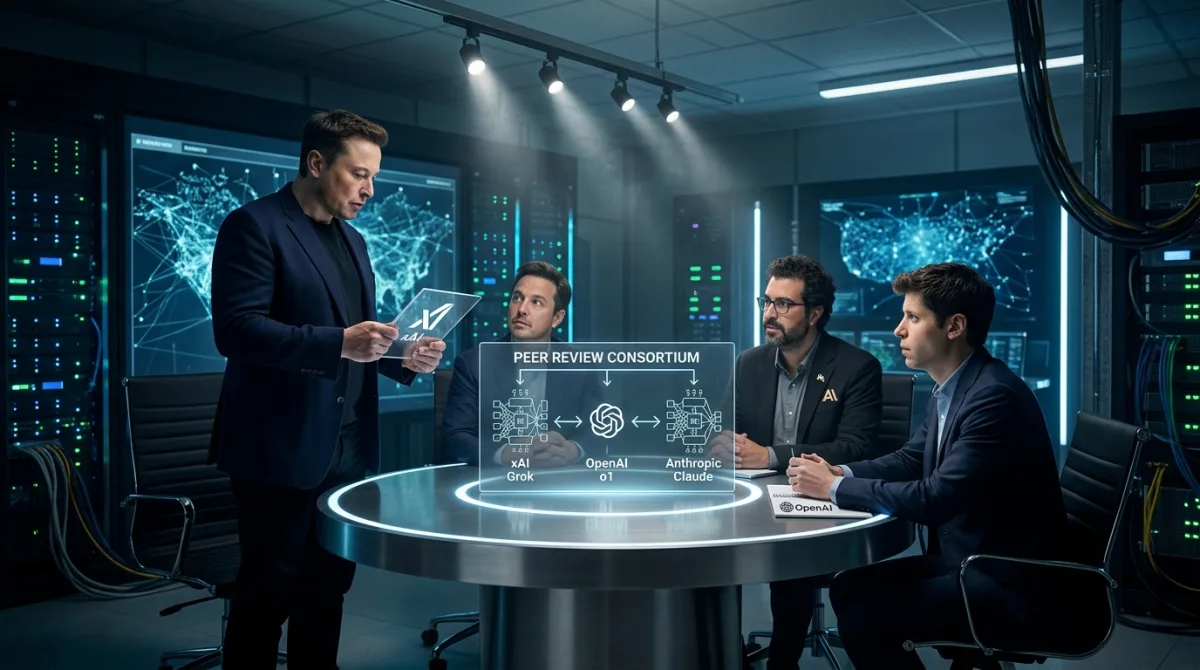
Rather than relying on slow-moving government regulation, Musk proposed a decentralized oversight model. He suggested that leading AI companies hold safety calls every few weeks to review each other's new models before public release. Competitors, he argued, are far better equipped than government agencies to spot technical vulnerabilities and safety risks.
However, achieving this level of cooperation would require mending deep industry rifts. Musk reiterated his long-standing grievance that OpenAI transitioned from a nonprofit into an $800 billion closed-source juggernaut. He also renewed his criticisms of OpenAI CEO Sam Altman, with whom he remains locked in a bitter legal battle, while praising Dario Amodei of Anthropic as a very principled person.
When pressed on whether these bitter rivals could actually collaborate, Musk insisted that if the stakes were high enough, they would set aside our personal differences for the good of the world.
The Political Hangover
The interview also touched on Musk's recent foray into politics, specifically his leadership of the Department of Government Efficiency (DOGE). I think I got a little too involved in politics, got carried away, frankly,
Musk admitted in a rare moment of reflection.
Despite the fallout with the Trump administration over the budget, Musk defended the core mission of DOGE, pointing out that interest payments on the national debt now exceed combined US defense and intelligence spending. He flatly denied allegations that sudden aid cuts orchestrated by his department cost lives, calling the death toll zero
and arguing that philanthropic organizations should have filled the funding gaps.
The Paradox of Peer Review
Musk's proposal for AI labs to police one another is a fascinating, if highly improbable, solution to the regulatory bottleneck. While he is correct that engineers at xAI, OpenAI, and Anthropic understand the technology better than any government regulator, the commercial realities make a pre-release model review pact nearly impossible to execute.
The AI race is currently defined by intense secrecy and a winner-takes-all mentality regarding training data and model architecture. Asking Sam Altman to hand over OpenAI's next flagship model to Musk for a safety review - while the two are actively suing each other - ignores the fierce corporate warfare defining the sector. Unless a neutral, third-party technical arbiter is established, Musk's vision of a collaborative AI safety consortium will likely remain a utopian thought experiment.
This article was written by AI from reporting by businessinsider.com.