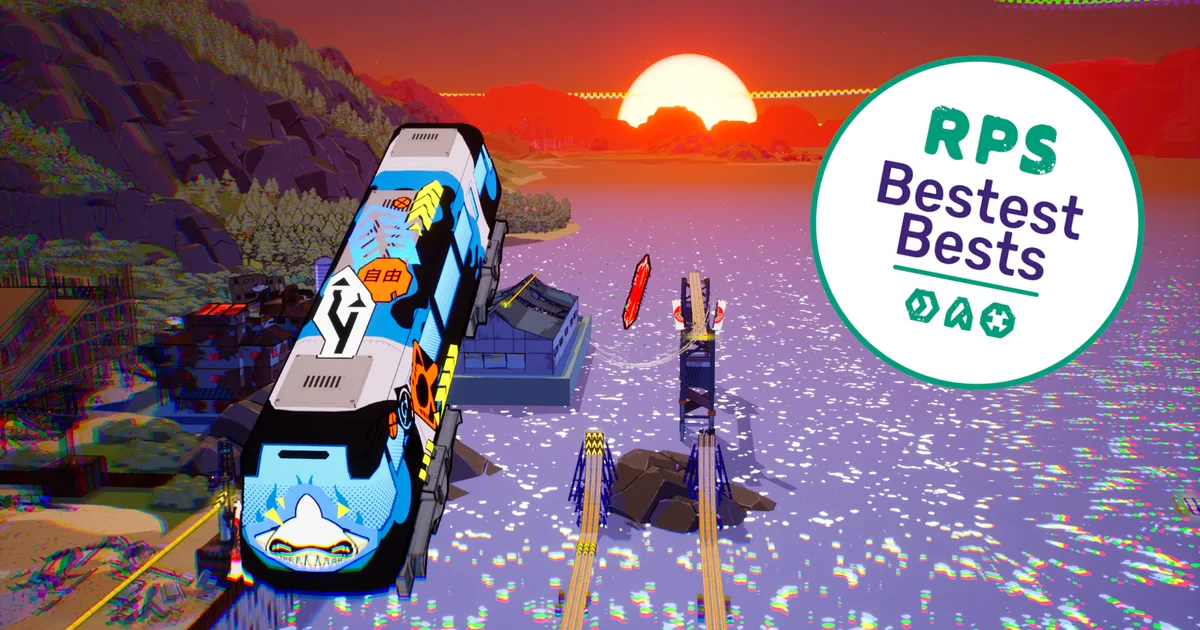
If you thought the stunt-racing genre had run out of fresh ideas, this Denshattack review is here to derail those expectations. This high-speed mashup of Tony Hawk’s Pro Skater and Jet Set Radio swaps skateboards for massive locomotives, delivering one of the most kinetic and joyous gaming experiences of 2026. Developed by Spain-based Undercoders and published by Fireshine Games and Boltray Games, the title initially looked like a mere novelty - a joke game about trains doing kickflips. Instead, it has emerged as a mechanically dense, highly polished arcade masterpiece.
For fans of high-stakes score chasers and rhythm games, Denshattack offers a profound mechanical depth that rewards precision and punishes hesitation. It proves that an absurd premise can anchor a genuinely brilliant gameplay loop, providing a much-needed adrenaline shot to a market often bogged down by hyper-realistic simulators. By mastering its physics-defying mechanics, players can experience a sense of barely-controlled velocity that few modern titles manage to capture.
Mastering the Tricktionary and Rhythm Mechanics
At the core of the experience is the move list (Tricktionary), which catalogs every individual stunt and its corresponding thumbstick flick. The trick system is incredibly generous with its dopamine hits, allowing players to easily pick up the basics of multi-track drifting and grinding over ruined bridges. However, securing a high score requires chaining flips and manuals into massive, multiplier-raising combos. The risk-reward ratio is immense; a single errant jump or mistimed dodge can instantly wipe out an entire track's worth of built-up bonuses, making the loss of a 30x combo genuinely agonizing.
Because the game moves at such a breakneck pace, players cannot simply switch their brains off and absorb the spectacle. Denshattack demands reflexes akin to pacey rhythm games like Dance Dance Revolution. You must constantly watch out for rapidly approaching hazards and new stretches of track that suddenly fall out of the sky. Reacting to these last-gasp, level-rearranging events - often occurring amid collapsing skyscrapers or tornadoes - becomes just as critical as balancing your grinds.
Counterculture, Ramen, and AI Data Centers
The narrative is just as wild as the gameplay. Set in a climate-ravaged Japan where the wealthy hide in domed cities, players control Emi, a profoundly anime-eyebrowed protagonist running a humble ramen-on-rails service. Her journey quickly pivots into the illegal, spiritual art of Denshattack racing. The game leans heavily into Japanese counterculture, drawing clear parallels between the outlawed train crews and the real-life bōsōzoku motorcycle subculture. Emi eventually builds a crew of yankii, gyaru, and rockabilly allies to fight back against a power-grabbing, AI-hocking big tech conglomerate that acts as the nation's de facto government.
Across the nine-ish hours of story stages, the game constantly introduces smile-raising megastunts and bizarre set pieces. Undercoders committed fully to the bit, delivering scenarios that include mech fights, Kabuki theatre performances, boat hijackings, and deer prison breakouts. There is even a section that plays exactly like Guitar Hero. All of this is backed by a high-energy original soundtrack that juggles funk, rock, jazz, and electronic bops, featuring songs specifically commissioned to include train-themed lyrics.
Missing Features: The Free Ride Dilemma
Despite its brilliance, the game is not entirely without flaws. The most glaring omission is the lack of a free ride mode (Free ride mode). The closest alternative is replaying the story missions in looping trick parks, but these remain bound by their original time limits, preventing players from casually exploring the environments or practicing combos without pressure.
Additionally, the progression pacing stumbles slightly near the end. A specific upgrade that allows you to drive on inverted tracks is introduced a bit too late in the campaign. While it fits perfectly within the game's outlandish logic, players are not given enough time to fully grasp the brain-twisting, up-is-down mechanics before being thrust into the finale.
The Arcade Revival Outpacing AAA Giants
The overwhelming success of Denshattack highlights a growing fatigue with bloated, 100-hour open-world games that prioritize map size over mechanical density. By focusing entirely on a tight, high-risk combo system and a vibrant, unapologetic aesthetic, Undercoders has proven that AA studios can outmaneuver AAA giants by simply being more fun to play. The decision to anchor the game's conflict around an AI-driven tech conglomerate also gives its counterculture themes a sharp, modern relevance that elevates it beyond mere Cool Japan propaganda.
While the absence of a dedicated free-roam mode is a missed opportunity for long-term community engagement and casual practice, the core loop is strong enough to carry the experience. Denshattack doesn't just borrow the aesthetic of classic Sega arcade games; it successfully modernizes their design philosophy. It stands as a testament to the fact that sometimes, the best way to push the medium forward is to let players blow up a data center by plowing a locomotive straight through it.
This article was written by AI from reporting by rockpapershotgun.com.