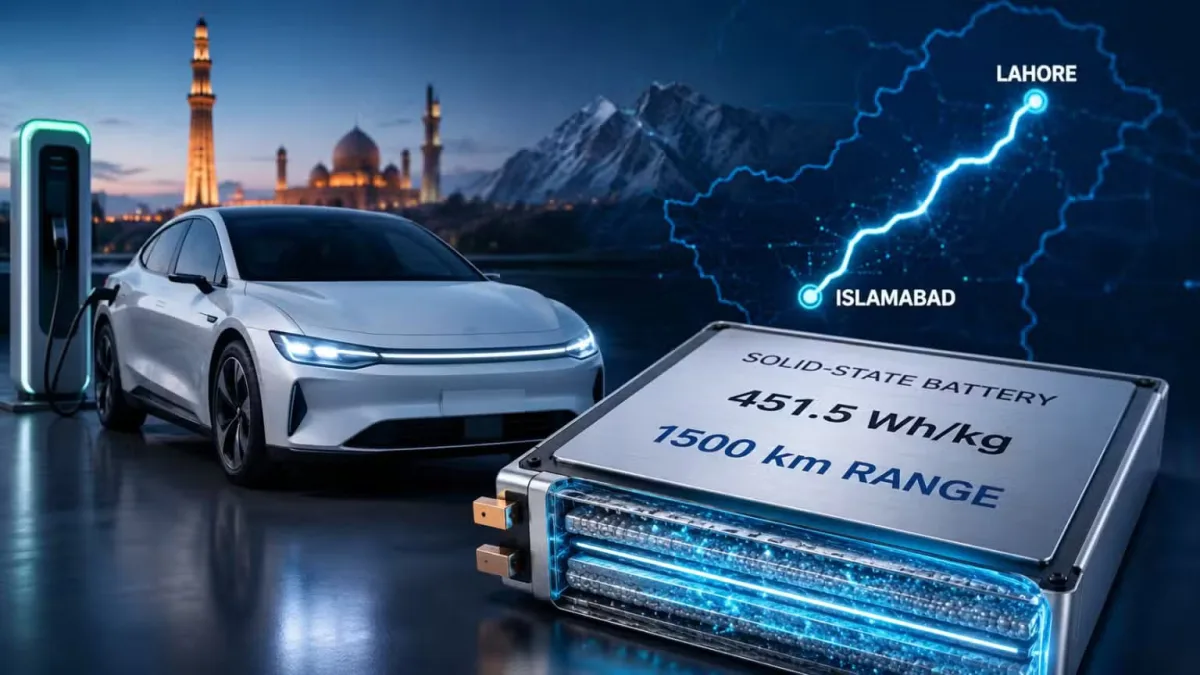
Electric vehicle owners may soon leave range anxiety in the rearview mirror. Researchers at the Chinese Academy of Sciences’ Institute of Metal Research have developed a solid-state lithium-metal battery capable of delivering a staggering 1,000 to 1,500 kilometers on a single charge. This breakthrough directly addresses the two biggest hurdles in EV adoption: limited driving range and lengthy charging times.
The newly engineered battery achieves an energy density of 451.5 Wh/kg, representing a massive leap over current industry standards. For context, conventional lithium iron phosphate (LFP) batteries, which currently dominate the EV market, typically operate at around 200 Wh/kg. This doubling of energy density means future electric vehicles could complete multiple long-distance journeys - such as driving a 370 km route four times - without ever needing to stop at a charging station.
The Science Behind the 3-Minute Charge
Beyond raw capacity, the research team achieved unprecedented ultra-fast charging capabilities. Under high-rate testing conditions at a 20C charge rate, the battery completed charge and discharge cycles in approximately three minutes. Crucially, it maintained stable performance during these extreme tests, retaining 81.9% of its original capacity after 700 cycles.
The secret to this stability lies in a novel manufacturing technique called "compatibilizing-solvent plasticization." The researchers applied this method to PVDF-based polymer electrolytes, which improves the compatibility of the materials during the manufacturing process. Once the solvent evaporates, the internal structure stabilizes, allowing the thin lithium-metal anode to function efficiently without degrading quickly.
Safety, a major concern for high-density batteries, was also rigorously tested. The team successfully built an ampere-hour-scale pouch cell prototype that maintained its structural integrity and passed severe safety evaluations, including the notoriously difficult nail penetration test.
The Commercial Reality Check
While a 1,500 km range and 3-minute charging sound like the ultimate EV endgame, the transition from an ampere-hour-scale laboratory pouch cell to a mass-produced automotive battery pack is notoriously difficult. The current electric vehicle market is heavily entrenched in LFP technology because it is cheap, highly stable, and easy to manufacture at scale. Solid-state lithium-metal batteries require entirely new manufacturing lines and face significant cost hurdles before they can reach consumer driveways.
However, this breakthrough proves that the fundamental chemistry works, and the pressure is mounting on major industry players. Battery giants like CATL, BYD, Ganfeng Lithium, Sunwoda, and Farasis Energy are already pouring billions into their own next-generation solid-state programs. As these companies move from pilot stages to validation, innovations like the PVDF plasticization method will be critical in solving the manufacturing bottlenecks that have kept solid-state batteries out of commercial vehicles.
This article was written by AI from reporting by techjuice.pk.