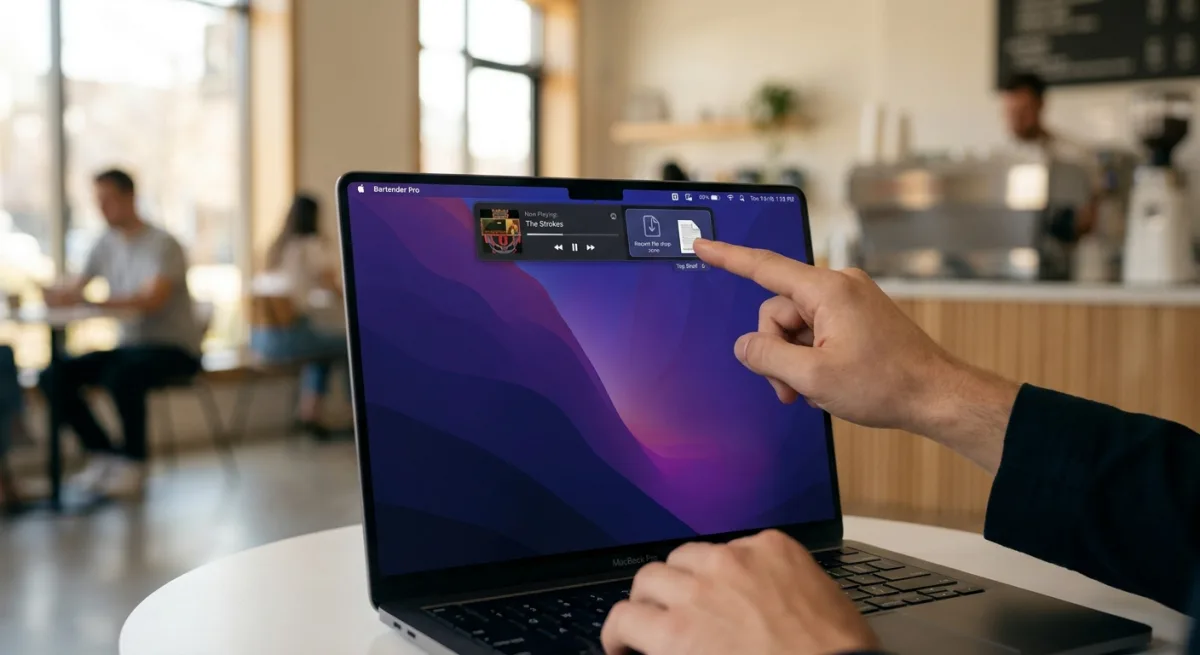
The MacBook notch has long been criticized as dead space, but a major update to a popular menu bar management app is changing that. Bartender Pro introduces a new feature called Top Shelf, effectively transforming the notch into a functional, interactive hub akin to the iPhone's Dynamic Island.
This upgrade expands the physical footprint of the notch area to house multiple utility tools. Users can drag and drop files directly into the notch for temporary storage or quick sharing via AirDrop. It also integrates a robust clipboard manager that automatically captures copied content, complete with customizable duration limits and an option to ignore sensitive passwords.
Key Features of Top Shelf
- Media and Widgets: Full Now Playing controls and widgets for calendar, weather, Apple Music, and Spotify.
- System Monitoring: Quick access to volume, display brightness, and battery levels.
- AI Tracking: Live Activity-style tracking for AI agents like Codex and Claude Code.
Top Shelf operates seamlessly alongside the standard Bartender toolset. When not actively in use, the interface tucks away cleanly, and it automatically hides when the main Bartender menu is expanded. Notably, while the feature is optimized for the MacBook notch, it remains fully functional on Mac desktops and older models without a notch.
The pricing model offers flexibility for different user needs. Bartender Pro is available for a $15 annual subscription, which includes Bartender 6 and all future updates. Users who prefer to avoid subscriptions can still purchase the standard Bartender 6 for a one-time fee of $20, while an $80 Mega Supporter tier grants lifetime access to both the base app and the Pro suite.
The Software Evolution of Hardware Constraints
Apple introduced the MacBook notch purely as a hardware compromise to accommodate better webcams while shrinking bezels, leaving the software integration surprisingly bare. Bartender Pro proves that this space has massive untapped potential for macOS UI design.
By adopting the Dynamic Island philosophy for the desktop, third-party developers are solving a UX problem Apple itself has ignored. If Top Shelf gains enough traction, it could pressure Apple to natively integrate similar drop-zone mechanics into future versions of macOS, fundamentally changing how users interact with the top edge of their screens.
This article was written by AI from reporting by macrumors.com.