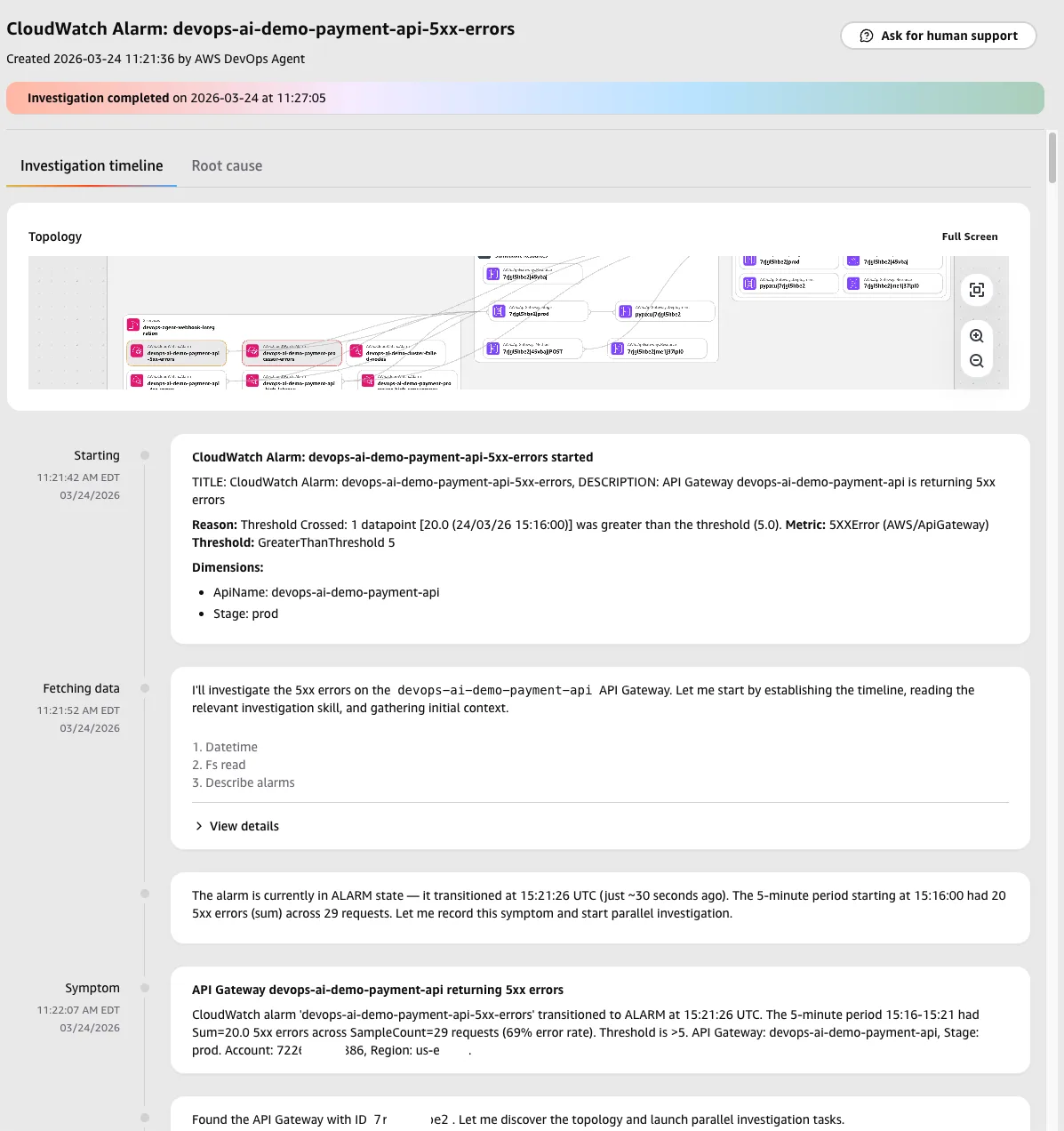
Operations teams constantly battle alert fatigue and manual incident triage, draining valuable time from strategic innovation. The newly launched AWS DevOps Agent eliminates this operational toil by acting as an autonomous AI teammate that investigates and resolves incidents across multicloud environments. By correlating telemetry, code, and deployment data, this tool drastically reduces Mean Time to Resolution (MTTR) and proactively prevents future outages.
Designed specifically for Site Reliability Engineers (SREs) and DevOps professionals, this general availability (GA) release shifts the paradigm from reactive firefighting to proactive system management. It empowers engineers to focus on building rather than debugging, offering a unified response system whether applications run on AWS infrastructure, competitor clouds, or legacy on-premises servers. Early preview data indicates that organizations using the agent achieved up to 80% faster investigations and 94% root cause accuracy.
Expanded Multicloud and On-Premises Capabilities
The GA release significantly broadens the agent's operational scope beyond native AWS environments. It now features built-in support for Azure workloads, allowing the agent to correlate data across multicloud deployments for a unified incident response. Furthermore, the agent extends its reach to on-premises applications utilizing the Model Context Protocol (MCP), which discovers local resources by analyzing metrics, logs, and code to build a comprehensive system topology.
To manage complex alert storms, AWS introduced a new Triage Agent that automatically assesses incident severity and identifies duplicate tickets. When duplicates are detected, they are linked to the primary investigation, reducing noise and consolidating team efforts. The system also introduces Code Indexing, enabling the agent to understand application repository structures, identify potential bugs during active investigations, and suggest code-level mitigation plans.
The agent becomes smarter over time through Learned Skills, adapting to an organization's specific investigation patterns and topology. Teams can also program Custom Skills to enforce specific investigation procedures and best practices, targeting them to specific agent types such as Incident Triage, Root Cause Analysis (RCA), or Mitigation.
New Integrations and Enterprise Features
AWS DevOps Agent builds upon its existing integrations with Datadog, Dynatrace, New Relic, Splunk, GitHub, GitLab, ServiceNow, and Slack. The GA launch introduces native support for PagerDuty to trigger automatic responses, and Azure alongside Azure DevOps for tracking cross-cloud deployments. It also features a built-in Grafana MCP server that connects to Prometheus, Loki, and OpenSearch data sources, alongside Amazon EventBridge support for custom automation workflows.
For enterprise readiness, the service is now available across six global AWS Regions: US East (N. Virginia), US West (Oregon), Frankfurt, Ireland, Sydney, and Tokyo. Security is reinforced through Private MCP connections, ensuring no confidential traffic routes over the public internet. Additionally, the agent supports customer-managed keys and direct identity provider integration with Okta and Microsoft Entra ID.
Real-World Impact and Customer Success
Early adopters have reported massive reductions in operational downtime. Western Governors University utilized the native Dynatrace integration during a production disruption, reducing their total resolution time from an estimated two hours to just 28 minutes - a 77% improvement in MTTR. The agent successfully pinpointed a Lambda function misconfiguration that was previously buried in undiscovered internal documentation.
Similarly, restaurant technology platform Zenchef leveraged the agent during a company hackathon to diagnose a customer-facing issue without pulling engineers away from their projects. The agent systematically ruled out authentication errors and traced the root cause to an IAM misconfiguration on an EC2 instance hosting GitHub, wrapping the investigation in 20 to 30 minutes instead of the usual two hours. Other major adopters include T-Mobile, which utilizes the Splunk integration for centralized log analysis, and Granola, which relies on the agent for deep PostgreSQL and RDS performance insights.
How to Deploy AWS DevOps Agent
AWS DevOps Agent operates on a per-second billing model for the time spent on operational tasks, with no upfront commitments. AWS Support customers also receive monthly usage credits. To establish immediate value, follow these deployment steps:
- Create an Agent Space: Navigate to the AWS Management Console and initialize your first dedicated workspace for the agent.
- Connect Observability Tools: Link your existing telemetry platforms, such as Datadog, Grafana, or Dynatrace, to feed real-time data into the agent's context engine.
- Benchmark Performance: Select a production incident your team manually investigated within the past 30 days. Run the agent against the same alert to directly compare the automated results and time savings against your manual baseline.
My Take: The Future of Autonomous SRE
The general availability of AWS DevOps Agent signals a massive shift in how cloud providers view their operational responsibilities. By aggressively supporting Azure, Azure DevOps, and on-premises environments via the Model Context Protocol (MCP), AWS is positioning this tool not just as an AWS-specific feature, but as a universal control plane for the entire enterprise IT stack. The per-second billing model is particularly strategic, lowering the barrier to entry and allowing teams to treat AI investigation as an on-demand utility rather than a massive capital expenditure.
The concrete metrics from early adopters - specifically the 75% to 77% MTTR reductions seen by Zenchef and Western Governors University - prove that AI agents have evolved past simple code generation. They are now capable of executing complex, multi-step infrastructure debugging that requires deep contextual awareness. As the agent builds its 'Learned Skills' based on unique organizational topologies, the role of the junior SRE will fundamentally change. Instead of manually grepping through logs at 2 AM, engineers will transition into automation architects, focusing on refining the agent's custom skills and overseeing mitigation strategies.
This article was written by AI from reporting by aws.amazon.com.