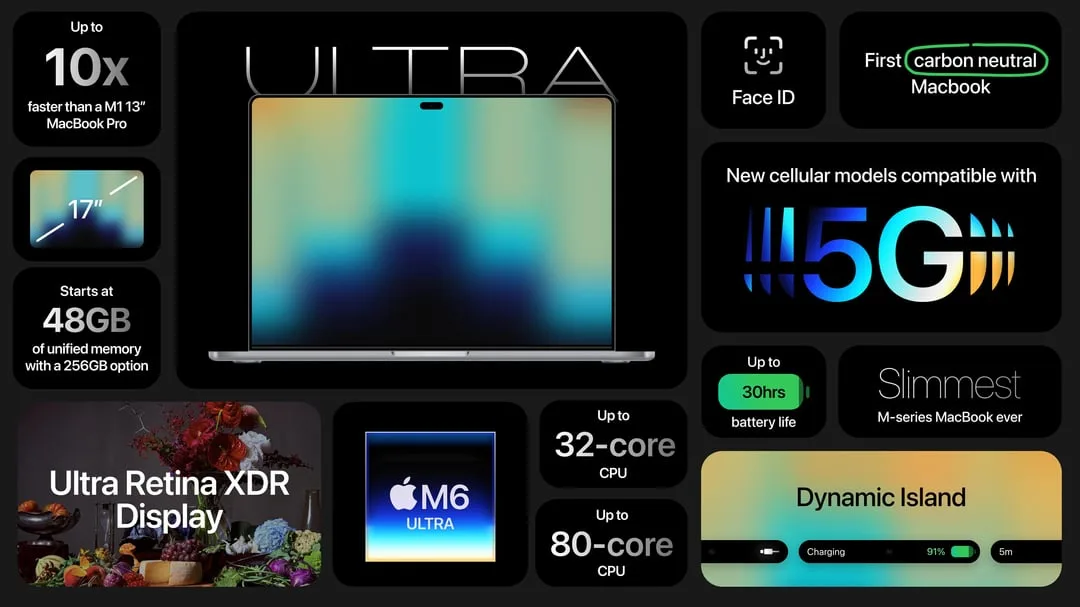
Apple is preparing a radical overhaul of its premium laptop lineup with the rumored MacBook Ultra, a device set to introduce the first-ever OLED touchscreen to the Mac ecosystem. Expected to launch by late 2026 or early 2027, the new flagship will feature a thinner chassis and replace the traditional display notch with an iPhone-style Dynamic Island. This design shift aims to unify how Siri AI behaves across iOS 27 and macOS Golden Gate.
Design and Display Upgrades
The most significant hardware shift is the transition to OLED technology. Unlike current mini-LED panels, an OLED display allows individual pixels to turn off completely, eliminating light leakage and delivering true blacks with a higher contrast ratio. Apple is pairing this visual upgrade with a touchscreen interface, marking a historic first for the Mac lineup. The MacBook Ultra will be available in both 14-inch and 16-inch sizes.
To support this new input method, the MacBook Ultra will incorporate a reinforced hinge to prevent screen wobble during touch interactions. The touchscreen is designed to supplement, rather than replace, the traditional keyboard and trackpad workflow. Apple is already adapting macOS Golden Gate for touch input, ensuring the software is ready for the hardware leap.
Software Clues in macOS Golden Gate
The foundation for this hardware shift is already visible in the latest software betas. macOS Golden Gate introduces direct touch input to Sidecar, allowing users to tap and interact with macOS elements when using an iPad as a secondary display. This serves as a clear testing ground for native Mac touch capabilities.
Additionally, Apple has integrated an iPhone-style pull-to-refresh gesture across core applications like Safari, Mail, News, Podcasts, and Calendar. Implementing a pull-to-refresh mechanic on a desktop operating system makes the most sense when paired with a dedicated touch display.
Performance: Sticking with M5 Chips
Despite the dramatic external redesign, the MacBook Ultra will reportedly rely on existing Apple silicon. The new laptops will utilize the M5 Pro and M5 Max chips rather than waiting for the M6 series. According to recent supply chain shifts, Apple has scrapped plans for M6 Pro and M6 Max variants entirely.
Because of this roadmap change, Apple will use the M5 Pro and M5 Max to avoid delaying the hardware until the M7 series is ready. A second-generation MacBook Ultra is already planned to feature the M7 Pro and M7 Max chips. It remains unclear if the Ultra will replace the current Pro models or sit above them as a distinct, higher-tier option.
Pricing and Release Timeline
This technological leap will come at a steep cost. Following Apple's recent across-the-board price increases in June 2026, the MacBook Ultra is positioned as an ultra-premium tier. With the current 14-inch M5 Pro starting at $2,499 and the 16-inch at $2,999, the OLED models will push Mac pricing to new heights.
Mass production for the MacBook Ultra is slated to begin in late 2026. If the device launches this year, it will likely debut between October and December, separate from the September iPhone event. Alternatively, Apple may hold the release for its first major hardware event in early 2027.
The Touchscreen Gamble and iPad Cannibalization
For years, Apple executives insisted that Macs and touchscreens were a fundamentally flawed combination, pointing users toward the iPad Pro instead. The MacBook Ultra represents a massive philosophical pivot, likely driven by the need to justify higher price points in a maturing laptop market. By integrating a touchscreen and a Dynamic Island, Apple is blurring the lines between iOS and macOS more than ever before.
However, this strategy carries a significant risk. A touchscreen MacBook Ultra with an OLED display directly undercuts the primary selling points of the M-series iPad Pro. If the Ultra successfully integrates touch without compromising the traditional macOS workflow, it could render Apple's high-end tablets redundant for power users who have long begged for a single device that does it all.
This article was written by AI from reporting by macrumors.com.