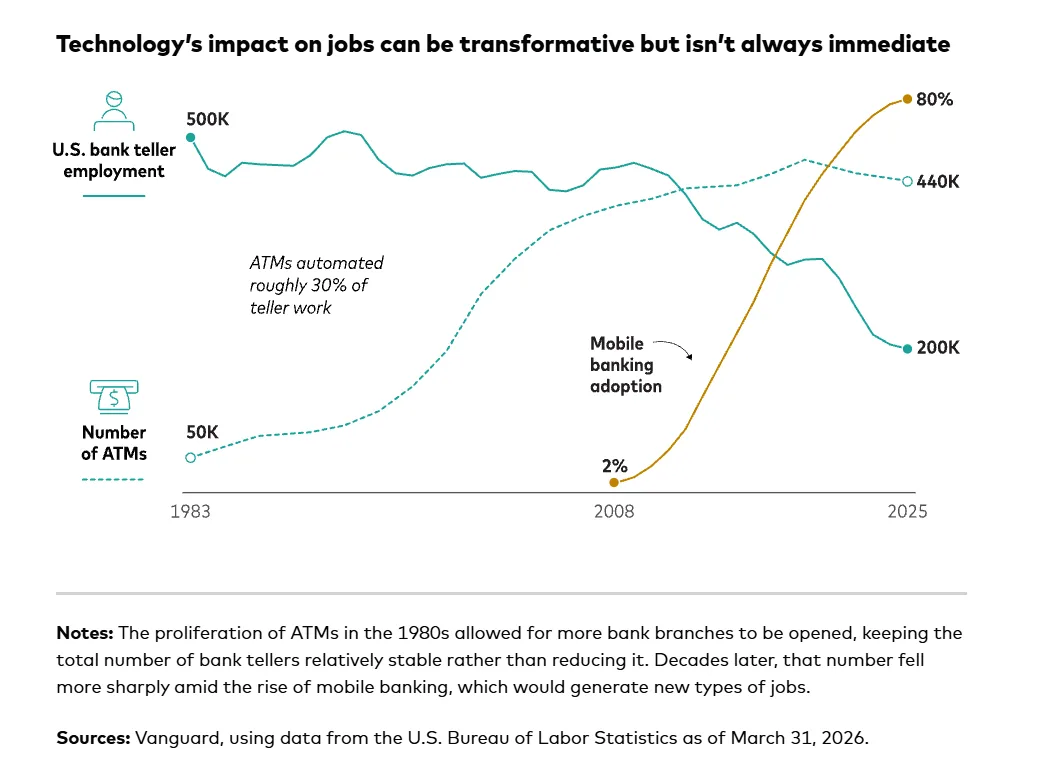
The fear that artificial intelligence will permanently eradicate white-collar jobs is dominating corporate anxieties, but nearly four years after the launch of ChatGPT, the labor market is telling a completely different story. Instead of mass layoffs, employment growth in highly AI-exposed occupations has kept pace with or exceeded less exposed fields. According to a new analysis by Vanguard's Chief Economist published in Fortune, the current state of generative AI is far closer to the introduction of the automated teller machine (ATM) in the 1980s than the true disruption of mobile banking.
When ATMs first arrived, forecasts predicted the obsolescence of bank tellers. Instead, by lowering operating costs, ATMs made it economical for banks to open more branches. As a result, total U.S. bank teller employment remained broadly stable from 1980 through 2010. For a mid-career teller in the 1980s, the ATM posed far less of a threat to employment than many industry forecasts suggested.
The Shift from Transactions to Relationships
Rather than destroying jobs, the expansion of retail banking created demand for a wider range of specialized occupations. Banks aggressively hired loan officers, credit analysts, personal bankers, and fraud and risk specialists. The work performed inside a branch moved up the skill-value chain, focusing less on processing routine transactions and more on managing customer relationships.
The lesson is that isolated task automation rarely results in large-scale job losses, except in occupations built around a very narrow set of activities.
- Vanguard Chief Economist, Fortune
The true structural shift did not occur until around 2010 with the rise of mobile banking. Unlike the ATM, which merely automated a specific task, mobile banking automated the entire trip to the bank. By 2025, only 9% of bank customers reported that branches were their primary banking channel, a massive drop from 36% in 2007. This shift led to a corresponding fall in bank teller employment.
When Real Disruption Actually Hits
Crucially, this transformation was not driven by technology alone. The Electronic Signatures in Global and National Commerce Act of 2000 gave electronic signatures the same legal standing as ink, accelerating the shift away from in-person transactions. However, this disruption also birthed entirely new categories of employment. The mobile banking era created massive demand for:
- Cybersecurity analysts
- Digital product managers
- Payment-platform engineers
- Data-platform operators
The Institutional Trigger for AI Job Loss
The Vanguard analysis exposes a critical blind spot in how we measure the AI job market impact: technology alone rarely dictates employment outcomes. The real danger to white-collar jobs won't materialize just because a Large Language Model gets faster or more accurate. As seen with the E-Sign Act of 2000, true disruption requires a catalyst in institutional workflows and legal frameworks.
Right now, AI is functioning as an ATM - a powerful tool that augments workers and makes them more productive without dismantling the broader structure of work. But when AI reaches its "mobile banking" phase, it will likely be triggered by a fundamental reconfiguration of corporate structures, such as fully autonomous AI agents gaining legal authority to execute contracts or manage budgets. Until those business models and institutional changes align, the panic over an immediate, AI-driven employment apocalypse remains vastly overblown.