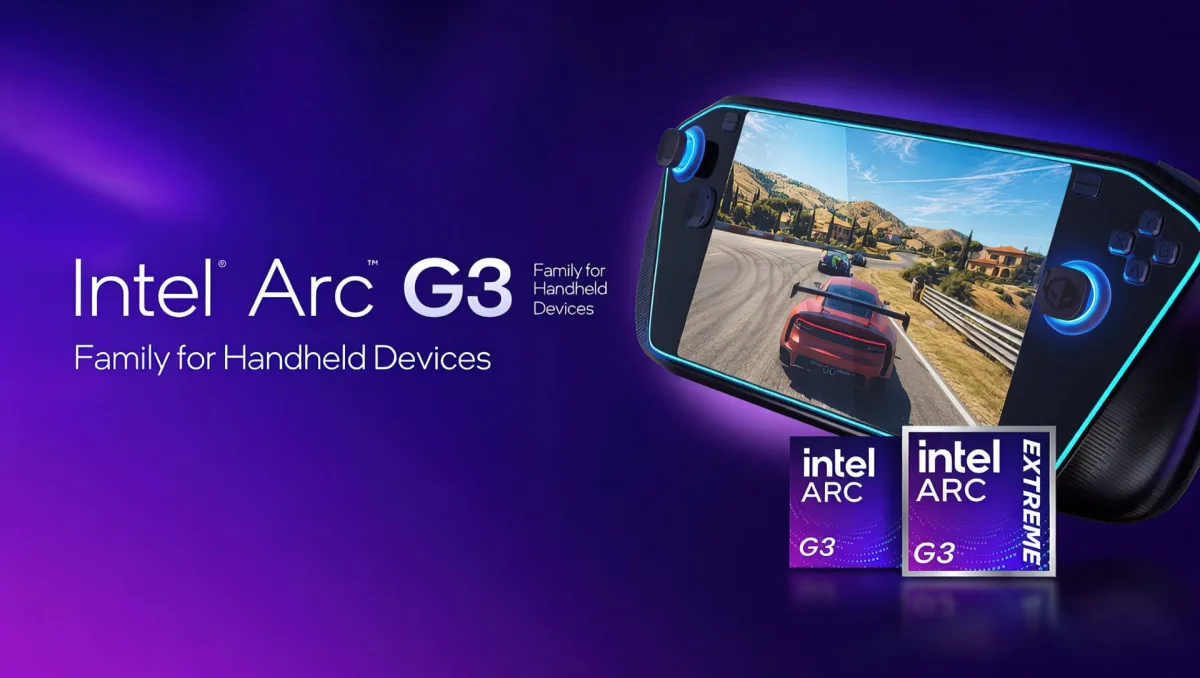
AMD has dominated the portable gaming console market for years, leaving competing silicon scrambling to match its efficiency and performance. Intel aims to disrupt this stronghold completely by introducing its first purpose-built handheld processors: the Intel Arc G3 Extreme and Arc G3. Moving away from modified laptop processors, these newly announced chips are engineered explicitly for portable gaming systems, utilizing the next-generation Panther Lake architecture to address the severe battery drain and stuttering issues that plagued earlier Intel-powered portables.
Targeting PC gaming enthusiasts who demand console-like fluidity on mobile screens, these processors provide a specialized foundation for upcoming hardware. Devices powered by this new platform will enable immediate access to major game libraries with dedicated handheld software enhancements, giving mobile gamers a viable high-performance alternative to long-standing Ryzen options. The architecture introduces substantial efficiency upgrades via advanced node manufacturing alongside specialized hardware-level features designed to maximize frames per watt.
Inside the Hardware Specs: Arc G3 Extreme vs Standard Arc G3
The flagship chip of the lineup, the Intel Arc G3 Extreme, brings massive compute density to a configurable 8W to 35W thermal envelope. It features a 14-core CPU configuration consisting of 2 Performance-cores (P-Cores) peaking at 4.7 GHz, 8 Efficient-cores (E-Cores), and 4 Low-Power Efficient-cores (LP-E Cores) alongside a 12 MB L3 cache. Graphics processing is handled by the integrated Arc B390 GPU, showcasing 12 Xe3 architectural cores clocked up to 2.3 GHz. For localized AI processing, the silicon embeds a 46 TOPS NPU, backed by support for up to 96 GB of ultra-fast LPDDR5X-8533 memory.
For more budget-conscious or power-optimized form factors, the standard Intel Arc G3 lowers the ceiling to a 8W to 30W TDP. It maintains the identical 14-core CPU layout and input/output capabilities but drops the peak core frequency by 100 MHz. The primary differentiation lies within the graphics department, which utilizes the scaled-down Arc B370 GPU featuring 10 Xe3 cores running at 2200 MHz, trading minor graphical throughput for enhanced system-level battery endurance.
Both processors share a modern, integrated connectivity suite engineered for high-bandwidth peripherals and low-latency wireless performance. The platform includes 12 PCIe lanes splitting across Gen 4 and Gen 5 speeds, dual Thunderbolt 4 ports supporting up to 40 Gbps bandwidth, integrated Intel Wi-Fi 7 R2, and dual Bluetooth 6.0 controllers.
Silicon Architecture and Dedicated Gaming Software Features
The structural secret behind the efficiency claims of the family lies in the manufacturing process. The compute tiles are fabricated using the Intel 18A process node technology, representing the most advanced logic node developed and manufactured in the United States. This architecture allows the SoC to dynamically delegate minor background operating system tasks to the 4 LP-E cores, preserving the power-hungry P-cores exclusively for rendering calculations and physics pipelines during heavy gaming sessions.
On the software front, Intel is coupling this hardware with a dedicated suite of gaming optimizations to streamline the portable Windows 11 experience. The platform introduces Xbox mode, a controller-optimized, console-inspired full-screen UI that unifies fragmented game launchers into a singular library. To eliminate the annoying hitching and stutters common during initial gameplay, the system deploys Intel Precompiled Shaders, allowing compatible titles to download prebuilt shader files directly from the cloud rather than forcing the device to compile them locally on the fly.
Visual fidelity also receives an upgrade through integrated support for XeSS 3, which combines AI upscaling with advanced Multi-Frame Generation. This lets the handhelds render games at lower internal resolutions to save massive amounts of battery power while outputting sharp, high-frame-rate imagery to the display. Furthermore, an Endurance Gaming power policy aggressively manages system resources during travel to maximize unplugged playtime without introducing visible performance drops.
First Hardware Partners Launching This Summer
Gamers will not have to wait long to see this silicon in action. Intel confirmed that its hardware partners will publicly showcase initial product designs at Computex 2026. The first wave of portable gaming devices powered by the Arc G3 series includes the Acer Predator Atlas 8, the MSI Claw 8 EX AI+, and the OneXPlayer 3, with retail rollouts scheduled to begin in June this year.
The Battle for the 15-Watt Sweet Spot
This launch signals a massive strategic shift in how Intel views the low-power silicon market. Historically, using a laptop chip for a handheld console meant fighting inherited architectural limitations, resulting in high idle power draw and poor low-wattage scaling compared to AMD's monolithic layouts. By developing a dedicated Arc G series, Intel is signaling that portable gaming is no longer a side project, but a primary hardware demographic that justifies its own custom engineering pipelines.
Building on the 18A process node gives Intel a crucial opportunity to capture the highly competitive 15W sweet spot where portable devices live. If the Xe3 graphic architecture coupled with cloud-delivered precompiled shaders can deliver stable frame pacing without requiring high thermal targets, AMD will face its first true competitive pressure in this category. For consumers, this newfound competition will likely accelerate display upgrades, push device prices down, and force both chipmakers to optimize their driver support cycles far faster than before.
This article was written by AI from reporting by wccftech.com.