For decades, the dream of a viable tokamak fusion reactor has been hindered by extreme plasma turbulence that bleeds critical heat from the system. Now, researchers have discovered that the very plasma instabilities previously blamed for this energy loss might actually be the key to self-regulating the reactor. This breakthrough provides nuclear physicists and energy engineers with a new pathway to stabilize fusion reactions, potentially accelerating the timeline for commercial, limitless clean energy.
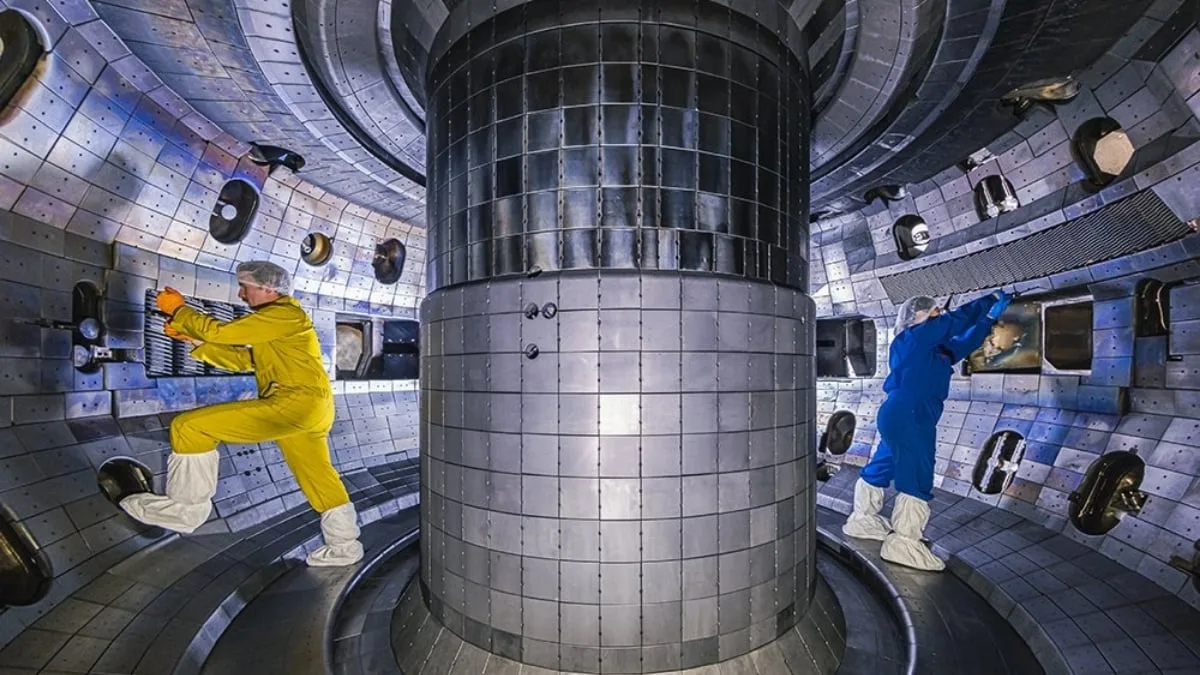
Inside a tokamak, intense magnetic fields are used to heat plasma to 150 million degrees Celsius - roughly ten times the temperature at the core of the Sun. This extreme environment forces heavy hydrogen isotopes to fuse and release immense energy. However, maintaining this astronomically hot plasma is fraught with difficulties, primarily because turbulence causes the heat to leak outward, degrading the containment necessary for sustained fusion.
In a new study published in the journal Physical Review Letters, researchers utilized the DIII-D National Fusion Facility in San Diego, California - North America's largest operating tokamak - to challenge long-held assumptions. They found that the relationship between plasma instability and turbulence is far more complex than previously understood, flipping traditional containment theories upside down.
How Alfvén Eigenmodes Stabilize Plasma
Historically, scientists believed that specific plasma waves, known as Alfvén eigenmodes (AEs), were a hindrance to fusion performance because they degraded the containment of energetic particles. The new experimental evidence demonstrates the exact opposite effect under certain conditions.
- Wave Generation: As the reactor reaches high energy thresholds, AEs drive specific plasma flows and electromagnetic currents.
- Shear Flow Creation: These currents generate a phenomenon known as shear flow within the plasma structure.
- Turbulence Suppression: The shear flow acts as a barrier, actively suppressing plasma turbulence within the tokamak and preventing energy from escaping.
- Thermal Containment: By reducing thermal transport, more heat stays confined in the plasma core, increasing the temperature of electrons and charged atomic nuclei to create highly fusion-conducive conditions.
To prove this, the research team employed a nuclear-fusion diagnostic tool called the Motional Stark Effect (MSE). By shooting a beam of neutral deuterium atoms into the plasma, the MSE measures how the shifting magnetic field alters the polarization of emitted light. This allowed physicists to observe the internal magnetic changes in real-time.
The diagnostic tool revealed a 5 percent change in the safety factor - a critical metric measuring how magnetic field lines travel around the inner confinement area - across just 20 milliseconds. Researchers interpret this rapid shift as concrete evidence of AE-driven zonal currents, confirming that the instabilities actually generate forces that rip apart turbulence.
The Paradigm Shift in Reactor Engineering
This discovery fundamentally alters how engineers will approach the design of next-generation fusion reactors. For years, the primary engineering objective has been to build increasingly massive and complex magnetic coils to forcefully suppress all plasma instabilities. By proving that Alfvén eigenmodes can self-regulate turbulence once a specific energy threshold is reached, this research suggests that future reactors could be designed to intentionally ride these waves rather than fight them.
If engineers can reliably leverage this self-regulating process, it could reduce the need for over-engineered magnetic containment systems, potentially lowering the astronomical costs associated with building commercial tokamaks. While harnessing this turbulence-taming effect on a grid-scale level remains on the horizon, it transforms a perceived physical flaw into a vital mechanical advantage, bringing humanity one step closer to the holy grail of clean energy.
This article was written by AI from reporting by sciencealert.com.