

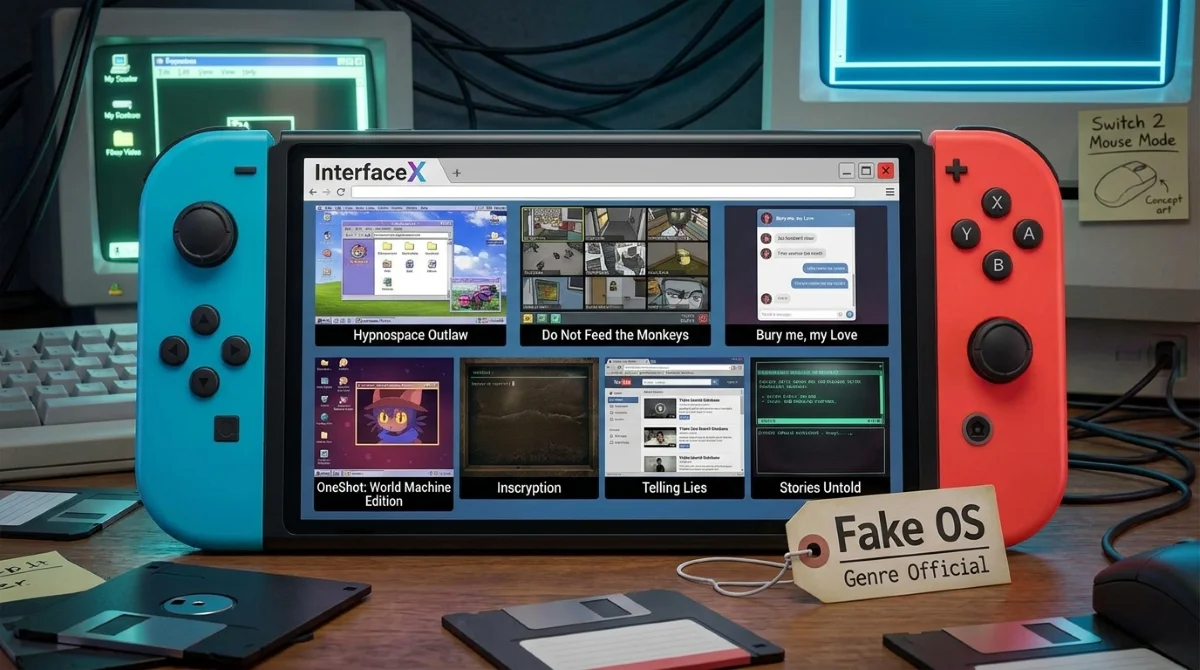
The "Fake OS" genre is officially gaining traction thanks to the developer-led InterfaceX campaign on Steam, and the Nintendo Switch has quietly become a premier destination for these interface-driven experiences. For players who enjoy the voyeuristic thrill or puzzle-solving mechanics of navigating simulated computer desktops, smartphones, and retro operating systems, the Switch and its upcoming successor offer a robust library of highly-rated titles.
InterfaceX is pushing to make "Fake OS" an official Steam tag, uniting games previously scattered across descriptors like Interface Sims, Desktop Dramas, or Found Device games. To support this categorization, here are the top-rated Fake OS games currently available on the Switch eShop that weave interface navigation directly into their core gameplay.
- Bury me, my Love: This emotionally heavy text-based experience places you in the role of Majd, communicating via a simulated messaging app with his wife Nour as she attempts to flee Syria for Germany. The entire narrative unfolds through texts, photos, and map locations sent to your phone, delivering a powerful lesson in empathy and the harsh realities of war.
- Do Not Feed the Monkeys: Putting a sinister twist on voyeurism, this game invites you to the Primate Observation Club. You must monitor "monkeys" (unsuspecting people) through various surveillance cameras on your screen and report your findings via email, balancing a small but immersive desktop interface with an overarching sense of foreboding.
- Hypnospace Outlaw: A meticulously crafted puzzle game and razor-sharp satire that recreates the lawless, pre-Y2K GeoCities era of the internet. You act as an enforcer browsing a living, breathing '90s aesthetic web, untangling narrative puzzles while soaking up the anarchic nostalgia of early online creativity.
- Inscryption: While primarily a haunting deckbuilder, this title stretches its genre boundaries with mind-boggling ingenuity and first-rate presentation. The narrative jumps between concepts, ultimately delivering one of the most impressive feats of storytelling hidden within the framework of a dusty old floppy disk.
- Mainframes: A precision puzzle-platformer that utilizes a desktop-bending premise. Featuring pleasant pixel-art visuals and a laid-back soundtrack, it offers a fresh take on interface manipulation, though players should be prepared for sudden difficulty spikes.
- OneShot: World Machine Edition: Originally released in 2014, this point-and-click adventure frames the quest of a cat-like child named Nico as a game installed on a virtual PC. The interface functions as both a menu and a narrative device, frequently breaking the fourth wall to address you by your Switch profile name in a deeply compelling, bittersweet story.
- Stories Untold: An interactive horror adventure that draws players in through its ingenious UI and lo-fi aesthetic. By forcing you to interact with old technology and complicated machinery, it creates a uniquely strong bond between the player and the narrative, slowly twisting the familiar into something chilling.
- Telling Lies: Developed by Sam Barlow, this detective game tasks you with searching a large database of phone-filmed video clips on a virtual desktop computer. The transition to the Switch remains entirely intact, offering an exhilarating web of relationships and intrigue driven by strong live-action performances.
- Videoverse: A nostalgic time capsule of early online communities tailored for Millennials who grew up making friends over the internet. Despite some minor input frustrations on the Switch, it tackles difficult topics with a smile, serving as a much-needed tonic for the modern online soul.
The Future of Interface Sims on Nintendo Hardware
While the current Switch lineup is strong, several classic Fake OS titles remain absent from the platform. Highly requested games like Emily is Away, Hacknet, Her Story, Immortality, Pony Island, The Roottrees are Dead, and Uplink have yet to make the jump. However, with the anticipated addition of Mouse Mode on the Switch 2, the barrier for porting these PC-centric, interface-heavy games could be significantly lowered, paving the way for a broader library of desktop simulations on Nintendo's next-generation console.
Why the "Fake OS" Tag is a Necessary Evolution
The push by InterfaceX to formalize the Fake OS genre highlights a broader shift in how we categorize interactive media. For years, games like Telling Lies and Hypnospace Outlaw were awkwardly shoehorned into the "puzzle" or "adventure" brackets, which fails to communicate their actual mechanical hook: the tactile simulation of operating a digital workspace. By establishing a dedicated tag, developers can better target the specific demographic of players who crave the voyeuristic, methodical pacing of desktop dramas.
Furthermore, the success of these titles on the Nintendo Switch proves that interface-driven games are not strictly bound to the PC ecosystem. While navigating a simulated desktop with a controller can sometimes introduce input friction - as noted with Videoverse - the portability of the Switch perfectly complements the intimate, "found device" nature of these stories. If the Switch 2 does indeed introduce native Mouse Mode, it will not only solve the input dilemma but likely trigger a renaissance of PC-to-console ports for this uniquely immersive genre.
