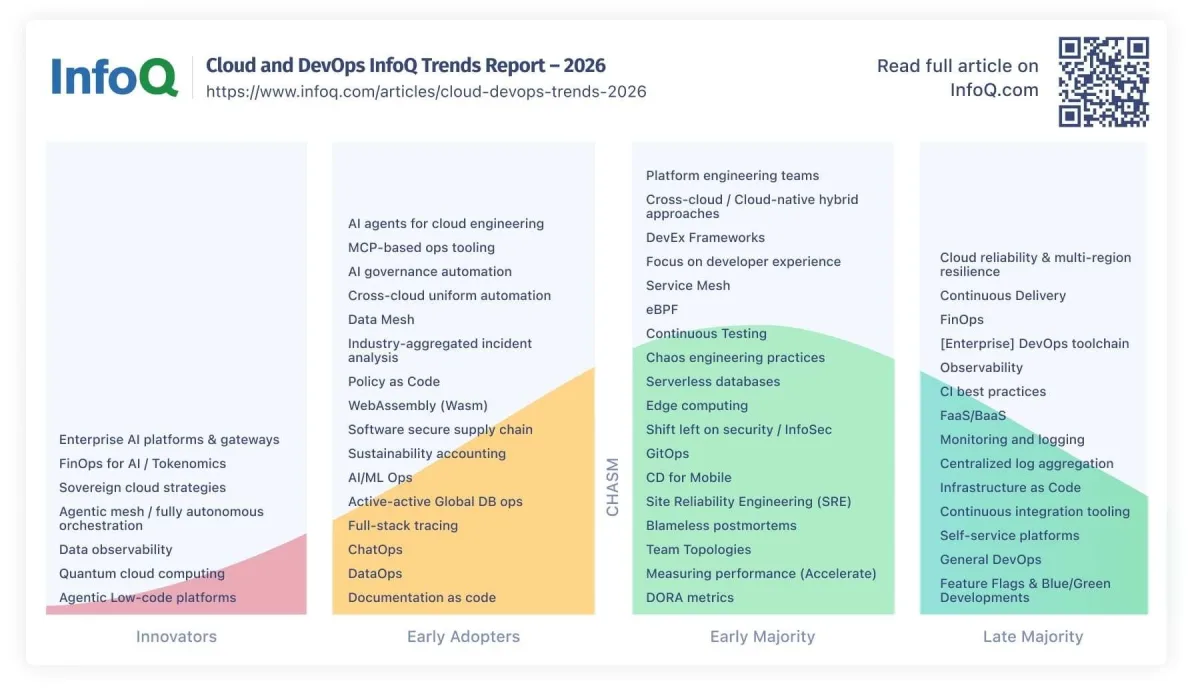
The defining Cloud and DevOps Trends 2026 reveal that AI has officially moved from experimental sandboxes to enterprise execution, fundamentally reshaping cloud strategies. Organizations are rapidly shifting away from fragmented, individual coding assistants in favor of team- and enterprise-level AI systems. At the same time, a series of severe outages across major cloud providers has violently thrust reliability and multi-region design back into the spotlight.
Platform teams are evolving from mere infrastructure builders to strategic enablers. Rather than simply provisioning servers, these teams are now tasked with standardizing AI capabilities, enforcing governance, and reducing shadow platform initiatives. This shift is forcing technical leaders to balance the rapid adoption of agentic infrastructure with the sobering realities of operational readiness and digital sovereignty.
The Rise of Enterprise AI Platforms and Gateways
One of the clearest architectural shifts this year is the move toward centrally governed AI platforms. Instead of allowing individual teams to wire up their own models, enterprises are establishing internal platforms featuring centralized gateways, approved model catalogs, and provisioned team workspaces. This approach borrows heavily from established API management principles and applies them directly to AI models and agents.
Steef-Jan Wiggers described this as a hub-spoke model, noting that centralized AI gateways function similarly to traditional API management tools offered by Microsoft or Apigee. Behind this gateway sits a governed model catalog, ensuring that teams building on the platform only use approved, secure models. This model routing is essential for cost control, in-house hosting for sovereignty, and preventing a chaotic sprawl of independent model decisions.
FinOps for AI and the Tokenomics Challenge
While traditional cloud FinOps is a mature discipline, AI spending has opened a complex new frontier. AI token usage has become a major operational expense, yet organizations still lack effective ways to connect this spending with developer productivity and tangible business outcomes. Matt Saunders pointed out that while current tools can track exactly how much is spent on tokens in models like Opus or Sonnet, they cannot relate that spend back to actual value.
The proliferation of AI agents has only amplified this issue. Shweta Vohra warned that the current "agents' chaos" is more complex than the microservices boom, presenting numerous small optimization challenges rather than large, easily identifiable areas of waste. In response to this growing complexity, the FinOps Foundation has launched the Tokenomics Foundation, while the Agentic AI Foundation was established under the Linux Foundation to help standardize these efforts.
Sovereign Cloud Strategies in Europe
Digital sovereignty has transitioned from a theoretical policy discussion to a strict architectural concern, particularly for European organizations. Companies are aggressively evaluating what it takes to keep data - and increasingly, AI models - strictly within regional boundaries. However, achieving full sovereignty remains incredibly difficult when the vast majority of enterprise estates rely on American hyperscalers and SaaS platforms.
While European providers can supply basic infrastructure and storage, they struggle to offer viable sovereign alternatives for complex platform layers and CRM systems like Salesforce. Despite these limitations, Mark Silvester noted that regulated European clients are absolutely adamant about keeping data local, with roughly half of his clients gradually migrating workloads back to on-premises environments.
AI Agents and the Model Context Protocol (MCP)
The hyperscalers have turned AI agents into a primary product focus, sparking an infrastructure arms race. Major cloud providers are rapidly shipping agent registries, DevOps agents, and sandboxed execution environments. However, enterprise adoption is heavily gated by governance and compliance controls, such as those introduced under DORA, forcing teams to evaluate whether a given problem actually requires AI at all.
Simultaneously, the Model Context Protocol (MCP) is rapidly becoming the default integration standard for AI tooling. Introduced by Anthropic, MCP standardizes how models connect to external data. Saunders highlighted that the recent arrival of centralized authentication for MCP has solved one of its sharpest early problems - agents inheriting overly broad permissions - marking its transition into serious enterprise use.
Cloud Reliability: The Unignorable Fundamental
Despite the relentless focus on AI, the most critical architectural theme of the year is the urgent need for cloud reliability. The past year saw shockingly poor performance from major cloud services, reminding architects that resilience cannot be an afterthought.
What really surprised me is how poor the reliability of the major cloud services has been the last year. If someone had told me one year ago we would have had a region of AWS off for six months, I could not have forecasted that.
- Renato Losio
Beyond the unprecedented six-month AWS regional outage, a major disruption in the US Virginia region last October took down large segments of the internet for hours. These incidents prove that multi-region design and operational readiness are mandatory, especially as new AI workloads place unprecedented strain on global cloud capacity.
What to Avoid: Overrated Trends in 2026
As the market matures, industry experts urge caution regarding several overhyped narratives. Separating genuine architectural substance from aggressive marketing is critical for the coming year:
- Agent Washing: Slapping an "agent" label on existing products without adding real value. In regulated industries like healthcare, fully autonomous decision-making is prohibited; humans must remain in the loop.
- Fully Autonomous Enterprise Agents: Teams should avoid being distracted by flashy portals and instead focus on the deeper complexities of agentic meshes and harnesses.
- Over-proliferation of Managed AI Services: Many rapidly rebranded cloud AI services are expected to fail within the next twelve months as developers prioritize actual outcomes over specific model brands.
- Death-of-the-Engineer Predictions: The narrative that AI will entirely replace junior or senior engineers is fading rapidly, replaced by a focus on AI as an enabling tool rather than a total replacement.
The Hidden Cost of the AI Infrastructure Race
The aggressive push toward enterprise AI platforms is creating a dangerous blind spot in cloud architecture. While organizations are pouring capital into centralized AI gateways and agentic infrastructure, the FinOps tools required to measure the ROI of these token-heavy workloads are severely lagging. The formation of the Tokenomics Foundation is a step in the right direction, but until companies can definitively link token consumption to business outcomes, AI spending will remain a financial black hole.
Furthermore, the catastrophic six-month AWS regional outage serves as a brutal reality check for the industry. Hyperscalers are clearly prioritizing the AI infrastructure arms race - shipping agent registries and sandboxes at breakneck speed - potentially at the expense of core infrastructure stability. For technical leaders in 2026, the mandate is clear: do not let the pursuit of agentic AI distract from the non-negotiable fundamentals of multi-region resilience and strict cost governance.