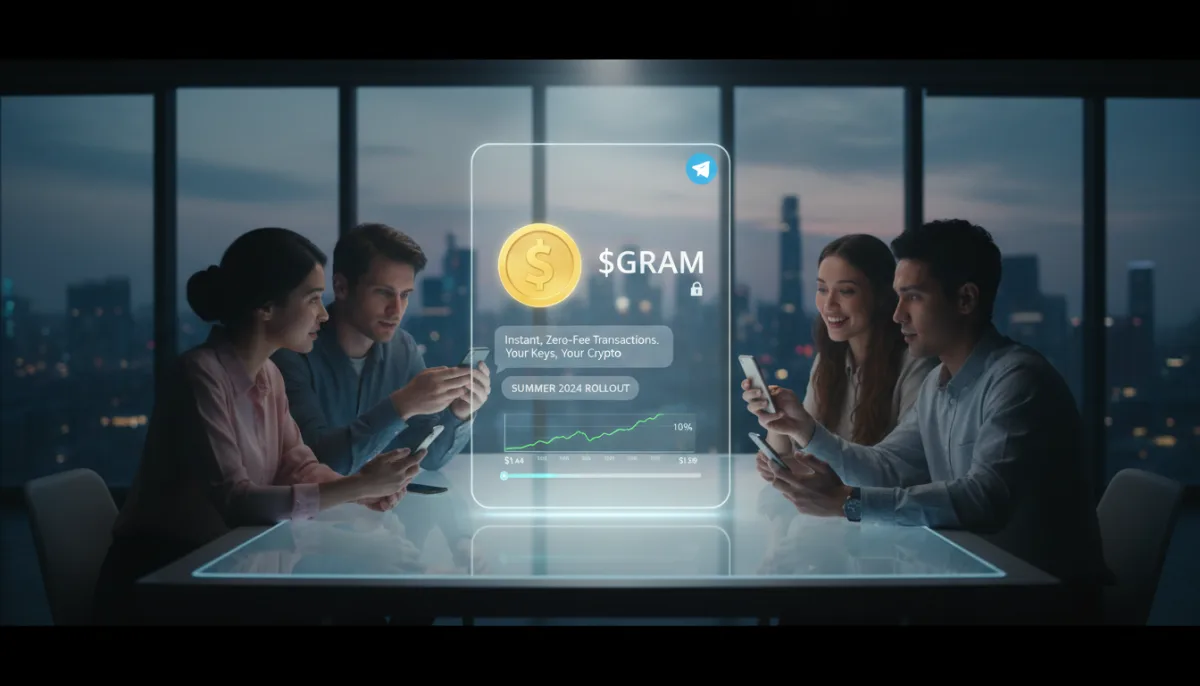
Telegram is preparing to embed a native, non-custodial Gram wallet directly into the messaging apps of over a billion users this summer, triggering a massive 10% surge in the token's value. The integration marks an aggressive push to make Gram ($GRAM) - formerly known as Toncoin - the default currency within the platform's sprawling ecosystem. By removing the friction of third-party exchanges, the messaging giant is positioning itself as a dominant force in consumer-facing Web3 distribution.
The sudden price movement was catalyzed by a monumental announcement from Telegram founder Pavel Durov. Unlike traditional custodial wallets managed by centralized entities, this new opt-in feature gives users complete ownership of their private keys and digital assets. It will coexist alongside the existing Wallet in Telegram, which caters to more advanced trading needs.
This summer will see the largest rollout of a non-custodial crypto wallet in human history. Instant zero-fee crypto transactions for over a billion users are about to become reality. We’re bringing a native non-custodial Gram wallet to every Telegram app!
- Pavel Durov, Telegram
Following the news, Gram climbed from roughly $1.44 to an intraday peak near $1.59, before stabilizing between $1.52 and $1.55. Trading volume more than doubled as investors rushed to position themselves ahead of the summer launch. This momentum builds directly on the network’s recent June 15 rebrand from Toncoin to Gram, which secured an 81.22% community approval vote, and Telegram's takeover of network development in May that introduced a sixfold reduction in transaction fees.
Technical Levels and Ecosystem Upgrades
Beyond the wallet integration, the broader Gram ecosystem is undergoing significant infrastructure upgrades. The recent implementation of Catchain 2.0 has reduced block times to under one second, enabling faster block finality. Additionally, the network is rolling out Agentic Wallets designed to support automated AI interactions on-chain. Despite these bullish fundamentals, technical analysis reveals that GRAM is still battling heavy overhead resistance.
The daily GRAM/USDT chart shows buyers successfully defending the $1.47 support region, aligning with the 0.236 Fibonacci retracement level. However, the token continues to trade below major exponential moving averages (EMAs), which are clustered between $1.56 and $1.72. The Relative Strength Index (RSI) has recovered to the 45 - 57 range, indicating eased selling pressure, but key levels remain critical for a macro trend reversal:
- Immediate Resistance: Sits tightly between $1.60 and $1.62, where the 0.5 and 0.618 Fibonacci retracement levels converge. A decisive daily close above this zone is required to target $1.74 and $1.84.
- Ultimate Upside Target: Extended resistance and technical projections point toward the $2.14 level, aligning with the 1.618 Fibonacci extension.
- Downside Support: If momentum fails, immediate support rests at $1.47, with deeper downside protection located near the $1.40 to $1.43 region.
The $52 Million Liquidity Test
While the narrative of a fee-free, native wallet for a billion users is undeniably bullish, the market is ignoring a critical near-term hurdle. A scheduled token unlock is set to release approximately $52 million worth of GRAM tokens into circulation. This impending supply inflation will serve as the ultimate stress test for the token's current momentum. If the market can absorb this liquidity without breaking the $1.47 support floor, it will signal immense institutional and retail confidence.
Furthermore, the introduction of Agentic Wallets hints at Telegram's true endgame. This isn't just about peer-to-peer human payments; it is about building an automated micro-economy where AI agents can execute on-chain transactions seamlessly. For GRAM to reach psychological milestones like $5, it must do more than just reclaim its moving averages at $1.62 - it must successfully convert its massive chat user base into active, daily DeFi participants once the wallet goes live.