

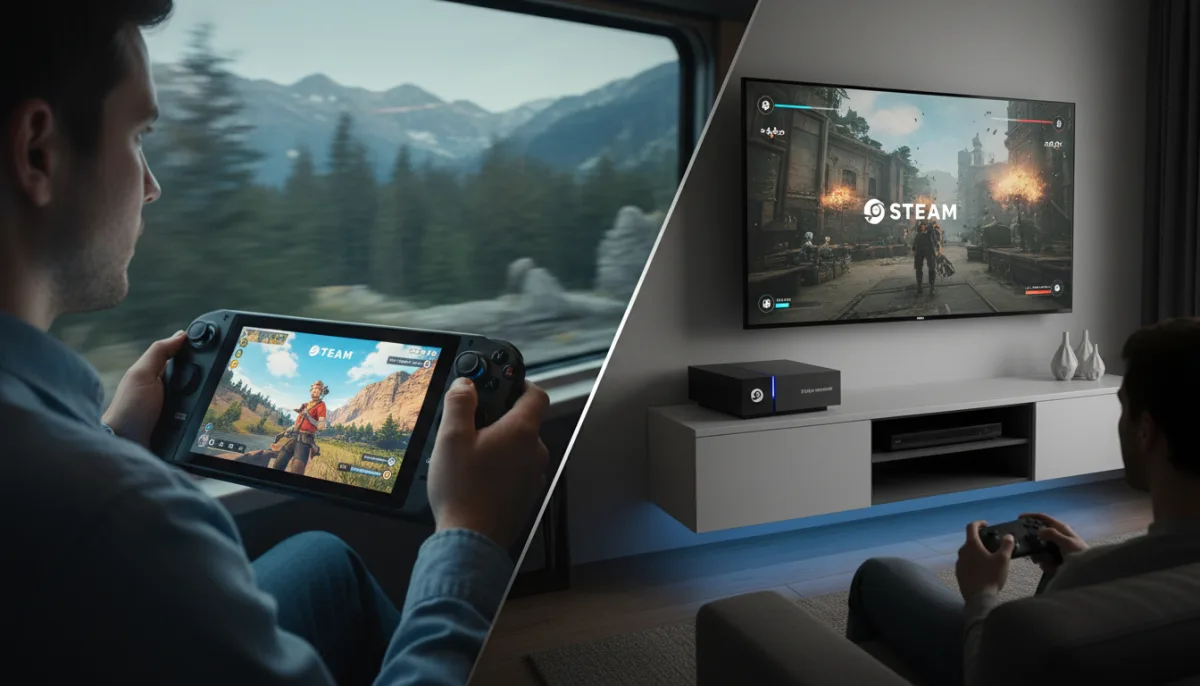
Choosing between the Steam Deck and the newly revived Steam Machine comes down to a single question: do you want your PC games in your backpack or permanently anchored to your living room TV? Valve’s dual-pronged approach to PC gaming forces players to choose between the mobility of a 7.4-inch OLED handheld and the raw, RDNA 3-powered muscle of a console-style desktop. Both devices run on the Linux-based SteamOS, but they target entirely different gaming lifestyles and budgets.
As noted by Tech Fowler, evaluating these two systems requires looking beyond just the spec sheet. You have to weigh the convenience of on-the-go play against the graphical fidelity required for modern AAA titles.
Head-to-Head Hardware Comparison
To understand the fundamental differences in Valve's hardware strategy, it helps to look at the raw specifications side-by-side. The gap in processing power and pricing is substantial.
| Feature | Steam Deck (OLED) | Steam Machine |
|---|---|---|
| Display / Target | 7.4-inch OLED (720p - 800p) | TV / Monitor (1080p, 1440p, some 4K) |
| Processor (CPU) | Custom AMD Zen 2 APU | 6-core AMD Zen 2 CPU |
| Graphics (GPU) | Integrated RDNA 2 | RDNA 3 GPU |
| Performance Gap | Baseline portable power | 5-6x more powerful than Steam Deck |
| Starting Price | $789 (Base) / $949 (1TB) | $1,049 (Base) / $1,428 (High-end) |
The Steam Deck: Portability at a Premium
The Steam Deck remains a dedicated portable handheld gaming PC tailored for players who prioritize mobility. Weighing under 700 grams, it features an ergonomic design complete with haptic feedback trackpads that make navigating desktop-centric games surprisingly intuitive. The 7.4-inch OLED display delivers vibrant visuals at a 720p to 800p resolution, which is perfectly suited for its custom AMD Zen 2 APU and integrated RDNA 2 graphics.
Battery life is highly variable, ranging from 3 to 10 hours depending on how demanding the game is. However, the device's value proposition has shifted recently. With the base model now starting at $789 and the 1TB version reaching $949, the Steam Deck faces fierce competition from newer handheld PCs that offer more raw power at similar or lower price points.
The Steam Machine: Living Room Powerhouse
In stark contrast, the Steam Machine is a compact, console-style gaming PC engineered specifically for entertainment centers. It abandons battery life and built-in screens in favor of a 6-core AMD Zen 2 CPU and a dedicated RDNA 3 GPU. Valve claims this hardware combination makes the Steam Machine 5 to 6 times more powerful than the Steam Deck.
This massive leap in performance allows the Steam Machine to handle demanding AAA titles smoothly at 1080p and 1440p resolutions, with support for some 4K gaming. Starting at $1,049 and scaling up to $1,428 for high-end configurations, it is a premium investment. While it features a sleek, minimalist design that blends into a living room, it notably lacks sufficient USB-C connectivity, which could frustrate users with modern peripherals.
SteamOS and the Compatibility Hurdle
Regardless of which hardware you choose, both systems are bound by the limitations of SteamOS. While Valve's Linux-based operating system provides a seamless, console-like user interface, it inherently struggles with certain Windows-only titles. This is particularly problematic for popular multiplayer games that rely on strict anti-cheat software (Anti-cheat).
If your gaming library consists heavily of competitive shooters or titles outside the Steam ecosystem, this OS limitation might force you to look toward Windows-based alternatives. Both devices require you to accept that not every game in your library will be playable out of the box.
The Market Reality Behind Valve's Hardware Push
Valve is clearly trying to corner two distinct segments of the PC market, but both devices carry significant financial friction. The Steam Deck's recent price hike to $789 makes it a tough sell for budget-conscious gamers, especially when competitors are flooding the market with aggressive alternatives. It is no longer the undisputed king of budget handhelds; it is now a premium portable for dedicated Steam users.
Meanwhile, the Steam Machine at $1,049 is a fascinating but niche proposition. It targets adults with disposable income who want the plug-and-play convenience of a console but the library of a PC. However, by locking a $1,400 machine behind Linux-based SteamOS, Valve is asking users to pay premium PC prices while accepting console-like software restrictions. For gamers who want absolute freedom and maximum compatibility, building a custom mini-ITX Windows PC might still be the smarter, albeit more complex, investment.
