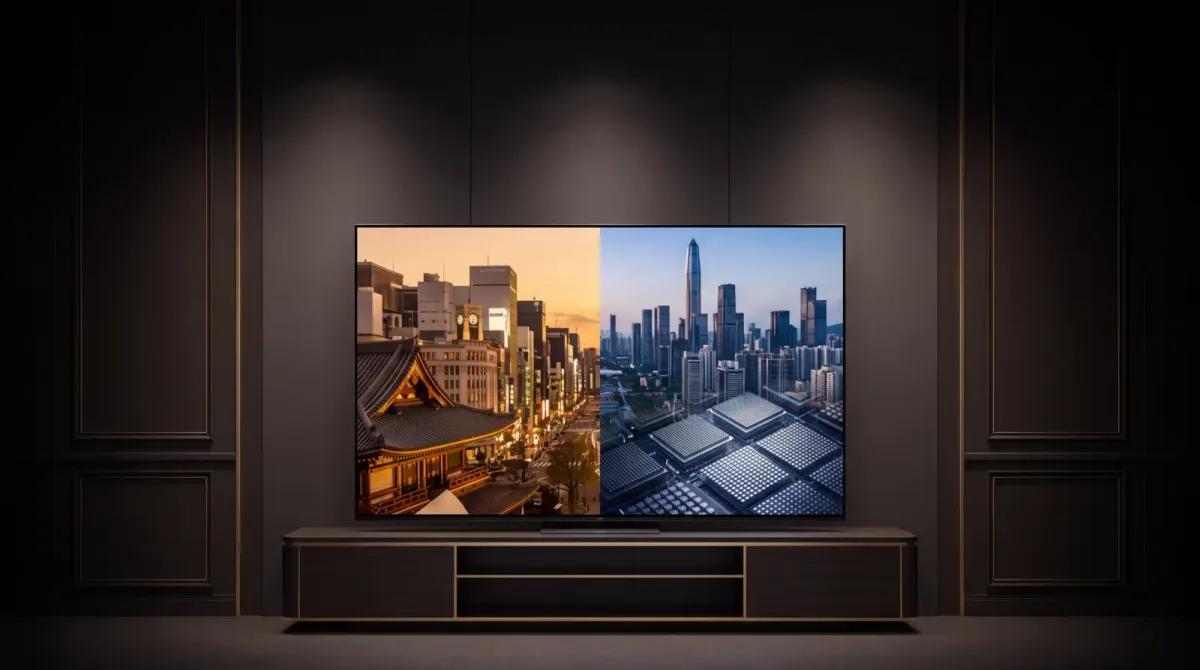
Sony is officially handing over the majority control of its legendary television and home entertainment business to TCL in a seismic industry shift. The two tech giants have finalized an agreement to form BRAVIA Inc., a new joint venture where TCL holds a 51 percent controlling stake, fundamentally changing how premium televisions will be manufactured and sold. Sony will retain a 49 percent share in the new entity, which is expected to begin operations in April 2027.
According to the definitive partnership agreement finalized on March 31, 2026, the venture extends far beyond a simple supplier contract. Headquartered inside Sony City Osaki in Tokyo, BRAVIA Inc. will handle product development, design, manufacturing, sales, and customer service for consumer televisions, B2B flat-panel displays, projectors, and audio components. The structural handoff follows a memorandum of understanding signed earlier in January.
The ¥102.8 Billion Transfer of Gravity
This partnership represents a massive transfer of physical and operational assets. Sony and TCL place the enterprise value of the transferred businesses at approximately ¥102.8 billion. As part of the deal, TCL will acquire Sony EMCS (Malaysia), the Japanese company's manufacturing subsidiary for home-entertainment products, with TCL's consideration estimated at roughly ¥75.4 billion before final adjustments. The companies are also continuing discussions regarding Sony's manufacturing operations in Shanghai.
For TCL, the acquisition provides immediate, unquestioned access to the premium tier of consumer electronics. While TCL already possesses advanced display technology and a massive global industrial footprint, majority ownership of the BRAVIA brand grants it the showroom trust that Sony has cultivated over decades. Sony's historical value has always lived in its picture judgment - the ability to make an image feel composed rather than artificially processed.
Conversely, Sony desperately needs TCL's manufacturing muscle. The economics of the modern television business demand larger panels, denser local dimming, and aggressive pricing. By leveraging TCL's end-to-end cost efficiency and vertical supply-chain strength, Sony can ensure its ambitious display hardware reaches the market at a competitive price, particularly in the rapidly expanding Mini-LED segment.
The Uncertain Future of OLED
One of the most pressing questions surrounding BRAVIA Inc. is the fate of Sony's acclaimed OLED televisions. Historically, Sony has sourced OLED panels from other manufacturers while adding its own bespoke processing, thermal strategies, and audio systems. Because TCL's display ambitions lean heavily toward Mini-LED and other advanced LCD architectures, the balance of the BRAVIA lineup is expected to evolve.
While the definitive agreement does not declare the end of Sony OLED, it is highly likely that very large premium LCDs and denser Mini-LED systems will become the primary focus. The new company's approach to OLED will ultimately reveal whether BRAVIA Inc. intends to select the best display technology for each specific product, or if it will primarily amplify the technologies closest to TCL's industrial strengths.
What Buyers Should Watch For
For consumers purchasing a television in 2026, very little changes, as current Sony models and warranties remain under their published terms. However, as the 2027 transition approaches, industry experts are closely monitoring the first products developed under the new ownership structure. HD Guru will be watching five things:
- Processing continuity: Does difficult content still receive the restraint associated with Sony?
- Panel ambition: Does TCL give BRAVIA earlier or better access to advanced hardware?
- Model discipline: Does the line remain curated, or expand into indistinct price-point variants?
- Support quality: Does global scale improve service without making it impersonal or inconsistent?
- Premium integrity: Does BRAVIA continue to mean something visible before the logo appears?
The Survival of the Premium Badge
This joint venture is a stark admission that bespoke processing alone can no longer justify a massive price premium in a market dominated by raw hardware specs. Sony's finest televisions have always justified their cost, but its mid-tier models have consistently struggled against competitors offering more dimming zones and higher peak brightness for less money. By integrating with TCL, Sony is attempting to fix its cost structure without abandoning its brand identity.
However, the risk of commoditization is severe. Premium brands rarely collapse overnight; instead, they slowly become less specific until the badge is merely a trim level spread across products engineered to hit price points. If BRAVIA Inc. uses TCL's scale to make Sony's exacting standards available in more formidable hardware, the brand will emerge stronger than ever. But if operational efficiency overrides Sony's traditional editorial control over the image, the television market will have preserved a famous trademark while entirely misplacing its soul.