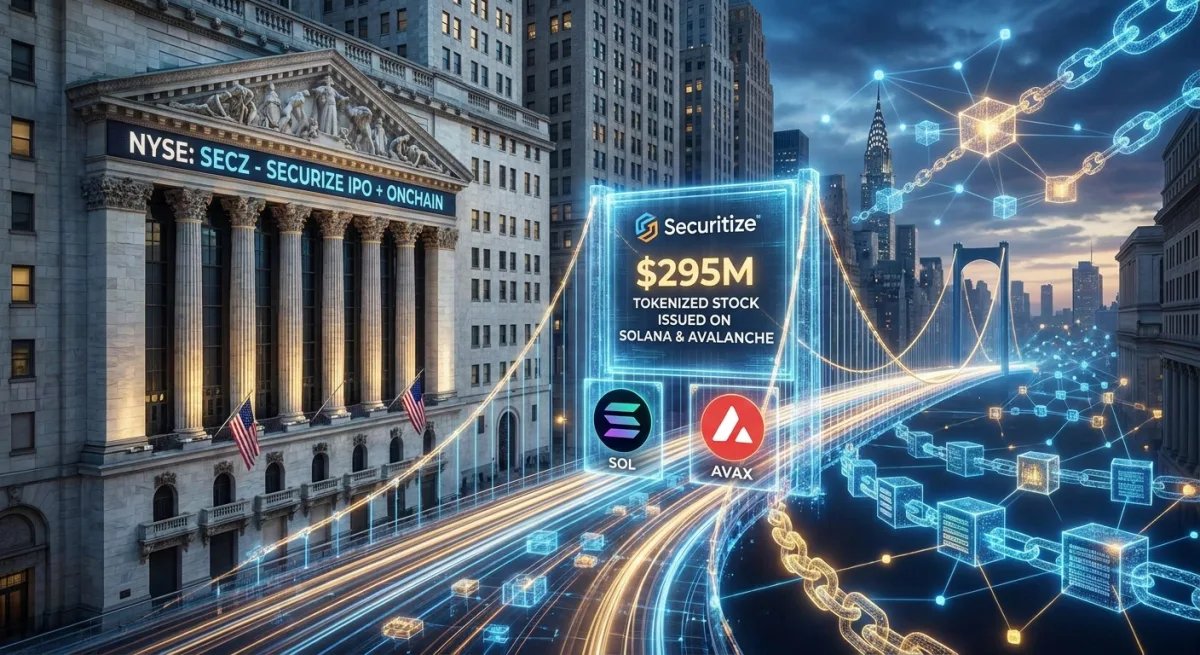
Securitize has officially bridged Wall Street and decentralized finance by launching $295 million of its own tokenized stock on the Solana and Avalanche blockchains. The move coincided with the company's debut on the New York Stock Exchange (NYSE) under the ticker SECZ, marking the first time a newly public company has tokenized its own shares on day one.
Backed by heavyweights like BlackRock and ARK Invest, Securitize went public following a SPAC merger with Cantor Equity Partners II. The stock closed its Thursday session up 10%, while eligible U.S. investors simultaneously gained access to the blockchain-based shares through the company's regulated platform.
Unlike third-party wrapped tokens that often operate in regulatory gray areas, these blockchain-based shares represent the exact same common stock trading on the NYSE. By issuing the tokens directly on Solana (SOL) and Avalanche (AVAX), Securitize is demonstrating an issuer-sponsored model that bypasses unofficial copycat tokens.
We just wanted to lead by example and show people that if you want to issue real shares onchain, not fake shares, not copy cats, whatever you want to call it, then you can do it.
- Carlos Domingo, CEO, Securitize
The tokenization sector is rapidly expanding as traditional financial institutions seek to leverage blockchain rails for faster settlement times and around-the-clock transfers. Securitize, founded in 2017, has already built infrastructure for Apollo, KKR, and VanEck. Earlier this year, NYSE parent company Intercontinental Exchange (ICE) partnered with Securitize, alongside transfer agents Computershare and Continental, to develop a standardized framework for tokenized equities.
The financial opportunity in bringing real-world assets onchain is massive. Citi projects that the market for tokenized securities could reach $5.5 trillion by 2030, while Boston Consulting Group and Ripple estimate it could surge to $18.9 trillion by 2033.
The Death of Third-Party Wrapped Stocks
Securitize’s dual NYSE and onchain launch is a direct threat to the unregulated, third-party stock token market. By proving that a fully compliant, issuer-sponsored tokenization model works on day one, the company is setting a new standard that institutional investors will inevitably demand.
If major transfer agents like Computershare are already on board, the days of relying on offshore exchanges for synthetic exposure to U.S. equities are numbered. This $295 million launch isn't just a proof of concept; it is the blueprint for how every modern IPO could be structured by the end of the decade.