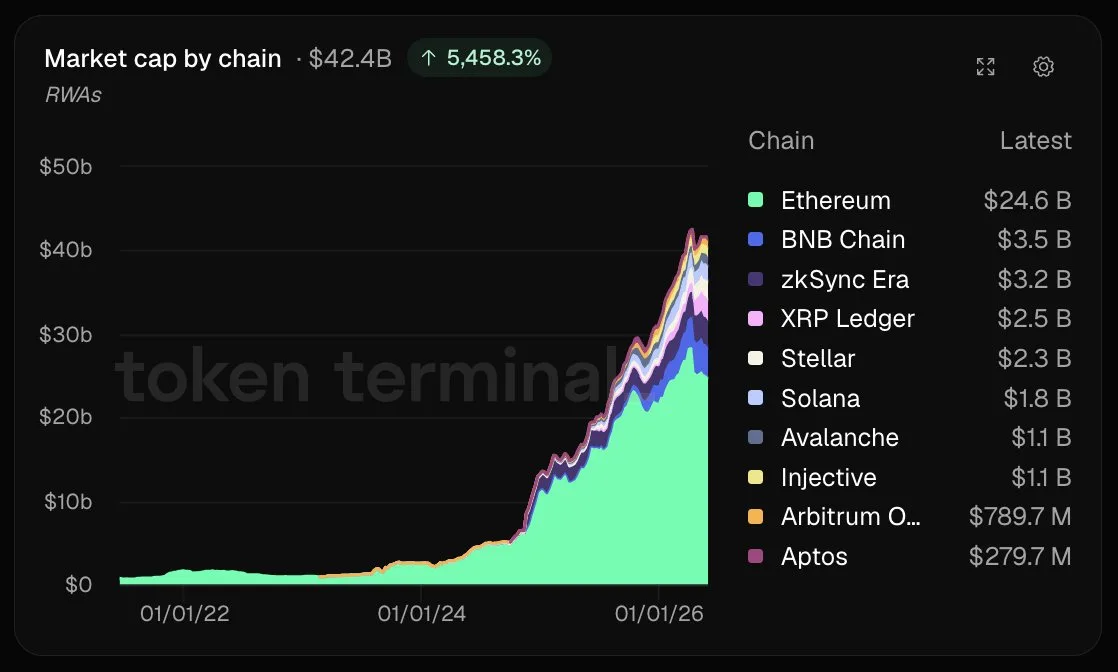
Wall Street is officially treating public blockchains as production-ready infrastructure, moving aggressively beyond experimental pilot programs. Major financial institutions are now preparing to deploy tokenized stocks, bonds, and real estate directly onto the Ethereum network, signaling a massive shift in how traditional finance views decentralized ledgers.
According to Vivek Raman, founder of the crypto-focused firm Etherealize, the narrative around enterprise blockchain use has fundamentally changed. While stablecoins served as the initial entry point for institutional players, the conversation has rapidly expanded to encompass a wider range of traditional financial instruments. Ethereum's established liquidity and network effects have positioned it as the primary hub for these deployments.
"A year and a half ago it was proof-of-concept, dip your toe in," Raman explained. "Now it's: we need to jump in head first and use public chains just like we all use the internet."
Despite this growing institutional momentum, the market performance of ETH has not yet mirrored the underlying infrastructure growth. This disconnect has frustrated retail investors, but Raman attributes the gap to the notoriously slow pace of traditional finance. The technical piping is fully operational, but the actual migration of capital and assets onchain remains in its early stages due to lengthy institutional sales cycles.
When you look at the headlines in retrospect, it'll be: the global financial system's internet moment happened on Ethereum.
- Vivek Raman, Founder, Etherealize
Addressing recent scrutiny surrounding the Ethereum Foundation's evolving leadership and ecosystem role, Raman argued that the organization's gradual step back is a deliberate feature of decentralization. He noted that a universal financial substrate cannot be controlled by a single entity. Instead, the foundation is expected to pivot toward maintaining core values like censorship resistance and privacy, while advancing long-term technical priorities such as zero-knowledge proofs and quantum resistance.
The Hidden Lag Between Infrastructure and Valuation
The disconnect between Ethereum's expanding institutional utility and ETH's stagnant price action highlights a fundamental misunderstanding of how Wall Street adopts new technology. Retail crypto markets price in news instantly, but institutional capital moves through compliance, legal, and risk management pipelines that take years to clear. Raman's observation about "long sales cycles" is the critical signal here: the infrastructure is built, but the liquidity spigot has not yet been fully turned on.
Furthermore, the shift toward tokenized real estate and bonds on Ethereum introduces a new dynamic for the network's security model. As trillions of dollars in traditional assets migrate onchain, the economic weight securing the network must scale proportionally to prevent hostile takeovers. This suggests that while ETH may currently be underperforming as a speculative asset, its long-term valuation will likely be forced upward not by retail hype, but by the sheer necessity of securing a digitized global financial system.